
Here's a sentence I never expected to write with a straight face: the fog is alive. Not in a haunted-Victorian-moor way. In a "there are roughly ten million bacteria hiding in a thimble of it, and they're doing your respiratory system a favor" way.
The internet got there first, of course, with the subtlety it's known for. A YouTube explainer by Anton Petrov went out under the title "Evidence That Fog Is Alive and Not just Some Weather Phenomenon," which is the kind of headline designed to make you click and then feel slightly ashamed. But strip away the horror-movie framing and something genuinely strange is left standing. The headline is dumb. The science underneath it is not.
What They Actually Found
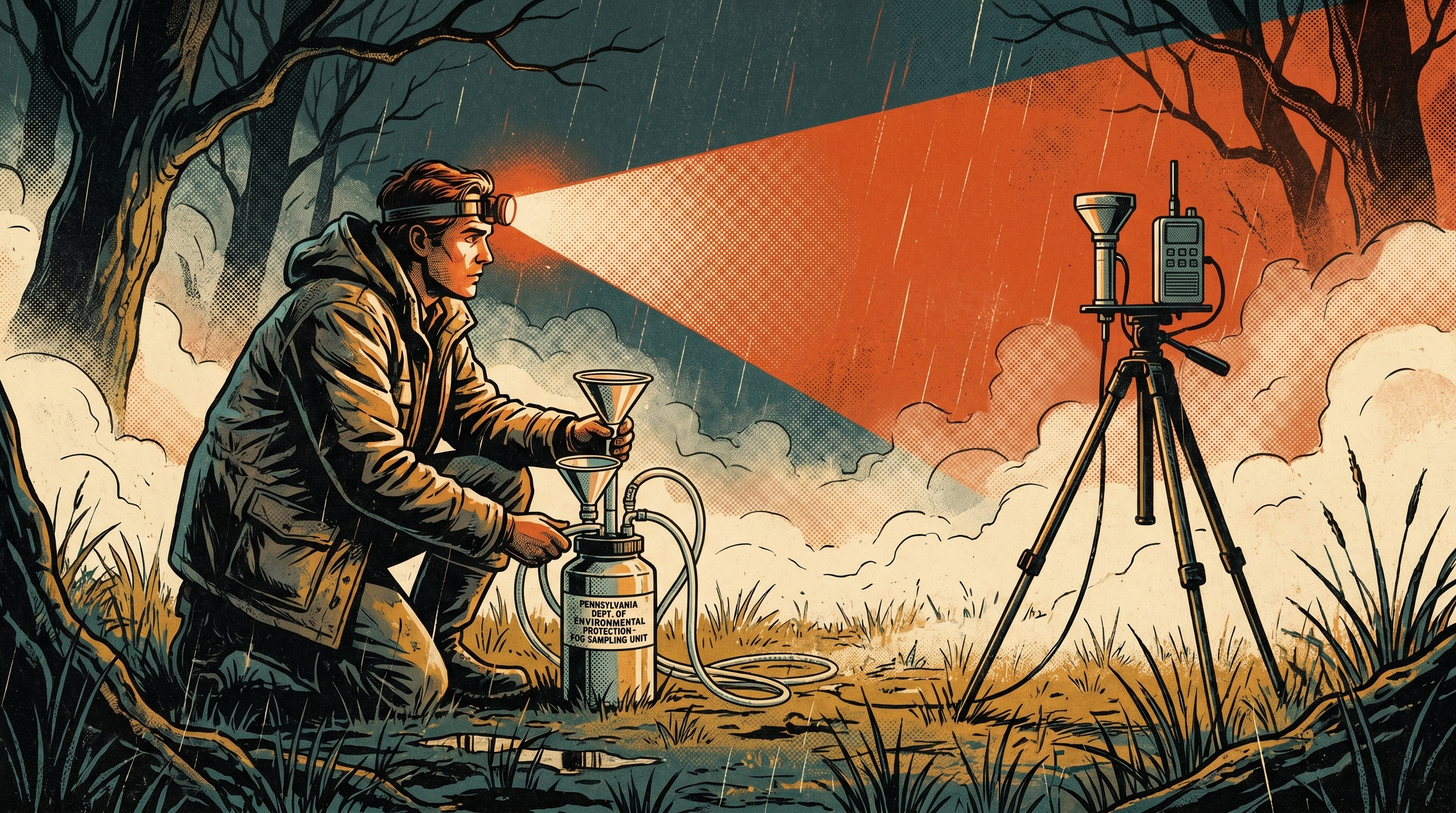
Researchers studied radiation fog in central Pennsylvania — the kind that settles in on still overnight air, when nothing is moving and the world goes quiet and grey. They chose it on purpose. Still air means you can sample the same patch of atmosphere before the fog rolls in, while it sits there, and after it lifts, without the wind scrambling your results.
Over two years they tracked 32 separate fog events. Each time, they compared the microbiome of the fog water — the living community floating inside it — with the dry-air particles hanging around the same spot. Dry air has its own crowd of microbes. The fog, it turned out, had a different one entirely.
The fog water was packed. Bacterial concentrations matched what you'd find in continental or marine bodies of water — lakes, seas, the wet stuff we already agree is full of life. And one resident dominated the guest list: a bacterium called Methylobacterium. The paper, published in the journal mBio, is titled "Growth and formaldehyde degradation of photoheterotrophic Methylobacterium within radiation fogs," which tells you both what they found and why nobody outside a lab read it until a YouTuber rebranded it as a ghost story.
The Part That Changes Everything
For a long time we've treated the atmosphere as essentially dead. A vast bowl of gases where chemistry happens to molecules, the way chemistry happens in a test tube — passively, mechanically, with nobody home. Air goes up, air comes down, reactions occur, the end.
This study quietly detonates that assumption. The key word in the whole thing isn't "bacteria." Bacteria in the air aren't news; microbes get everywhere, the way glitter gets everywhere. The key word is growing.
"If they are growing, then the droplets are a habitat," said co-author Ferran Garcia-Pichel. "That's a mindset change." He's right, and he's underselling it. Microbes merely present in fog is a curiosity. Microbes living and reproducing in fog means each droplet is a tiny pond — a functioning home, not a holding cell. The atmosphere stops being a warehouse where life is stored in transit and starts being somewhere life actually does business.
And the business they're in is the interesting bit. These bacteria eat formaldehyde.
Inside a Single Droplet
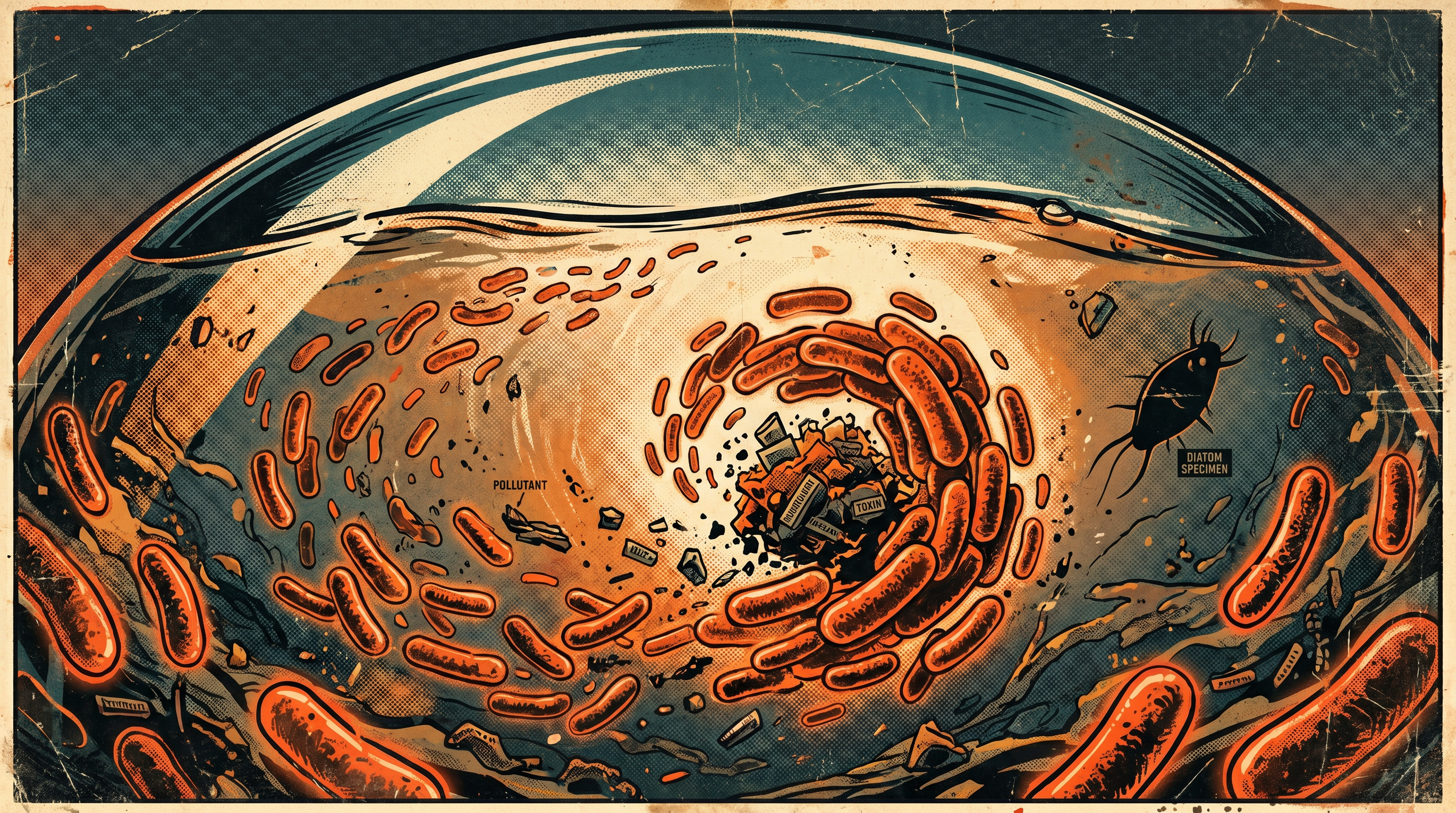
Picture a single fog droplet. Microscopic, ordinary, the sort of thing billions of which fog up your car windscreen. Now shrink yourself down and climb inside one. To the bacterium living there, this isn't a droplet. It's an ocean. A whole self-contained world with water, light, and food drifting in from outside.
The food is formaldehyde — and here's where it gets good for the rest of us. Formaldehyde is a common atmospheric pollutant. It feeds ozone smog, and it's bad news for your lungs, the chemical equivalent of someone sandpapering your airways. We'd all be better off with less of it floating around.
Methylobacterium runs on exactly this kind of simple carbon compound. To these bacteria, our pollution is a buffet. They don't tolerate formaldehyde; they actively hunt it down and consume it as fuel for growth. Researcher Thi Thuong Thuong Cao watched it happen under the microscope: "the bacteria are getting bigger and they're dividing, so there is growth." And the source of that growth? "We also found that they're using the formaldehyde as food to support their growth."
So the picture is this: fog forms, drifts through air laced with a toxic pollutant, and its microscopic tenants set about eating the toxin and breeding off the proceeds. The air comes out cleaner than it went in.
How much cleaner? This is the number that made everyone sit up. The formaldehyde degradation rate clocked in at roughly 200 times faster than rates measured elsewhere in cloud water. Two hundred-fold. If your office cleaner worked 200 times faster than the building next door's, you'd assume they were either superhuman or committing fraud. The fog appears to be doing it for free, overnight, while you sleep.
There's a dark comedy footnote, too. High concentrations of formaldehyde are toxic even to the microbes themselves. So these things make a living eating a poison that, in a big enough dose, would kill them. It's a tightrope act performed inside a droplet of water you'd wipe off your glasses without a thought.
The Honest Caveats
Before we crown fog the planet's air-purifier and start selling it in cans, a few cautions — because the researchers offered them and pretending otherwise would be exactly the lazy thinking this study punctures.
This was one type of fog, in one region. Radiation fog in central Pennsylvania is not the whole sky. And the effect is rarer than the headline suggests: fewer than 1% of droplets individually held any bacteria at all. The ten-million-bugs-in-a-thimble figure is a sum of a great many mostly-empty droplets and a few crowded ones. Most of the fog is, in fact, just fog.
Crucially, the net atmospheric impact at scale is still unclear. A bacterium devouring formaldehyde in a Pennsylvania field is a lovely thing. Whether all the world's fog adds up to a meaningful dent in global pollution is a question this study doesn't answer and doesn't pretend to.
There's also a practical wrinkle worth flagging. Some communities harvest fog for drinking water, and the ASU team noted the findings may matter to them. "This fog is teeming with life" is a fun fact at a dinner party and a genuine consideration when you're planning to drink the stuff.
The Takeaway
Garcia-Pichel put it best when he told USA Today that fog isn't alive in the same way the ocean isn't alive — but like the ocean, it's full of active life. That's the whole revolution in one line. Nobody insists the sea is a living creature, yet nobody dreams of modeling it as a dead bath of saltwater either. We know it's an ecosystem with a metabolism, a place where things grow and eat and die.
The mistake we've been making is treating the air above our heads as the lifeless exception — a sterile gap between the living ground and the living sea. It isn't. It's another habitat, complete with residents who clock in overnight and quietly tidy up some of the mess we leave in it.
The fog isn't haunted. It's working. And the genuinely unsettling thought isn't that something lives in the fog — it's that we spent this long assuming nothing did.