Somewhere in Tehran, a man named Rawa Majid is allegedly running a business that treats human life the way a food-delivery app treats a burrito: something to be ordered, dispatched, and delivered by whichever contractor happens to be available and desperate. The product is death. The workforce is teenagers. Europol has a chillingly corporate name for it. They call it "violence-as-a-service."
That phrase should stop you cold. Not because it's shocking, but because it isn't. We already live in a world where you can rent a stranger to walk your dog, assemble your furniture, or drive you home. Foxtrot simply asked the obvious follow-up question: what else can you outsource?
The Setup
The Foxtrot Network started in Sweden, where it grew into one of the country's most notorious organised crime groups during years of escalating gang violence. Its leader, Rawa Majid, left Sweden, then left Turkey, and Swedish investigators now believe he sits in Tehran. Since 2022, Foxtrot is thought to have been behind roughly 35 murders.
Here is the part that turns an ordinary gang story into something stranger. Some of Foxtrot's attacks look like ordinary turf wars, the grim arithmetic of criminals killing criminals. But Swedish reporting says others were carried out for the Iranian regime, aimed at Israeli or Iranian opposition-linked targets. The same network that settles drug disputes in Stockholm also, allegedly, takes contracts from a hostile government.
The Swedish investigative journalist Diamant Salihu puts it plainly: "The regime is ordering the leader of the Foxtrot Network to instigate his network to commit attacks against the Iranian regime's enemies." In April 2025 the UK sanctioned Foxtrot and Majid for exactly this — violence against Jewish and Israeli targets in Europe on behalf of Iran. The US had designated both a month earlier.
One Subcontractor, Two Customers
We keep describing organised crime and state-sponsored terrorism as if they're separate categories that occasionally overlap. Foxtrot proves they've merged into a single supply chain. A Swedish drug gang and the Iranian government are now, functionally, customers of the same subcontractor. That's the innovation here, and it's genuinely new: the middleman doesn't care whether your grievance is a stolen kilo or a geopolitical vendetta. He'll fulfil either order from the same pool of labour.
And that labour is what makes the whole thing work. The reason Foxtrot can operate like a startup is that it discovered the perfect gig worker: the teenager. Andy Kraag of Europol calls it "calculated outsourcing of murder." The calculation is cold and, from a purely operational view, brilliant. Teenagers are easier to recruit, more willing to take risks, and less focused on the consequences. They are, in the language of the modern economy, a scalable resource.
Salihu strips away any illusion about how the network views them: "They don't care at all if the teenagers get caught." Of course they don't. When your workforce is disposable, arrests aren't a failure. They're just churn.
The Breakdown
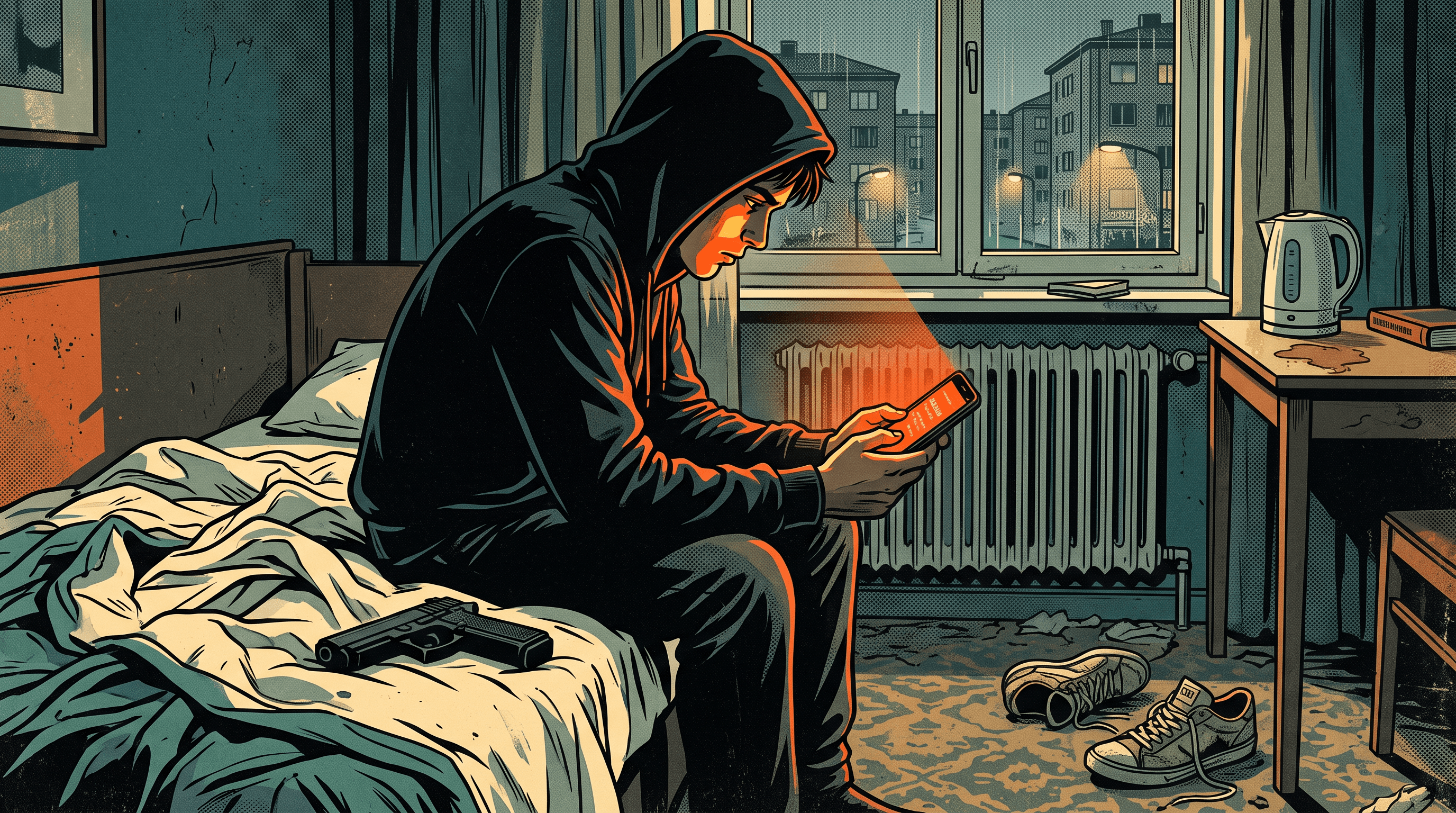
To understand how a bored, damaged 16-year-old ends up in a hotel room with a gun, forget the movie version of organised crime — the smoky back room, the handshake, the man who knows your family. Foxtrot doesn't do handshakes. It does user acquisition.
Think of it as a sales funnel, the same one every app on your phone is running to get you to sign up, except the conversion goal is a shooting.
Stage one is the top of the funnel: social media and encrypted messaging apps. This is where the net goes wide. Recruiters trawl for the vulnerable the way advertisers trawl for the impulsive. The pitch lands in a direct message, from someone who feels like a peer.
Take Johannes Natland, a 19-year-old from Stavanger in Norway. He didn't get pulled in by a hardened gangster. He was first approached through a teenage contact using the online handle UnknownHustler — a name that sounds less like a criminal syndicate and more like a kid who watches too many "day in the life of a millionaire" videos. Natland was already fragile, drawn into Foxtrot's orbit after a troubled stretch involving drug use, psychosis, and time in care. He was, in marketing terms, a warm lead.
Stage two is the handoff. Natland got passed up the chain into a group with another teenage recruiter called Generalen and a more senior figure using the handle Agent 47. Notice the structure. Teenagers recruit teenagers, so the adults at the top barely have to show their faces. It's a pyramid where the recruiter and the recruit are often the same age — a multi-level marketing scheme where the product is felony.
Stage three is the job itself, delivered like a quest. The whole operation is run in a gamified way — instructions handed down move by move, so the recruit never sees the full picture, just the next objective glowing on the screen. Prosecutors said Natland was guided via Signal to collect cash and hidden weapons in Huddersfield. Somewhere in that thread, Agent 47 allegedly sent him a line that could have come straight from a mobile game's morning notification: "We have much to do tomorrow."
Follow the breadcrumbs and you'll see how absurdly, horrifyingly frictionless it is. In March 2025, Natland flew from Stavanger to Manchester on an emergency passport. He was allegedly offered 270,000 Norwegian kroner — around £21,000 — for the job. He was found in Huddersfield with two firearms and live ammunition. He was convicted at the Old Bailey of conspiracy to murder.
Who was he supposed to kill? Nobody ever established it publicly. Sit with that for a second. A teenager crossed a border, collected a weapon, and waited for a target — and even the court couldn't say who the target was. The victim was, in effect, a variable to be filled in later. That's not a manhunt. That's a work order with a blank field.
The one mercy in Natland's case is that the system had a bug. He was arrested in a hotel room before any shooting took place, convicted of conspiracy rather than a completed murder. But the design worked exactly as intended right up to that hotel room. The dispatcher stayed anonymous. The weapon was pre-positioned. The gig worker was expendable. And when he got caught, the network lost a contractor, not a leader.
The leaders, meanwhile, are proving harder to reach — though not untouchable. Swedish police believe the man behind the Agent 47 handle is Ali Shehab Ahmed, who was arrested in Sulaymaniyah, Iraq, and is wanted by Sweden. Majid himself, the alleged chief executive of the whole operation, sits in Tehran, insulated by distance and, quite possibly, by a government that finds his services useful.

The Takeaway
The tech industry sold us a fantasy that "disruption" was neutral — just a smarter way to connect supply with demand. Foxtrot took that idea to its logical, ghoulish conclusion and proved the model doesn't care what it's moving. Connect a desperate Norwegian kid with a Swedish drug lord or an Iranian handler, skim the difference, and let the platform handle the rest. The genius of the gig economy was always that the company keeps the profits and the worker keeps the risk. Foxtrot just found a version where the worker is sixteen and the risk is a life sentence — his target's, or his own. Silicon Valley promised to make everything as easy as ordering a taxi. Nobody stopped to ask what would happen when someone applied that promise to a bullet.