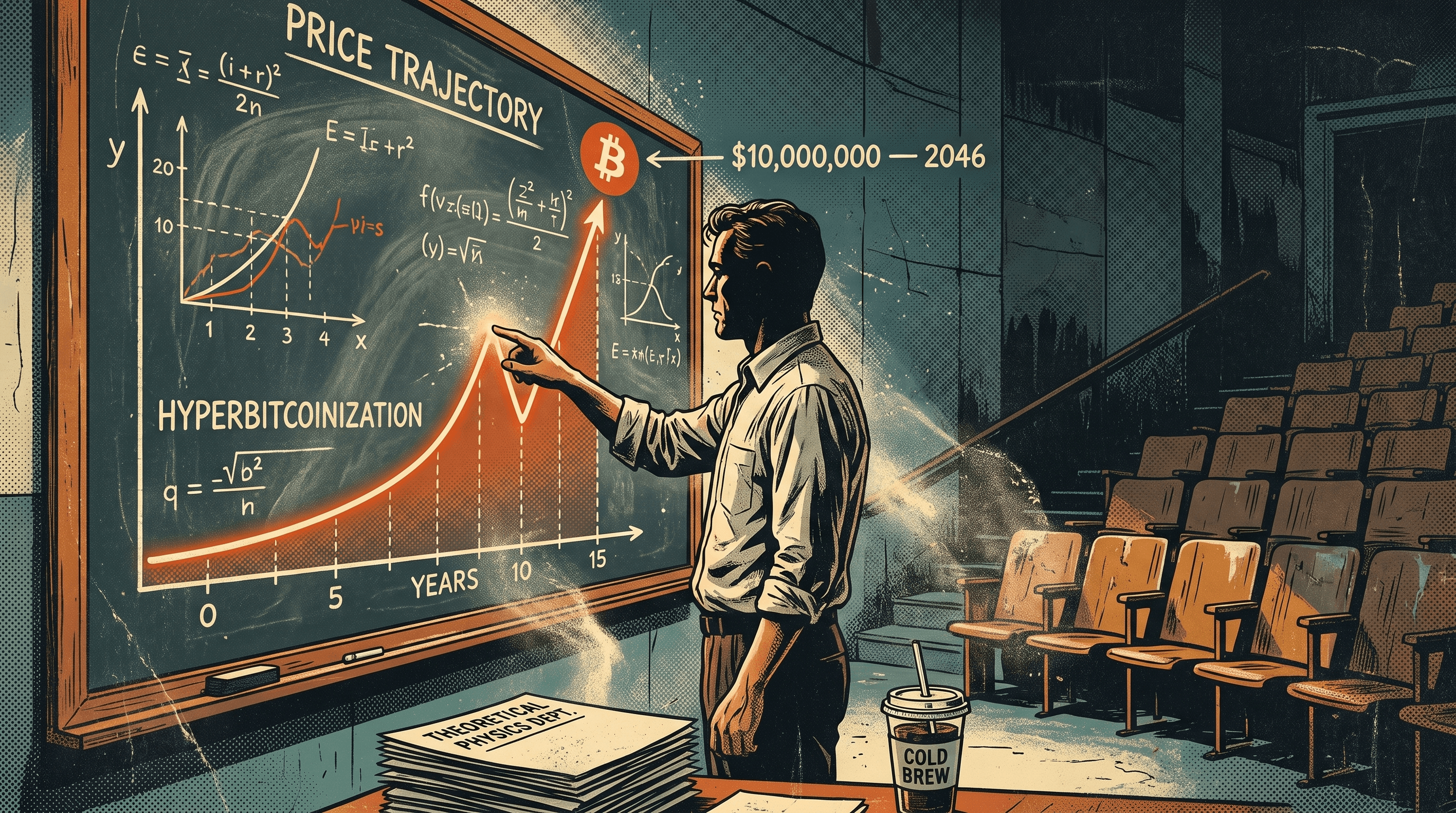
A physicist has studied fifteen years of Bitcoin prices and put a number on the year 2046. Giovanni Santostasi says one coin will be worth roughly $10 million by then, and he says he's about 90% sure. He isn't pulling this from a hat. He has 5,696 daily data points, a curve that hugs them with a reported R² of 0.961, and a co-author, astrophysicist Stephen Perrenod, backing the maths. The forecast is testable, the fit is real, and the framing is scientific. That last part is where the trouble starts.
The Curve and the Prophet
Santostasi runs the Scientific Bitcoin Institute, and his central claim is that Bitcoin doesn't behave like a stock — it grows like a city, along a power law.
A power law just means one quantity grows as a fixed power of another: here, price rises in step with Bitcoin's age raised to some exponent, so the early growth is explosive and the later growth slower but relentless. Plot it on a chart where both axes are logarithmic and that swooping curve flattens into a straight line — which is exactly why enthusiasts can point at fifteen years of dots and say, look, it's a law.
Feed the model and out comes the ladder: about $1 million within eight years, about $10 million within twenty. "I'm close to 90% sure," Santostasi says of the destination in his public commentary — a figure worth pausing on, because it isn't a confidence interval computed from the data. It's his subjective probability, a gut number wearing a decimal point.
He splits Bitcoin into two layers. The daily chaos — wars, crashes, panic, hype — he calls "weather." The deep trend underneath is "climate." As he puts it: "The power law is climate. Price volatility is weather." Storms pass; the climate marches on regardless.
The Trick Hiding in "If"
To his credit, Santostasi and Perrenod don't hide behind vagueness. They name conditions that would break the model: if the exponent drifts, if price tears out of the corridor and stays there, the power law is falsified. That makes it a real scientific claim, not a horoscope. Good.
The problem is whether those conditions are strict enough — and what happens when one trips. A model that can absorb years of misses by declaring each a temporary "structural break" is a model that's very hard to actually kill. The escape hatch is built into the phrasing: everything holds "if the structure continues to hold." When price obeys, the law was right; when it doesn't, the structure simply changed. Falsifiable in theory, slippery in practice.
There's harder trouble underneath. The estimated exponent — the whole engine of the forecast — is sensitive to where you start counting; nudge the origin date and the twenty-year figure swings by millions. Rival curves (log-periodic, S-shaped adoption, plain decaying growth) fit the same fifteen years about as well, and they don't all agree the line runs forever. Put a good curve-fit in a lab coat, hand it a tidy R², and you have not produced physics. You have produced prophecy with a footnote.
What a Power Law Actually Is
Forget the extrapolation for a second. Now the good bit — the city. Most corporations, Santostasi points out, eventually die; cities compound and survive. "Companies die. Cities live forever." Think about why. A company is basically one bet: one product, one boss, one bad quarter from oblivion. A city is thousands of overlapping bets that don't all collapse on the same Tuesday. Kill the biggest employer and the bakeries, plumbers and schools carry on. Santostasi calls Bitcoin a networked, self-organising system — far closer to a city than a company — and points to relentless growth in active addresses, a Metcalfe-style argument that a network's value climbs roughly with the square of its users.
Then he takes it somewhere genuinely wild. Corporations that anchor themselves to Bitcoin, he suggests, might inherit the city's immortality. "We are turning corporations into cities." Bolt a doomed company to the eternal city and it stops dying. That's not economics. That's alchemy with better branding.
The Reasonable Bit Nobody Screenshots
Give him credit where it's due, because part of this is genuinely sensible. Santostasi doesn't claim Bitcoin doubles forever. He argues the growth rate should slow as the thing matures — from roughly 41% a year today toward something nearer 20% two decades out.
His reasoning is the least glamorous and most convincing thing he says: the big money doesn't want fireworks. "Institutions don't want something that doubles every year forever. They want stability." Not a rollercoaster that gives their compliance department a stroke.
He even sketches a ladder of maturity — retail-led, then exchange-led, then institutional custody, then ETFs, then sovereign and treasury accumulation. It's a neat picture of an asset growing up: from your cousin buying $40 on his phone at the bottom rung to entire governments quietly hoarding the stuff at the top.
And here's the catch nobody puts on a chart. The fifteen years of data were mostly logged during the wild retail-and-exchange years; the mature ETF era the model is now asked to project forward barely registers in the sample — a sliver at the very end, not a track record. Fitting a curve through a long, boisterous adolescence is one thing. Betting the next twenty years of adulthood look identical is a bolder move than the straight line lets on.
Worth saying plainly, too: $10 million is a nominal 2046 dollar figure. What it actually buys — after two decades of whatever inflation does — is anybody's guess. A seven-figure headline in future money is a smaller, blurrier promise than it looks.
The Verdict
The honest version of this forecast is smaller and, frankly, more interesting than the headline. Bitcoin has grown in a strikingly regular way for fifteen years. There are real reasons — network effects, a maturing system, institutions craving calm — to think the violent swings might genuinely shrink over time. The pattern is real, and a testable model of it is useful. That's worth saying out loud.
What isn't supported is the leap from "this line has held" to "this line is a law of nature." A power law that fit fifteen years is an observation. A power law you're 90% sure will govern the next twenty is a bet dressed as a measurement. The weather-versus-climate line is clever, but climate models earn their forecasts from physics — energy, pressure, molecules that don't care what humans believe. Bitcoin's price has no such engine underneath it. If it reaches $10 million, it will be because sustained demand, adoption, liquidity, friendly regulation and capital keep flowing in — human choices, every one of which could reverse — not because a physicist found the number written into the fabric of the universe. The curve doesn't know the future. It only knows the past, combed and pressed and dressed up to look like destiny.