The first question a certain kind of person asks about a murder is not "who died?" It's "is he useful?"
Hold that thought, because a young man from Nottingham is dead, and almost nothing about how we now process such news does him any credit.
What actually happened
Isaac Clare-Watts was 26. He came from Arnold, in Nottinghamshire. He was a qualified joiner who had worked at Frank Goulding Ltd, and at some point he did something quietly admirable: he travelled to Thailand, trained his Muay Thai, and came home. Family and friends called him a loved son, a brother, a friend. That is what the world lost.
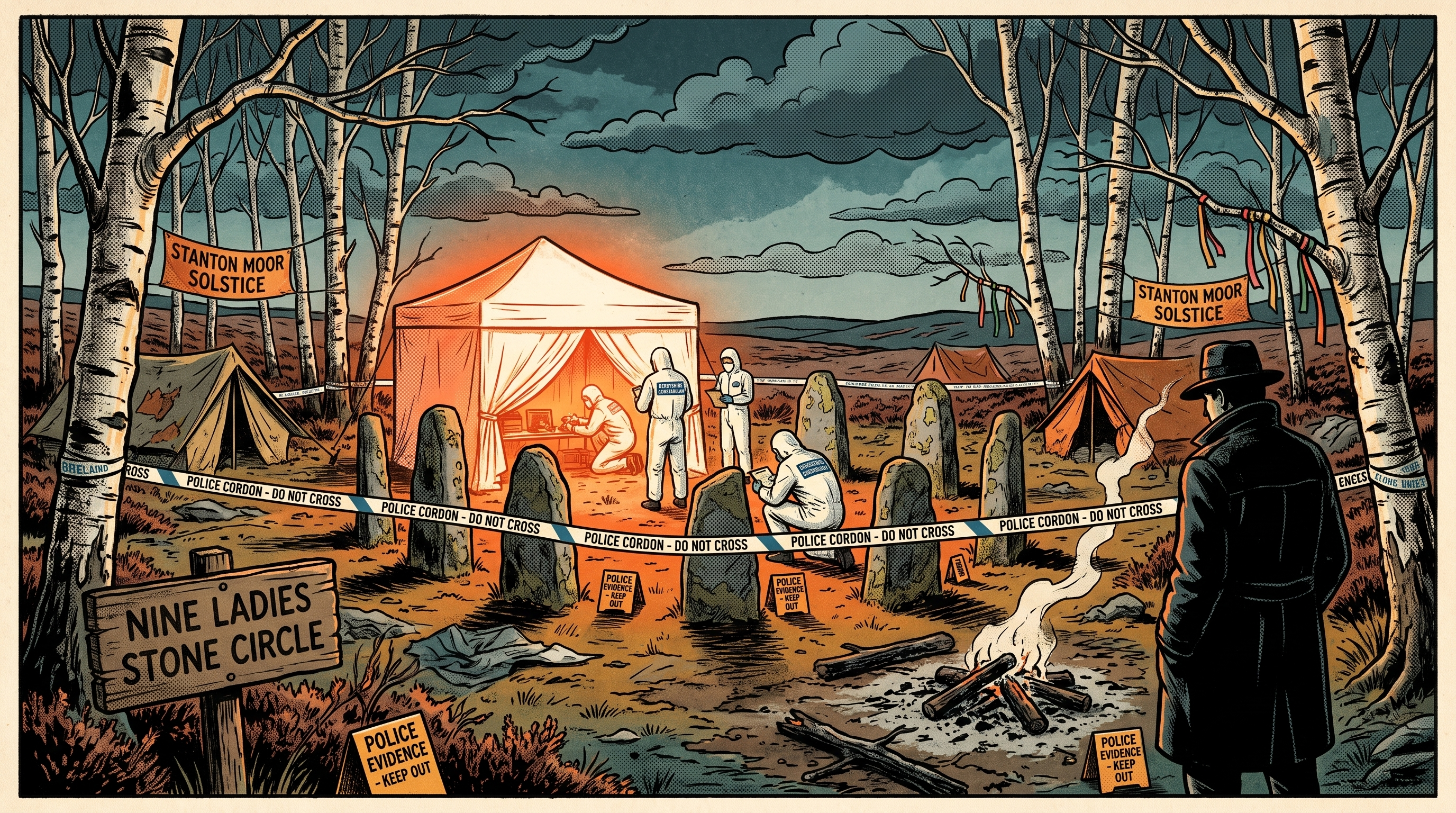
On 22 June 2026, at 13:38, Derbyshire Police were called to Stanton Moor in the Peak District, near the Nine Ladies Stone Circle. Isaac had been found dead there, after a summer solstice gathering. A number of people had passed through the area over the weekend. Detective Inspector Tony Owen said "a young man's life has been taken in the most brutal way," and asked anyone who was there between 19 and 23 June, or anyone holding dashcam footage, to come forward.
A 41-year-old man was arrested early on, then released on bail. Later, police arrested and charged Szymon Babynko, 23, of Commonwealth Way, London, described as a Polish national. He faces a charge of murdering Isaac, a charge of attempted murder over a separate incident on Hady Lane, Chesterfield, on 25 June, and a charge of possessing an offensive weapon. He appeared first at Southern Derbyshire Magistrates' Court, then at Derby Crown Court by video-link. He was not asked to enter a plea. He was remanded in custody. A plea hearing is set for 25 September 2026, and Judge Shaun Smith KC said a trial would land either in November 2026 or, more likely, March 2027.
He is accused. He is not convicted. A court will decide what happened. Everything after this point is about us, not him.
The audit nobody admits to running
Here is the part I find genuinely bleak. Somewhere, as this story surfaced, a certain kind of reader ran it through a filter before feeling anything at all. Where was the accused from? Poland. Where did he live? London. Any small boats? Any asylum hotel? Any failed deportation? No, no, and no. Nothing in the reporting links this death to Channel crossings, refugee accommodation, or immigration enforcement of any kind.
And so — this is the ugly bit — the story was quietly filed as not useful. A few smaller, right-leaning accounts on X poked at it. It didn't catch. There's no evidence of any coordinated push by the big political influencers, no evidence Elon Musk said a word. The machine sniffed the corpse, found no narrative meat on the bone, and moved on.
The lesson people usually draw here is the tediously predictable one: "Why isn't THIS trending? Where's the outrage?" The person writing "the media is burying this" has performed exactly the same audit as the ghoul who wanted to amplify it. They checked the death for political nutrition, found some, and got angry the algorithm didn't pay out. The complaint isn't compassion. It's an invoice.
We have built a culture that treats every violent death as evidence in a trial that has nothing to do with the actual crime. And we've gotten so fluent at it that we no longer notice we're doing it.
Customs for the dead
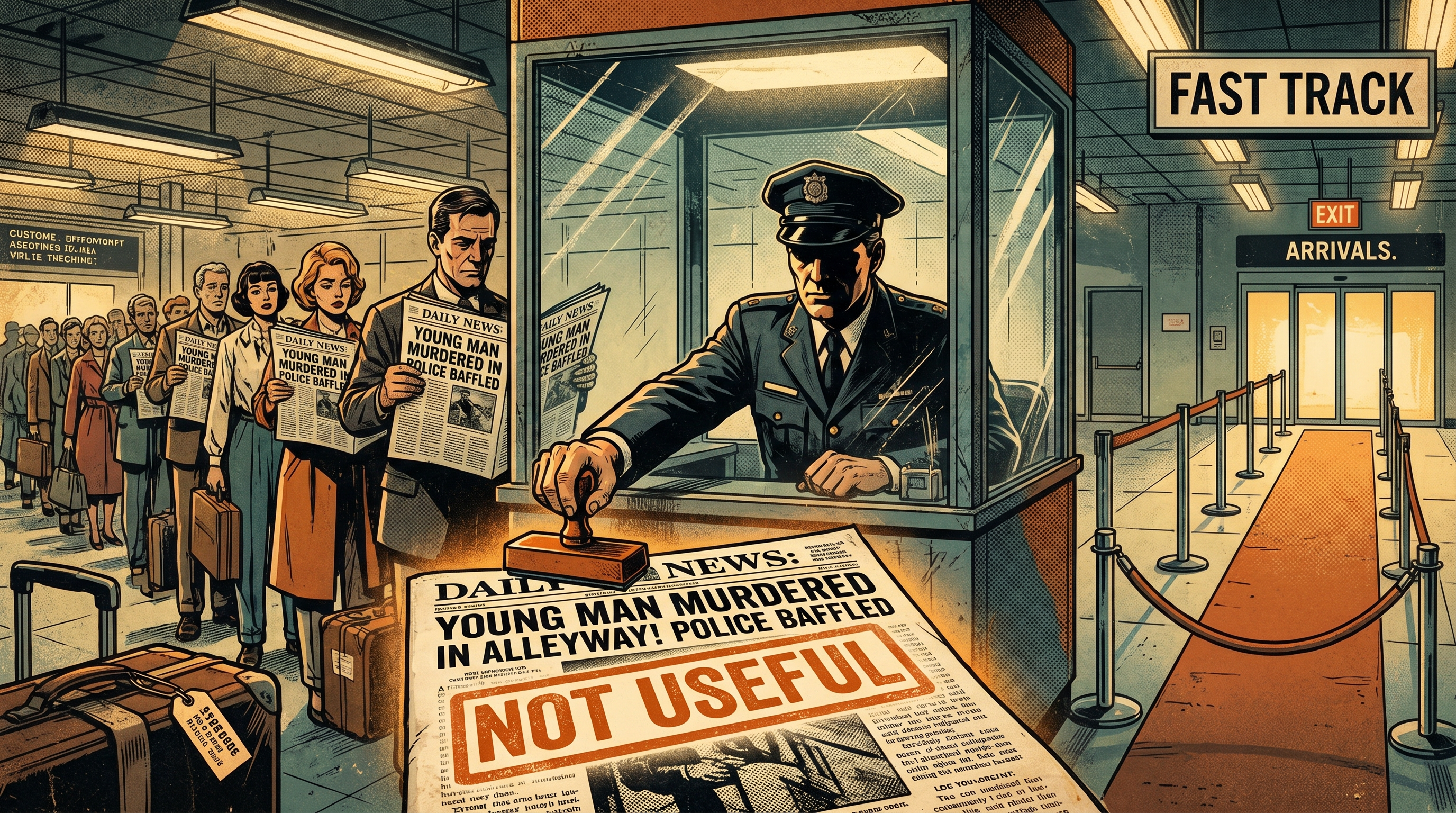
Picture the machine as an airport. Every murder that enters public life has to clear customs first.
At the desk sits an officer whose only job is to check a death's paperwork. Not "was this person loved?" Not "what did they want from their life?" Just: Do you fit my template?
The template is narrow. It wants a specific villain, a specific headline, a specific argument you were already having yesterday. If the death has the right documents, it gets waved straight through into the viral lane — retweets, quote-posts, a hundred accounts pretending they knew all along. If the death has the wrong documents, it gets sent to the back room, ignored, left to the local paper and the grieving family.
Isaac's death arrived at customs and handed over a very inconvenient set of forms. Poland isn't a small-boats story. Commonwealth Way, London, isn't an asylum hotel. The setting was a stone circle at the solstice, which is eerie and sad and specific and completely useless to a man who wanted to be furious about dinghies. The officer sighed, stamped it REJECTED, and reached for the next case that might actually earn some engagement.
Now here's the trick your brain plays. It feels like discernment. It feels like you're the sharp one, seeing the hidden patterns everyone else misses. You are not. You're a border guard for other people's grief, and you're proud of your uniform.
The tell is simple. If your reaction to a killing depends on where the accused was born before it depends on the fact that a 26-year-old joiner will never come home again, the machine isn't something you're watching. It's something you've become.
The specific weight of one life
Notice what the audit erases. It has no column for Thailand. No box to tick for a lad who saved up, flew across the world to get better at a hard and disciplined sport, and came back to keep working with his hands. The template can't hold any of that, because none of it advances an argument. So it deletes the human and keeps the demographic.
That is the con at the centre of the whole business. The outrage economy dresses up as caring about victims while treating them as raw material. A real person becomes a "case." A "case" becomes a "point." A "point" becomes a fight you were going to have regardless of whether anyone had died. By the end, the actual human being — the son, the brother, the friend — has been processed into fuel, and the people burning him will tell you they're the ones who truly care.
DI Owen's words are worth reading again, because they contain no template at all: "a young man's life has been taken in the most brutal way." That is a police officer describing a killing as a killing. No angle. No side. Just the plain, unbearable fact of it. It's a cleaner piece of moral writing than most of what will be posted about this case, precisely because it wants nothing from you.
Owed grief, not a verdict
A carpenter from Arnold is dead near a ring of ancient stones. A court will now do the slow, unglamorous work of establishing what happened, and it will take until next spring to get there. That is the entire story, and it is enough.
The measure of a decent person isn't how loudly they react when a death confirms their politics. It's whether they can look at a killing that confirms nothing, offers no ammunition, and hands them no enemy — and still feel the full weight of it. Isaac Clare-Watts is owed grief, not a verdict on his usefulness. Anyone running the audit has already told you exactly what they'd do with your death, too.