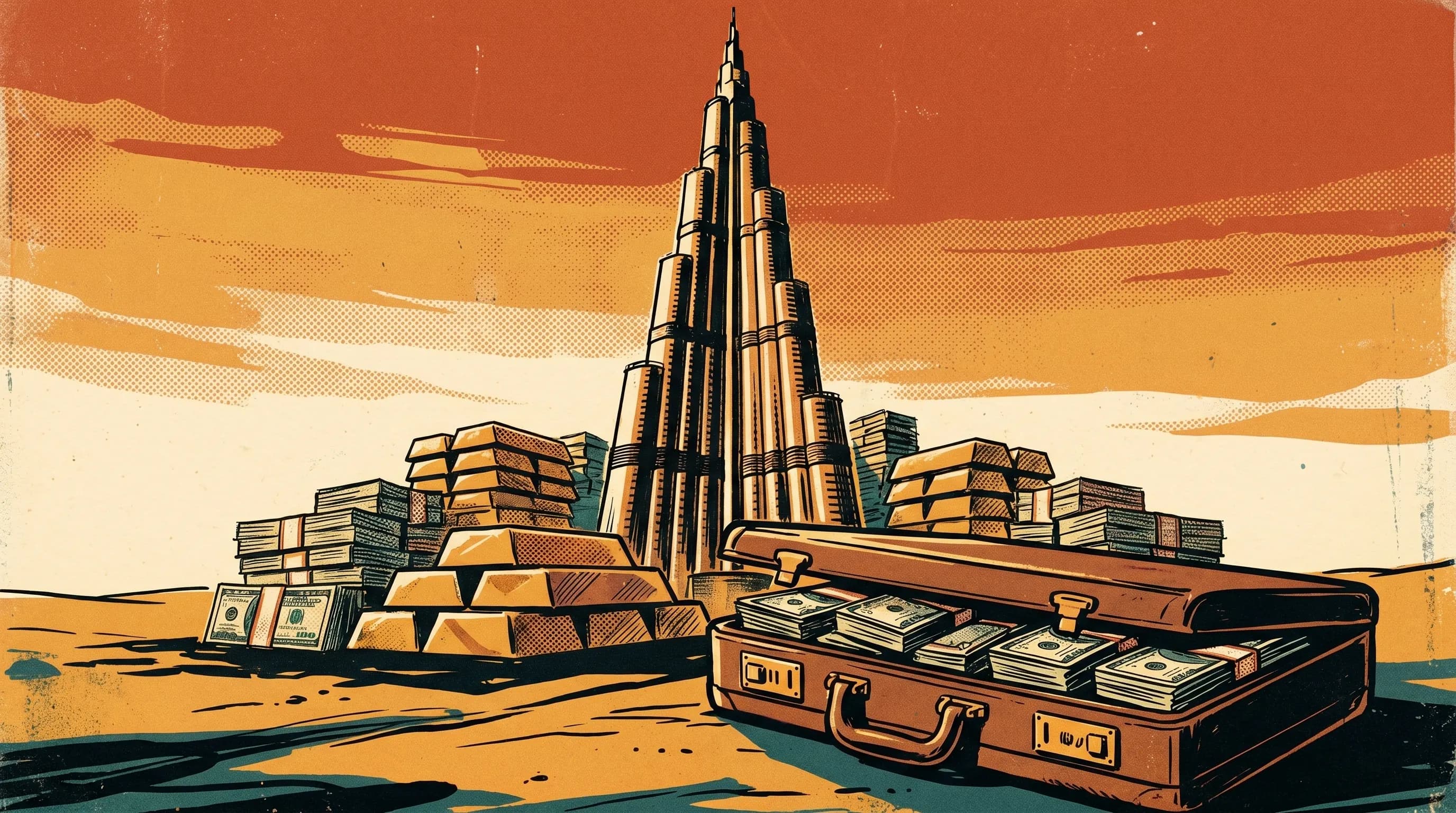
Dubai doesn't need a conspiracy. It needs a Marriott.
That's the thing about the modern underworld — it long ago stopped requiring shadowy meetings in basements or coded telegrams. It requires something far more banal: a city with good flights, easy company formation, nice weather, and a collective agreement not to look too hard at where the money comes from. Dubai has all four in abundance.
The Setup
Consider what we know. Daniel Kinahan — a man under international scrutiny for his alleged role in organized crime — was based in Dubai for years. Not hiding in Dubai. Based there. He held extensive property. He formed companies. He built influence and wealth.
Let that phrase sit for a moment. A super cartel environment — at a wedding. In. Presumably with canapés.
Meanwhile, in an entirely separate lane of the same highway, UAE-linked companies and jurisdictions have repeatedly appeared in sanctions-evasion and shadow-finance stories tied to Iran. Dubai keeps turning up — front companies, shadow banking systems, commodity and shipping opacity, layered beneficial ownership, financial intermediation. That's not one thing going wrong. That's an entire menu.
And then there's Hezbollah, whose financial model involves considerably more than state sponsorship from Iran alone. Authorities have linked the organization to money laundering, narcotics proceeds, trade-based schemes, global procurement networks, and cooperation with criminal actors — from Latin American cocaine flows to diaspora-linked facilitation across multiple continents.
Three separate worlds — Irish organized crime, Iranian sanctions evasion, Hezbollah's hybrid finance machine — and they all seem to find the same city perfectly hospitable.

The Real Product Dubai Sells
Here's what most coverage of Dubai's role in global finance misses: the city's appeal to illicit money isn't a bug. It's not even a feature, exactly. It's more like an emergent property of a system optimized for something else entirely.
Think of it this way. Imagine you built the world's greatest airport — enormous, beautifully designed, connected to everywhere. Millions of legitimate travelers pass through every year. But people who need to move quickly and discreetly between continents find it very convenient too. You didn't build it for them. But you didn't build it to keep them out, either.
It's not just flights. It's a dense company-formation ecosystem. It's a geographic position planted squarely between Europe, Africa, Asia, and the Gulf — basically the center of the board if global finance were a game of Risk. And it has a history of attracting globally mobile capital with, shall we say, uneven scrutiny.
Now, other cities play versions of this game. London, Miami, Cyprus, Malta, Panama, Hong Kong, and Istanbul have all served as useful nodes for opaque money. Panama will launder your shell company. London will sell your oligarch a townhouse. Miami will park your yacht. Each city offers a service or two.
What makes Dubai different — and this is the critical point — is that it offers the full stack. Company formation, property, banking access, geographic centrality, luxury lifestyle, and a regulatory environment that has historically asked fewer questions than the situation might warrant. It's the difference between a city that has a good restaurant and a city that has an entire food court. You don't need to coordinate between venues. Everything is right there.
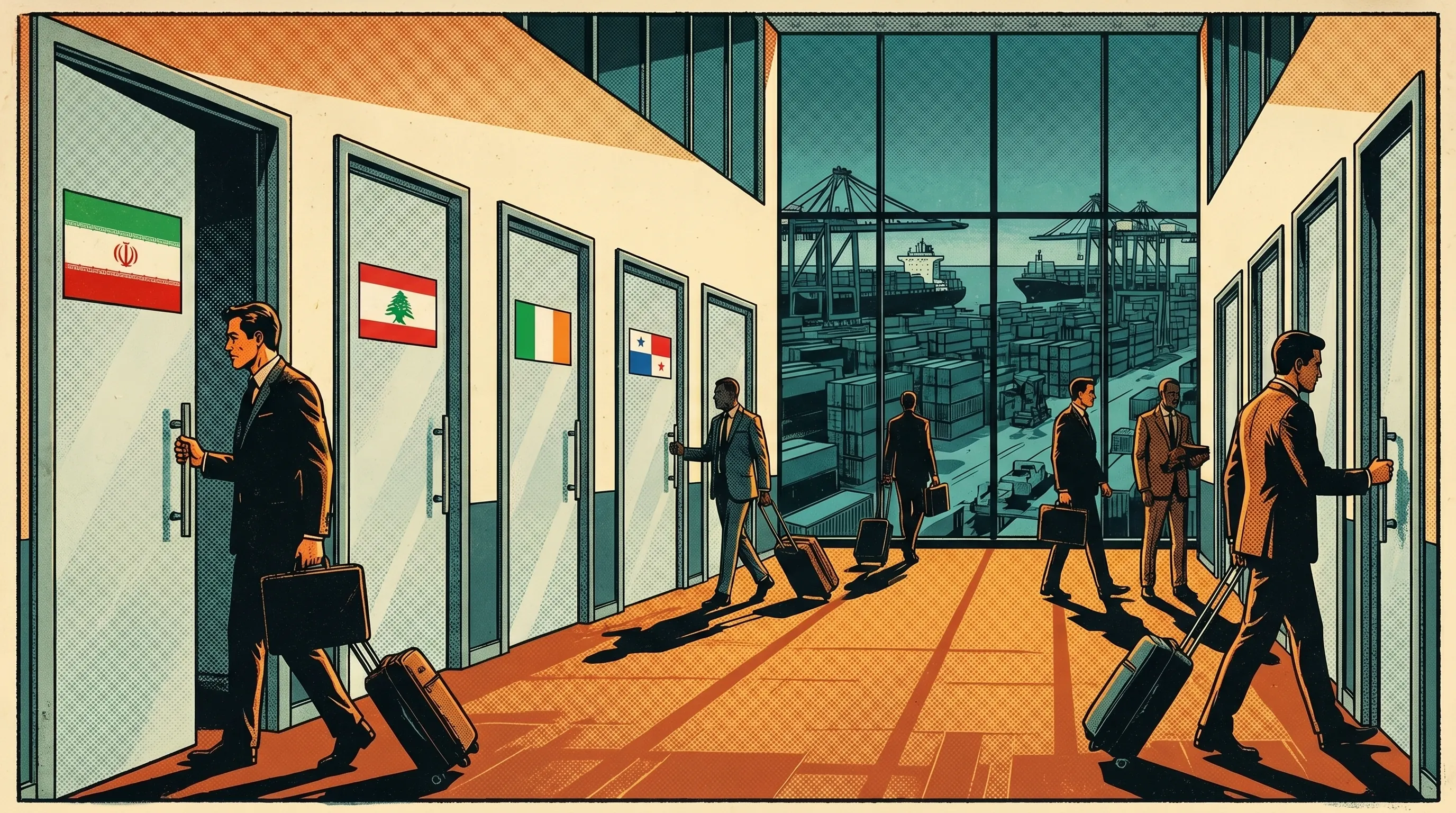
This is why Kinahan could run a global operation from Dubai while under international scrutiny. This is why Iranian sanctions-evasion networks have repeatedly routed through Dubai-based front companies. This is why Hezbollah-linked financial flows touch the same jurisdictions. None of these actors need to know each other. None of them need to cooperate. They're all just shopping at the same mall.
The Super Cartel That Isn't
The phrase "super cartel" is evocative but slightly misleading. A cartel implies coordination — people sitting in a room agreeing on prices and territory. and arguably more dangerous: a convergence.
A convergence market is what happens when a location becomes so efficient at servicing a particular need that all the buyers show up independently. Think of how Silicon Valley became the place for tech startups — not because someone organized it, but because the density of talent, capital, and infrastructure made it irrational to be anywhere else. Dubai has become something similar for the movement and concealment of questionable money. It's the Silicon Valley of opacity.
The beauty of a convergence market, from the perspective of those using it, is that it requires no formal organization. Kinahan doesn't need to coordinate with Iranian sanctions evaders. Hezbollah-linked procurement networks don't need to shake hands with European crime families. They all independently conclude that Dubai is the best place to form a company, hold property, and maintain a comfortable lifestyle while conducting business that would attract rather more attention in, say, Amsterdam.
This is harder to fight than a conspiracy. You can infiltrate a conspiracy. You can flip members. You can intercept communications. But how do you dismantle a city's competitive advantages? How do you regulate away the fact that Dubai is geographically convenient, architecturally gorgeous, and very good at forming companies quickly?
The Homework Phase
To be fair, Dubai has tightened enforcement in some areas over time, including greater sanctions responsiveness, extradition agreements, and higher scrutiny on certain figures.
These are real steps. But they carry a whiff of the student who starts doing homework only after the teacher calls their parents. The question isn't whether Dubai can enforce its rules. The question is whether the fundamental architecture — the company-formation ecosystem, the layered ownership structures, the geographic centrality, the luxury-as-a-service model — continues to function as a magnet for the very capital it's now supposedly scrutinizing.
Because here's the structural problem: every feature that makes Dubai attractive to legitimate global business also makes it attractive to illegitimate global business. The flights that bring tourists also bring fugitives. The company-formation infrastructure that enables entrepreneurs also enables front companies. The real estate market that welcomes foreign investment also welcomes foreign investment that would rather not explain its origins.
You can't put a "no criminals" sign on an open door and call it enforcement.
What We're Actually Looking At
Dubai isn't uniquely evil. It's uniquely efficient. It has built, whether intentionally or not, the world's first full-service convergence market for money that needs to move, transform, and settle down somewhere comfortable. Cartel wealth, sanctions-evasion infrastructure, and proxy finance don't rent the same architecture because they planned to. They rent it because it's the best product on the market.
The danger is that Dubai is a luxury marketplace where the line between legitimate and illegitimate capital becomes so blurred that distinguishing between them requires a level of scrutiny the system was never designed to provide.
Until someone figures out how to offer Dubai's speed, convenience, and lifestyle to clean money while making dirty money genuinely unwelcome — not performatively unwelcome but structurally unwelcome — the convergence will continue. The wedding guests will keep arriving. And they won't need to know each other to enjoy the same party.