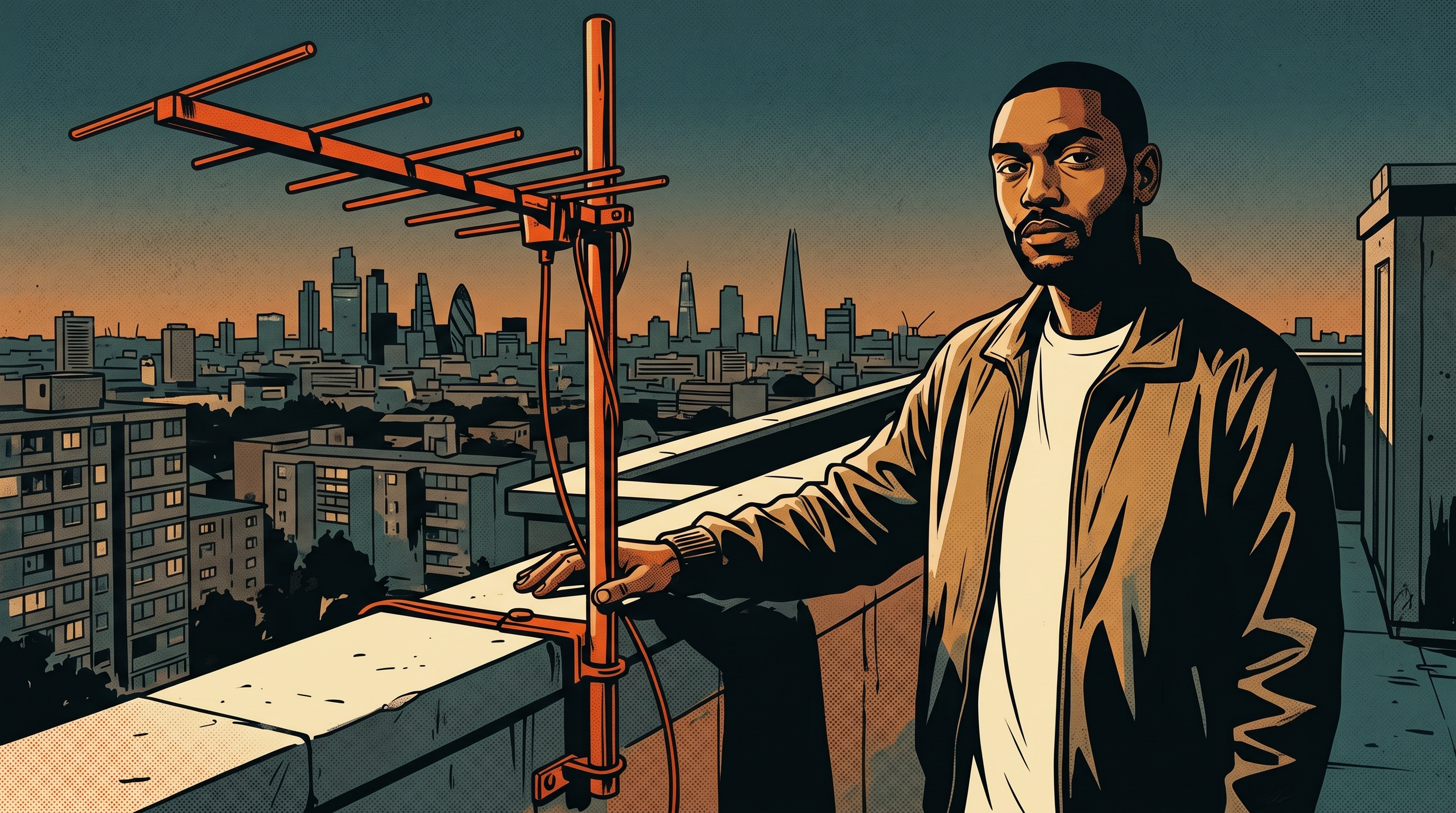
There is a moment in 8 Bar: The Evolution of Grime — Ewen Spencer's 90-minute documentary, built almost entirely from rare archive footage and first-hand voices — where Kano makes a remark about pirate radio that lands harder than any thesis statement could. The hustle of pirate radio, he suggests, helped define the genre itself. Not the sound. Not a particular record. The hustle. The climbing of tower blocks with transmitters, the physical risk, the Ofcom shutdowns, the rebuilding, the doing it again.
Spencer, a photographer and filmmaker who documented youth and music culture during grime's early years, understands proximity. His documentary, distributed via BBC Storyville and BBC iPlayer, is largely unnarrated. It lets the scene speak for itself through a weave of archive footage and recent interviews with figures including Dizzee Rascal, Skepta, D Double E, Jammer, Slimzee, DJ Target, and Geeneus. The method is honest — respectful, even. But there is a difference between a documentary that declines to impose a narrative and a participant who carries one in their body. Kano's framing of pirate radio as definitional, not incidental, is that second thing. And it points toward a question worth sitting with: what happens to the story of a subculture when the people who built it insist on telling it differently from the people who admire it?
The Infrastructure Was the Art
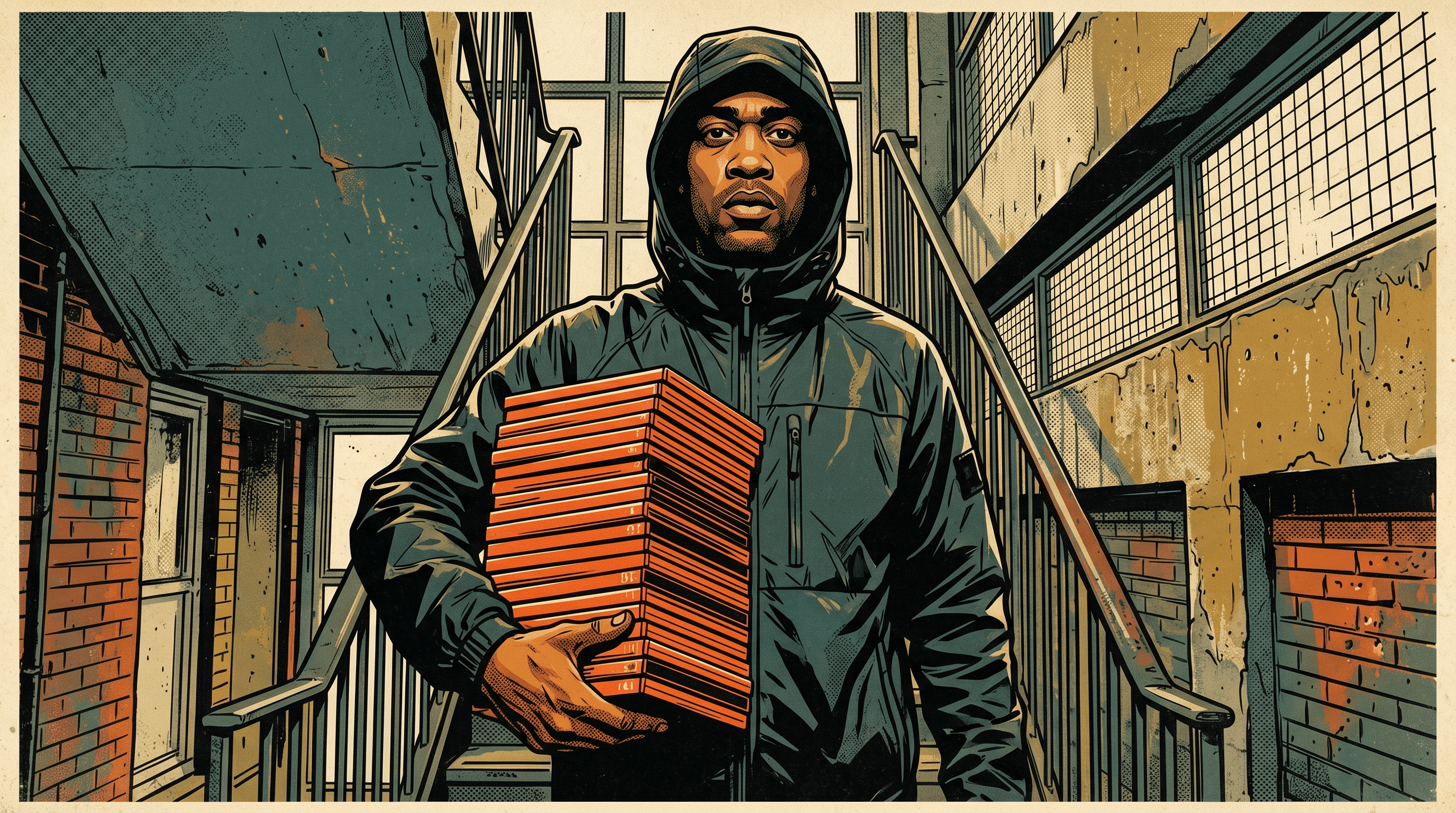
Grime emerged from late-1990s and early-2000s East London under conditions that every retrospective dutifully catalogues: social unrest, overpolicing, disenfranchised youth, council-estate life, exclusion from mainstream media access. These are real. But lists of deprivation can flatten the ingenuity that operated within those constraints. Before the BBC cared, before museum exhibitions and anniversary think-pieces, grime had already built its own distribution network — pirate radio recordings, Lord of the Mics DVDs (self-shot, self-distributed), Channel U broadcasts, and the Sidewinder rave circuit. This was not a culture waiting to be discovered. It was a culture that had already solved the problem of reach on its own terms.
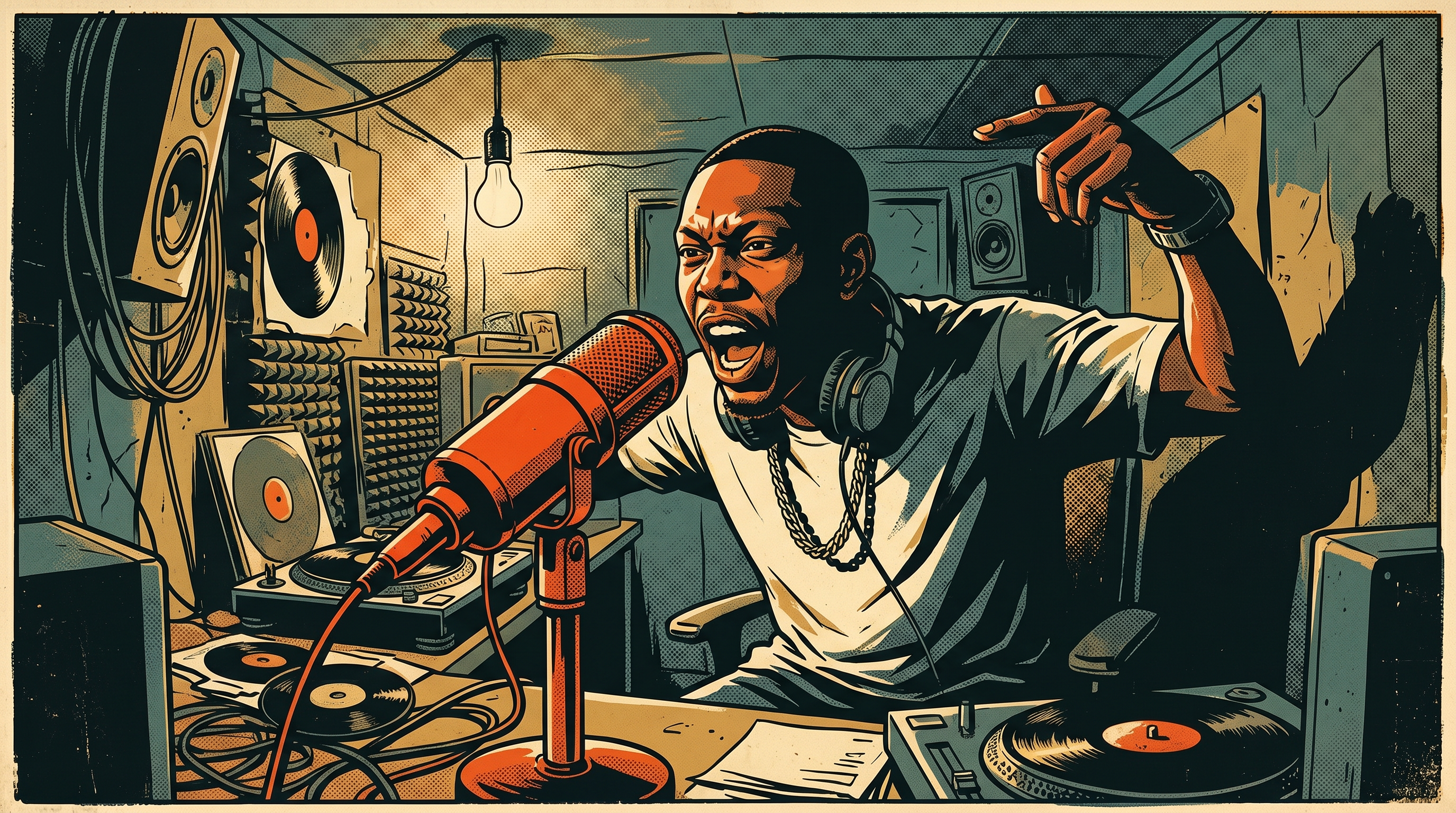
Pirate radio sits at the centre of that story. Rinse FM features heavily in 8 Bar, and Spencer treats Slimzee and Geeneus as foundational figures for good reason. Broadcasting illegally was physically risky and technically demanding. Broadcasting illegally meant hauling transmitters up rooftops, rigging aerials, and rebuilding every time Ofcom shut you down. But the stations were more than distribution channels. They were training grounds. Flows were tested in real time. Clashes happened live. Reputations were built or destroyed in the space of a set. The audience connection was immediate, unmediated, and brutal. If your bars were weak, you knew before the set was over.
This is what Kano's observation captures. The hustle was not a regrettable necessity preceding the "real" art. The hustle was the compositional environment. The genre's textures — its aggression, its improvisational speed, its combative energy — were shaped by the conditions of transmission. You cannot separate the sound from the signal.
Deeper Than Garage
One of the quieter achievements of 8 Bar is its willingness to trace grime's sonic inheritance without reducing it to a clean origin story. The documentary tracks a path from jungle and UK garage through pirate radio, basement raves, DVD culture, and Channel U into mainstream breakthroughs. But that lineage runs deeper than the documentary's 90 minutes can fully hold.
Grime sits within a Black British cultural continuum that includes sound system culture, dancehall and ragga energy, the MC clash tradition, and a long history of bass-heavy, community-built music spaces. Sound system culture contributed not just the bass pressure but a whole grammar of performance: rewinds, MC authority, crowd control, the dubplate mentality. From ragga and dancehall came the vocal attack, the reload energy, the rhythmic aggression. Jungle carried pirate-radio transmission practices, breakneck urban intensity, and what might be called Black British futurism — the sense that the future was being built in bedrooms and tower blocks, not handed down from institutions. UK garage provided the tempo and club infrastructure that grime first pushed against and then broke away from.
None of this is obscure history. But it tends to get compressed in mainstream accounts into a simple "grime came from garage" line. The lived-experience version — the version carried by people who were in those spaces, who heard jungle before they heard the word "grime," who understood the MC clash tradition as inherited grammar rather than stylistic choice — holds these layers in a way that even a sympathetic documentary struggles to.
The Documentary Versus the Counter-Memory
When Dizzee Rascal released Boy in da Corner in 2003, with its sparse sound and estate-centred lyricism, it became the landmark that mainstream culture could point to and say: here, this is where grime starts mattering. And it does matter — the record's raw production and unflinching perspective made it impossible to ignore. But from inside the scene, Boy in da Corner was not a beginning. It was a moment when something that had been happening for years became visible to people who had not been paying attention.
This is the tension that runs beneath 8 Bar without ever quite being named. The documentary's method — archive footage, first-hand voices, minimal narration — is a genuine attempt to let the culture represent itself. The critical reception has been broadly respectful — press and institutions alike treating the documentary's subjects and methods with care. Everyone is being respectful. Everyone is getting it broadly right.
And yet. The institutional frame — BBC distribution, broadsheet reviews, museum exhibitions — inevitably reshapes what it touches. A documentary broadcast on BBC Four exists in a different relationship to power than a pirate radio signal broadcast from a rooftop in Bow. The footage is the same. The context is not. When press synopses frame grime as tied to social unrest and media demonisation, they are describing something true. But they are also performing a kind of narrative housekeeping — filing grime into categories that make sense to audiences who encounter it as cultural history rather than lived reality.
What Gets Lost in the Archive
The counter-narrative is not a correction of facts. Nobody is disputing dates or names. It is a correction of emphasis. From the outside, grime's pirate radio era looks like a scrappy workaround — young people who could not access mainstream platforms finding alternative routes to an audience. From the inside, as Kano's framing suggests, it was something closer to the opposite: a generative constraint that shaped the art at the level of form. The illegality, the impermanence, the physicality of climbing buildings with equipment — these were not obstacles to be overcome on the way to legitimacy. They were the conditions that produced the thing that later got legitimised.
Grime's cultural impact now extends to British street style, independent youth media, regional scenes far beyond London, the broader UK rap landscape, and the mainstreaming of Black British urban narratives. That reach is real and worth celebrating. But there is something worth noticing in the gap between a culture that documented itself — through recordings, DVDs, raves, and the sheer persistence of illegal broadcasting — and the documentation that arrives afterward, however lovingly assembled.
8 Bar is, by most accounts, a careful and affectionate film. Spencer earned his proximity. But the most interesting thing the documentary surfaces might be the limits of its own form: the way Kano can say in a sentence what 90 minutes of footage can only approximate. The hustle defined the genre. Five words that contain an entire epistemology of creative practice — one that no archive, however rare, can fully reconstruct.
And maybe that is the final irony. The UK sound that was once criminalized on rooftops and ignored by broadcasters is now a global reference point — its rhythms, its vocal cadences, its confrontational energy admired and imitated from Tokyo to Toronto, Lagos to Los Angeles. Drill, Afroswing, and a dozen other mutations carry grime's DNA into scenes that have never seen a tower block in Bow. The infrastructure the scene built for itself turned out to be a blueprint that travelled. But the further the sound travels from the conditions that made it, the more essential it becomes to remember that the hustle was never just a means of distribution. It was the art itself — and it documented itself first.
If you want to see the scene tell its own story, 8 Bar: The Evolution of Grime is well worth your time.