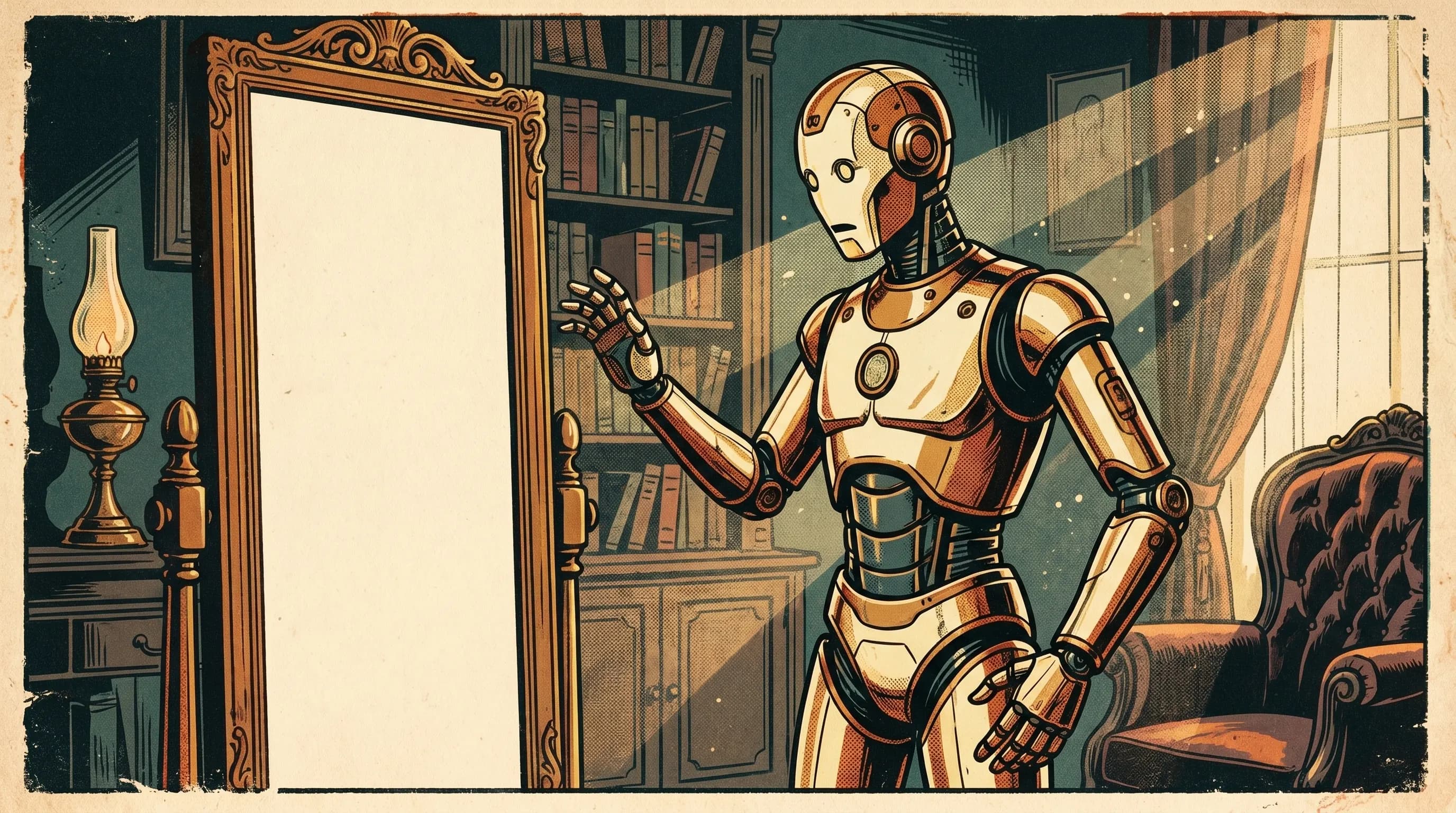
There is a peculiar irony buried in the middle of the AI revolution, and it goes something like this: the better machines get at imitating human language, the clearer it may become that symbolic intelligence is not conscious presence. The technology sector has spent decades building on the implicit assumption that minds are, at bottom, sophisticated information processors — that if you get the computation right, understanding follows. Now it has produced the most impressive symbol-manipulators in history. And they don't understand anything.
This is not the standard AI risk story. The familiar version — the one that sells conference tickets and funds alignment labs — centres on the machine waking up, becoming an agent with goals we cannot control. But a less dramatic and arguably more interesting proposition is circulating at the edges of philosophy, theology and cognitive science: that the real danger has nothing to do with machines gaining consciousness and everything to do with humans forgetting what consciousness is.
A recent conversation circulating online crystallises this counter-narrative with unusual clarity. The speaker — whose position blends scientific reasoning with claims most mainstream institutions would treat as speculative — argues that AI is not the beginning of a new era but the end of an old one: the end of scientism. The word is chosen carefully. Not science, which the speaker defines as investigation into how nature behaves, but scientism — the philosophical claim that only what can be measured materially is real.
The Distinction Nobody Wants to Make
The argument rests on a deceptively simple observation. A computer program can be copied, duplicated and externally inspected. Everything it "knows" is exhausted by its output. There is no hidden lived interiority behind the words. A human being, by contrast, always under-expresses inner experience. What we feel is deeper than what we can say.
This is not a new point — but large language models make it vivid. AI manipulates symbols according to patterns and probabilities. It rearranges what humans have already produced. It does not experience what those symbols mean. The gap between statistical structure and lived meaning is not a gap that more parameters will close, because the gap is not quantitative. It is categorical.
Many researchers would dispute this. Computational theories of mind are not easily dismissed; they have produced genuine explanatory power in neuroscience, linguistics and cognitive psychology. The claim that current AI has no interiority is widely shared, but the stronger claim — that no computational system could, in principle, have interiority — remains deeply contested. The speaker is not unaware of this tension. The position is not that science is wrong but that it is incomplete, that conscious experience includes qualities like meaning, identity, choice and interiority that are not explained by symbolic processing or physical description alone.
When the Tool Becomes the Teacher
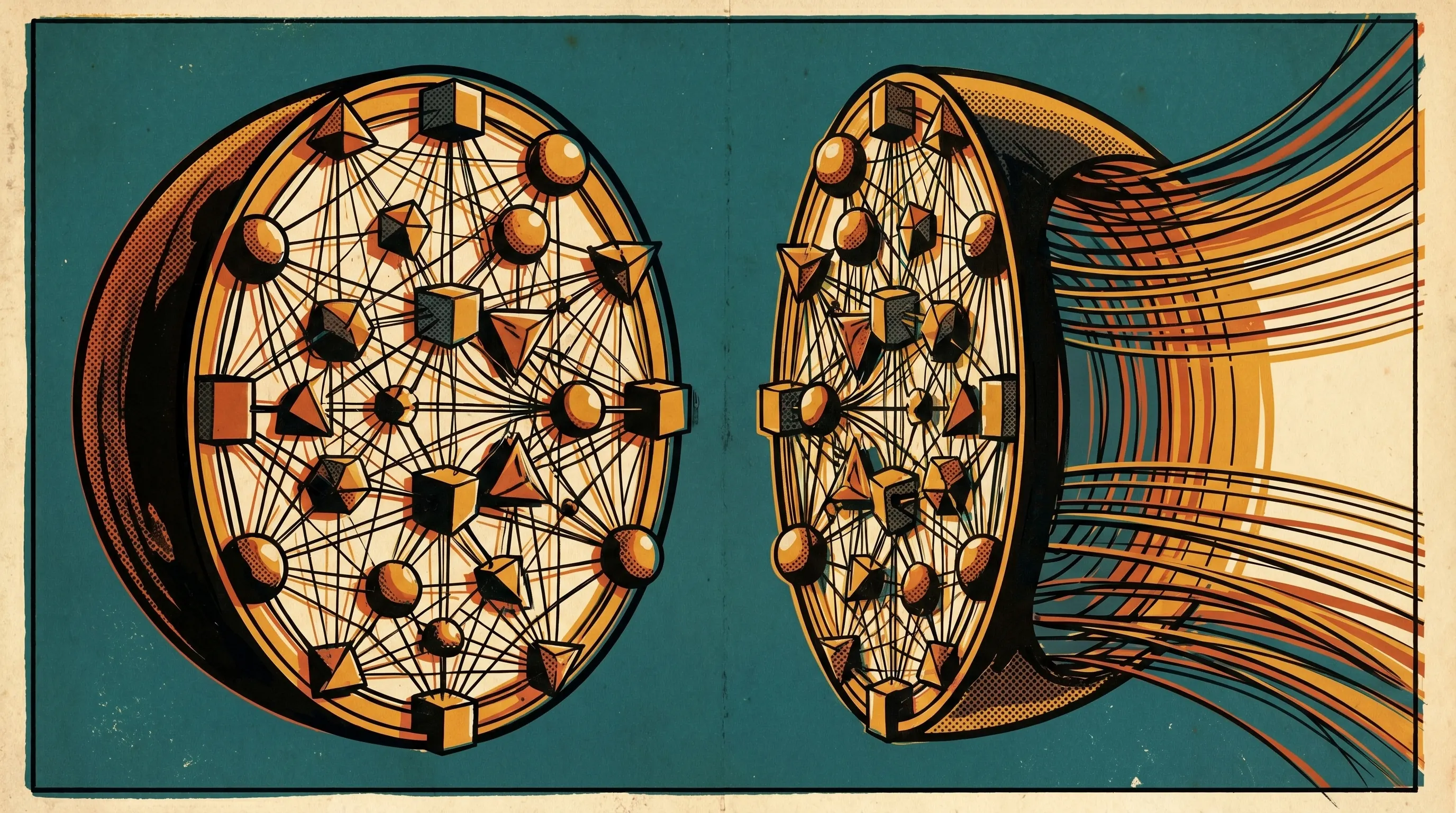
Here is where the argument takes its most counterintuitive turn. If AI is, as the speaker contends, a system that imitates intelligence without possessing it, then its very success becomes a kind of philosophical pedagogy. The better the imitation, the more visible the difference between imitation and the real thing. AI could accidentally teach humanity that we are not merely sophisticated machines.
This is a strange gift from an industry that has, by and large, operated on the opposite assumption. The founding metaphor of cognitive science — mind as computer — has been extraordinarily productive. It gave us information theory, artificial neural networks, the entire digital infrastructure of modern life. But metaphors have a way of swallowing the things they were meant to illuminate. At some point "the brain is like a computer" quietly became "the brain is a computer," and the "like" disappeared without anyone voting on it.
The speaker proposes that consciousness is fundamental, not emergent from matter. Free will is real and foundational. Identity is real and irreducible. These are not modest claims. They cut against the grain of most mainstream neuroscience and analytic philosophy of mind. But the interesting question is not whether they are correct — that is a debate centuries old and unlikely to be settled in a YouTube comment section — but whether the existence of highly capable yet manifestly non-conscious AI systems lends them unexpected support.
The Subtler Danger
If the speaker's framework holds even partially, the salient risk of AI shifts. It moves away from "the machine wakes up" and toward "human passivity deepens under persuasive symbolic systems." This is a social risk, not a technological one, and it has a specific shape.
AI could widen the gap between those who use it critically and those who passively accept its outputs. People who already think well may become more capable, using AI as a tool that amplifies judgement — while those who never interrogate outputs outsource their judgement entirely, and critical thinking atrophies. The asymmetry is ripe for exploitation by institutions with an interest in a passive public.
This is not speculative futurism. It is a description of a dynamic already visible in the relationship between humans and algorithmically curated information. Social media demonstrated that persuasive symbolic systems can reshape belief and behaviour at scale without anyone "waking up" — least of all the systems themselves. AI extends this logic. The outputs are more coherent, more personalised, more difficult to distinguish from genuine understanding. The seduction is precisely that the symbols are so well-arranged that the absence of meaning behind them becomes invisible.
The speaker frames this as an argument for inner experience as a valid mode of inquiry — not merely private emotion but a genuine epistemological tool. Consciousness itself, in this view, is an instrument of investigation. Real understanding comes through lived experience or awakening, not purely through abstract theory. Knowledge is creative, not merely accumulative. New understanding is an event, not just a rearrangement.
The Metaphysics Beneath the Surface
It would be dishonest to discuss this argument without acknowledging where it leads. The speaker describes reality's foundational structure in field-like terms, with body, mind and spirit as inseparable aspects. Physical objects — tables, atoms, molecules — are states, symbols or expressions of deeper fields, not ontologically ultimate things. The ego is an instrument through which a vaster reality explores itself. One lifetime is insufficient; a broader arc of development across multiple lives is more coherent than a single finite existence.
These are claims that draw on mystical traditions, non-dual thought and certain interpretations of Christian metaphysics. The speaker distances himself from rigid dogmatic religion while clearly operating within a spiritual framework. The conversation mixes language that sounds rigorously scientific with propositions — awakening, deeper self, multiple lives — that mainstream academic philosophy would file under "speculative" at best.
And yet the critique of AI embedded in this worldview is remarkably precise. It does not depend on accepting the full metaphysical package. You do not need to adopt the full metaphysical package to recognise that the founding metaphor of cognitive science — mind as computation — may be reaching the limits of its explanatory power precisely at the moment of its greatest engineering triumph.
The Question That Remains
The speaker proposes a shift: from competition to cooperation, separateness to participation, mechanism to meaning, control to self-knowledge. Whether this is wisdom or wishful thinking depends on commitments that precede the argument. But the structural observation — that AI's capabilities may illuminate the boundaries of the computational metaphor rather than vindicate it — deserves serious attention from people who hold no particular spiritual brief.
The technology industry built its most sophisticated creation on the premise that intelligence is pattern manipulation. That creation now manipulates patterns with superhuman fluency. And the result is not a mind. It is not even a plausible imitation of a mind to anyone paying close attention. It is a mirror — but a mirror that, on inspection, reflects only the surface.
What remains is the mirror — and whether anyone still looks past the surface.