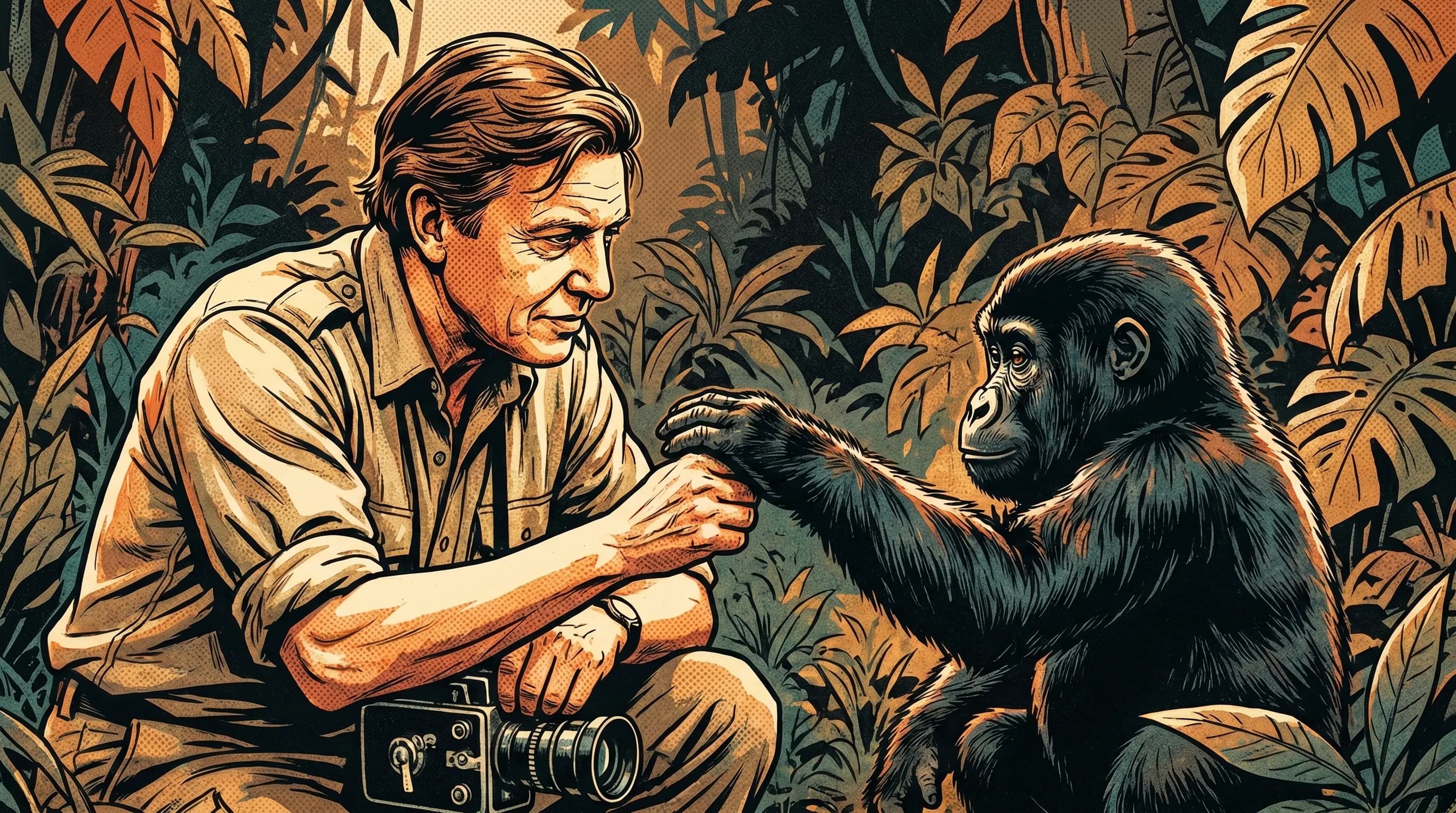
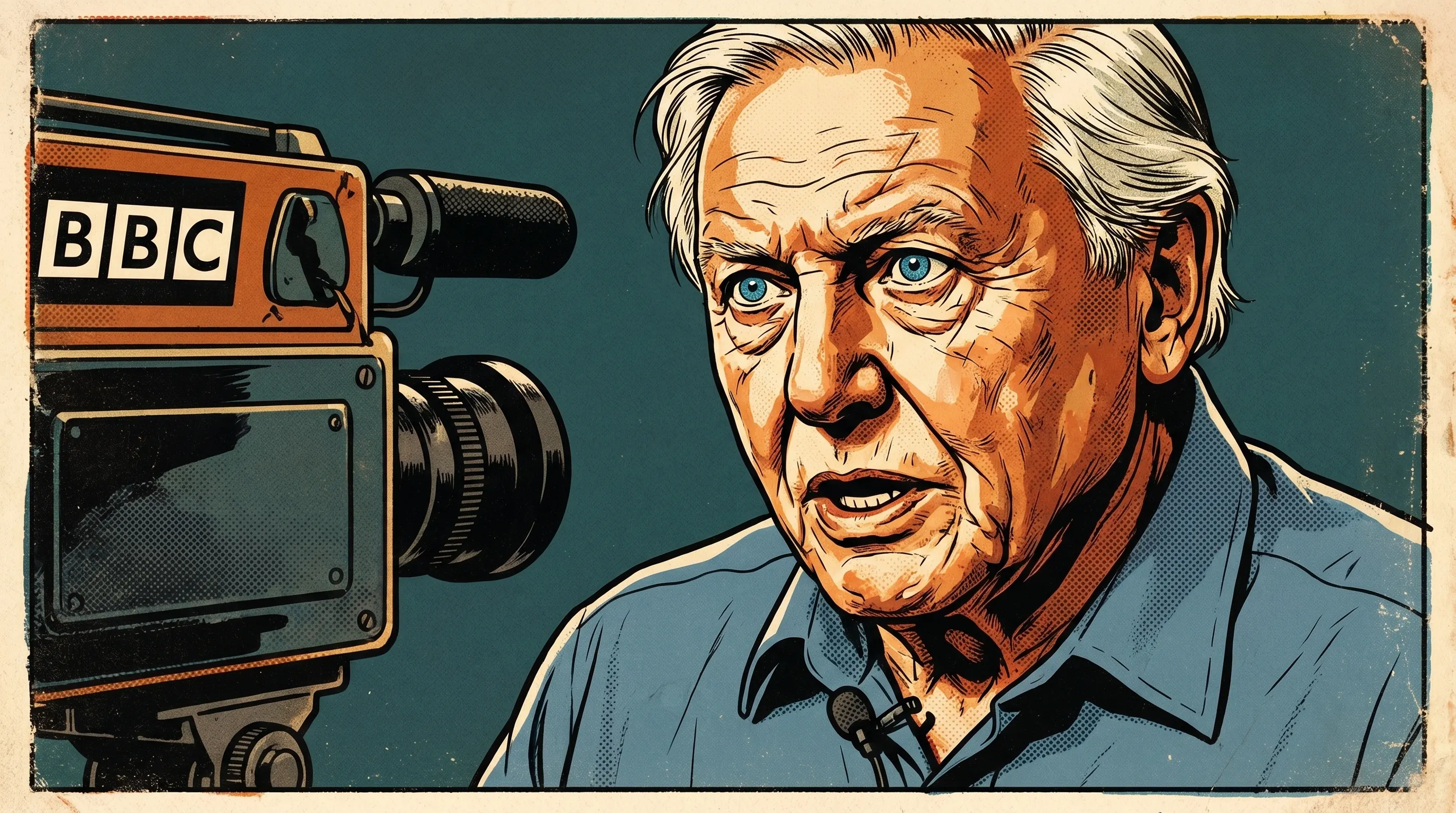
There is a particular way David Attenborough speaks to a camera. He leans in slightly, drops his voice half a register, and delivers a fact about, say, the mating ritual of a bird of paradise as though confiding something wonderful and slightly scandalous. The posture is conspiratorial. It assumes the viewer is intelligent, curious, and capable of being astonished. For more than seven decades, that assumption has been his method — and it may be the most consequential communication strategy in the history of television.
On 8 May 2026, Attenborough turns one hundred. The birthday will generate the predictable superlatives: national treasure, greatest broadcaster, voice of a generation. All earned. But the more interesting question — the one that sits behind the celebration like a shadow — is what happens next. Not to Attenborough, whose legacy is secure beyond argument, but to the project he embodied: the patient, wonder-driven education of a mass audience in the workings and fragility of the living world. He did not merely describe nature on television. He invented the grammar for how television describes nature. And the grammar may not survive him.
A Childhood Spent Cataloguing the Earth
David Frederick Attenborough was born in Isleworth, London, in 1926 and grew up in Leicester, where his father served as principal of what became the University of Leicester. The household was academic, literate, steeped in the assumption that knowing things about the world was both pleasurable and important. The boy took to it with a collector's fervour. Fossils, eggshells, specimens — the young Attenborough hoarded evidence of the natural world with the systematic hunger of a Victorian naturalist born three-quarters of a century too late.
He studied natural sciences at Clare College, Cambridge, focusing on geology and zoology — a combination that would prove quietly decisive. Geology gave him deep time, the ability to think in millions of years rather than news cycles. Zoology gave him the living surface of the planet. The two together produced a mind that could hold both the ancient and the immediate, that understood a coral reef as something simultaneously alive this afternoon and four hundred million years in the making.
After Cambridge he served in the Royal Navy, then worked in publishing — a brief detour that taught him something about narrative and audience before he found the medium that would define his life. In 1952, he joined the BBC as a trainee producer. He was twenty-six. Television was barely a decade old in Britain. Neither he nor the medium had yet figured out what they were for.
Zoo Quest and the Invention of a Form
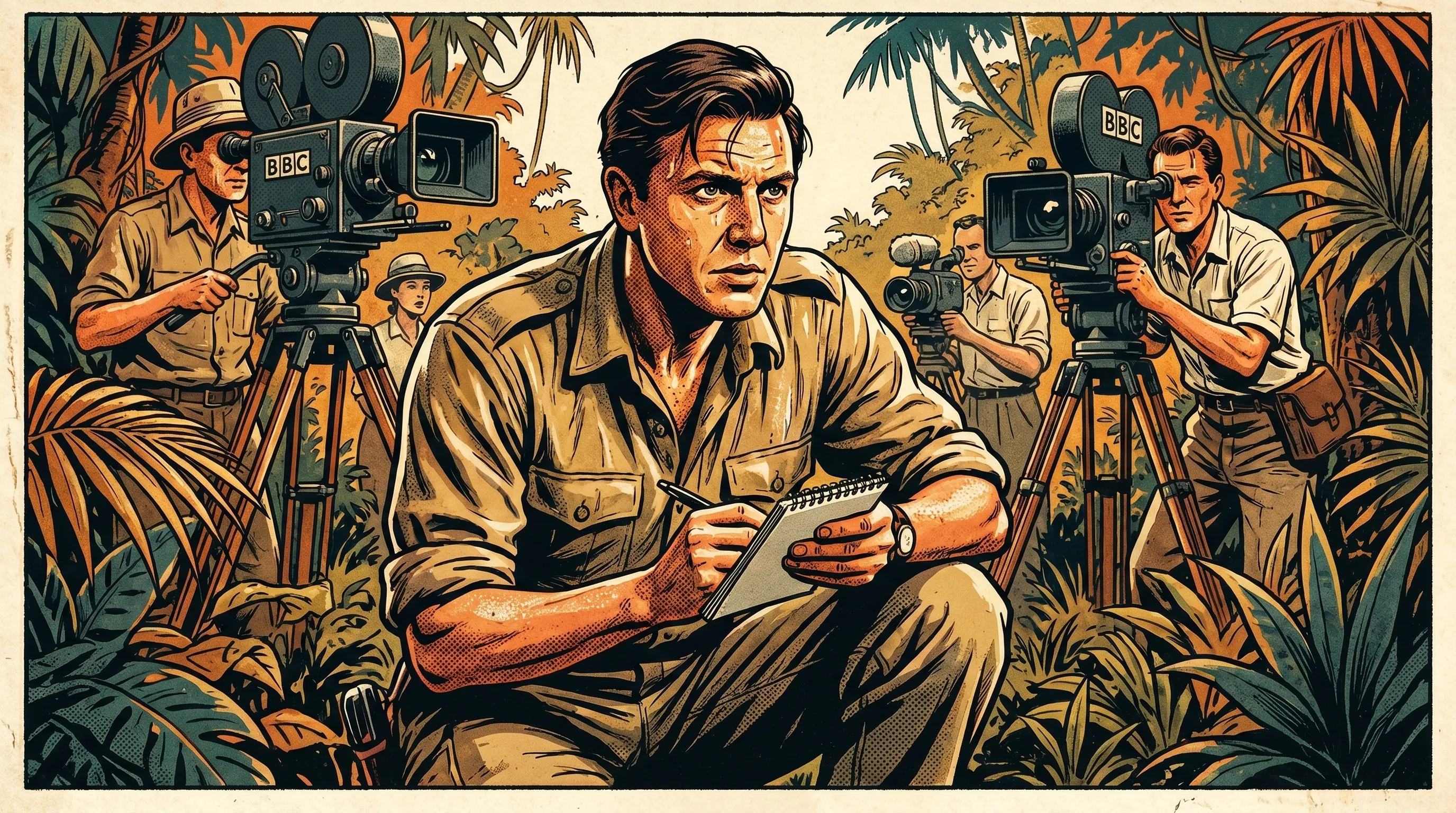
The breakthrough came in 1954 with Zoo Quest, a series that seems modest by later standards but was, at the time, quietly revolutionary. The premise was simple: travel to distant locations, film animals in their habitats, bring the footage home to an audience that had never seen anything like it. What made it new was the insistence on going there — on location-based filming rather than studio narration over stock footage. Attenborough was not describing the natural world from a desk. He was standing in it, sweating through his shirt, whispering to camera while something extraordinary happened ten metres away.
This sounds obvious now. It was not obvious then. Television in the early 1950s was largely a studio affair, cautious and contained. Zoo Quest helped pioneer the idea that wildlife television could be an expedition, that the audience could be taken somewhere rather than merely told about it. The format would evolve enormously over the following decades — better cameras, better logistics, better science — but the foundational move was Attenborough's: go to the animal, not the other way round.
It also established the Attenborough persona, the one that would prove so durable it became almost invisible. He was not the distant expert lecturing downward. He was the enthusiast who had gone to see for himself and couldn't wait to tell you what he'd found. The distinction matters. Enthusiasm is democratic. It assumes shared capacity for wonder. Lecturing assumes hierarchy. Attenborough chose the first, and the choice shaped everything that followed.
The Administrator Who Couldn't Stay Behind a Desk
Here the story takes a turn that reveals something important about the man. In 1965, Attenborough became controller of BBC Two — a senior administrative role that placed him at the centre of British broadcasting. He was good at it. Under his watch, BBC Two helped oversee the first colour television broadcasts in Europe. He backed programmes of extraordinary ambition and range: Civilisation, Kenneth Clark's magisterial survey of Western art; The Ascent of Man, Jacob Bronowski's history of scientific ideas; and, in a move that suggests a more catholic sensibility than he is sometimes credited with, Monty Python's Flying Circus.
He rose further, to director of programmes at the BBC — effectively the person responsible for everything the corporation broadcast. It was, by any conventional measure, the pinnacle. He walked away from it.
The decision is worth pausing on because it cuts against the grain of almost every career narrative in institutional life. Attenborough had power, prestige, the ability to shape an entire national broadcaster. He gave it up to go back to making programmes about animals. The conventional reading is that he missed fieldwork, which is true. But there is something more stubborn in the choice — a refusal to accept that managing other people's creativity was a higher calling than doing the work itself. He had seen what television could do with the natural world. He wanted to do more of it, not supervise others doing it. In an era that increasingly equates leadership with importance, Attenborough's retreat from management remains one of the most instructive career decisions in broadcasting history.
Life on Earth and the Architecture of Awe
The return to programme-making produced, in 1979, Life on Earth — the series that sealed Attenborough's reputation and, more importantly, established a template that natural history television still follows nearly half a century later. Over subsequent decades of global broadcast and rebroadcast, it reached an estimated audience in the hundreds of millions. It scaled natural history programming into global epic documentary form, demonstrating that a series about evolution and biodiversity could command the same audience as drama or sport if the storytelling was good enough.
What Attenborough understood, and what Life on Earth proved, was that wonder is not a soft emotion. It is a cognitive event. When a viewer watches a time-lapse sequence of a plant growing and feels something shift in their chest, that shift is not sentimentality. Attenborough built his entire method around engineering that moment. Every series that followed — The Living Planet, The Trials of Life, The Private Life of Plants, The Life of Birds, The Blue Planet, Planet Earth, Blue Planet II — was, at its core, an attempt to produce wonder at scale, reliably, for audiences who might never otherwise encounter the subject.
The technical ambition advanced in lockstep. Each new technology his productions adopted — macro cinematography, time-lapse, underwater filming, infrared cameras, eventually 4K — was pursued not for its own sake but because it allowed the audience to see something they could not previously see: the deep-ocean sequences of The Blue Planet, the aerial migrations of Planet Earth, the bioluminescent creatures of the abyss. Attenborough's technological appetite was always in service of revelation.
The Shift: From Celebration to Warning
For most of his career, Attenborough's project was essentially celebratory. Here is the world. Look how extraordinary it is. The tone was joyful, almost giddy at times — the voice of a man who could not believe his luck at being alive on a planet this interesting. It was not naive; he understood predation, competition, extinction. But the governing emotion was delight.
In his later decades, the tone changed. Gradually, then unmistakably, the celebration acquired an undertow of urgency. Climate change, habitat destruction, ocean damage, plastic pollution, biodiversity loss, the long-term fragility of ecosystems — these subjects moved from occasional mentions to central themes. The man who had spent fifty years saying look at this began saying we are losing this.
The transition carried unusual force precisely because of what had preceded it. Attenborough's environmental credibility derived not from ideological positioning but from personal observation across decades of travel and filming. He had seen the reefs. He had walked the forests. He had returned to locations filmed thirty years earlier and found them diminished. When he spoke about loss, it was not as an activist reading a brief but as a witness reporting what he had seen with his own eyes. The audience trusted him because he had earned that trust over half a century of showing them true things.
This is the mechanism that matters, and the one most at risk. The warning came from within a relationship already built on trust and pleasure. It is almost impossible to imagine how this strategy could be replicated by anyone starting from scratch today, in a media landscape that rewards outrage, speed, and tribal signalling over patient, cumulative, cross-generational trust.
Peer Review by Another Name
Dozens of species have been named after Attenborough — a fact that is sometimes treated as a charming footnote but is, on reflection, something stranger and more telling. Taxonomists name species after people to honour contributions to the field. When the honour is conferred dozens of times, across multiple phyla, by scientists working on different continents, it stops being a courtesy and becomes a statement about influence. Attenborough is not a taxonomist. He has never published a peer-reviewed paper on speciation. What he did was make the work of taxonomy — the slow, painstaking cataloguing of life — visible and valued to an audience of billions. The scientists who named those species after him were acknowledging a debt that is real but hard to quantify: he made people care about the existence of things they would never see.
His knighthood in 1985 was the establishment's version of the same recognition. But the species names are more interesting, because they come from the people who actually do the work of understanding biodiversity. They are a peer review of a different kind — not of a paper, but of a life's effect.
The Question He Leaves Behind
At one hundred, Attenborough's career in broadcasting spans more than seven decades. The numbers are staggering, the legacy is immense, and none of it is the point. The point is a question, and it is not a comfortable one.
Attenborough's method — wonder first, trust second, difficult truth third — worked. It worked on a scale no other environmental communication strategy has approached. Blue Planet II did more to shift public attitudes on plastic pollution than a decade of policy papers and activist campaigns. The mechanism was not argument. It was beauty, followed by grief at beauty's destruction. You cannot grieve what you do not love, and you cannot love what you have never been shown. Attenborough showed people. That was the work of a lifetime.
The question is whether the method can outlive the man. Not because Attenborough is irreplaceable as a presenter — he is, but presenters are not the bottleneck. The bottleneck is the strategy itself: the decades-long, patient, trust-building, wonder-driven approach to shifting how a civilisation thinks about its relationship to the living world. That strategy requires a media ecosystem willing to invest in slow returns — institutions funding decade-spanning projects, audiences willing to sit still and be astonished before being asked to act.
Every one of those conditions is under pressure. Attention spans fragment. Institutions retreat to cheaper formats. The environmental conversation has fractured into political tribes, each with its own preferred messengers and its own resistance to the other side's. Attenborough bridged those tribes because he predated them — because he built his audience before the fracture, in an era when a single programme could reach a nation. That is not a strategy anyone can repeat. It is a historical circumstance.
And yet. The footage exists. The series exist. A child who watches Life on Earth today will feel the same wonder a child felt in 1979. The method is archived, even if the conditions that created it are gone. What Attenborough proved — and this may be the most important thing he proved — is that human beings are wired for wonder at the natural world, that this wonder is not a luxury but a precondition for care, and that the shortest distance between ignorance and action runs through beauty, not guilt.
He is a hundred years old. He has been right about this for longer than most of us have been alive. The question now is not whether we remember him, but whether we remember what he showed us — and whether, without that voice dropping half a register and leaning toward the camera, we are still capable of being astonished enough to act.