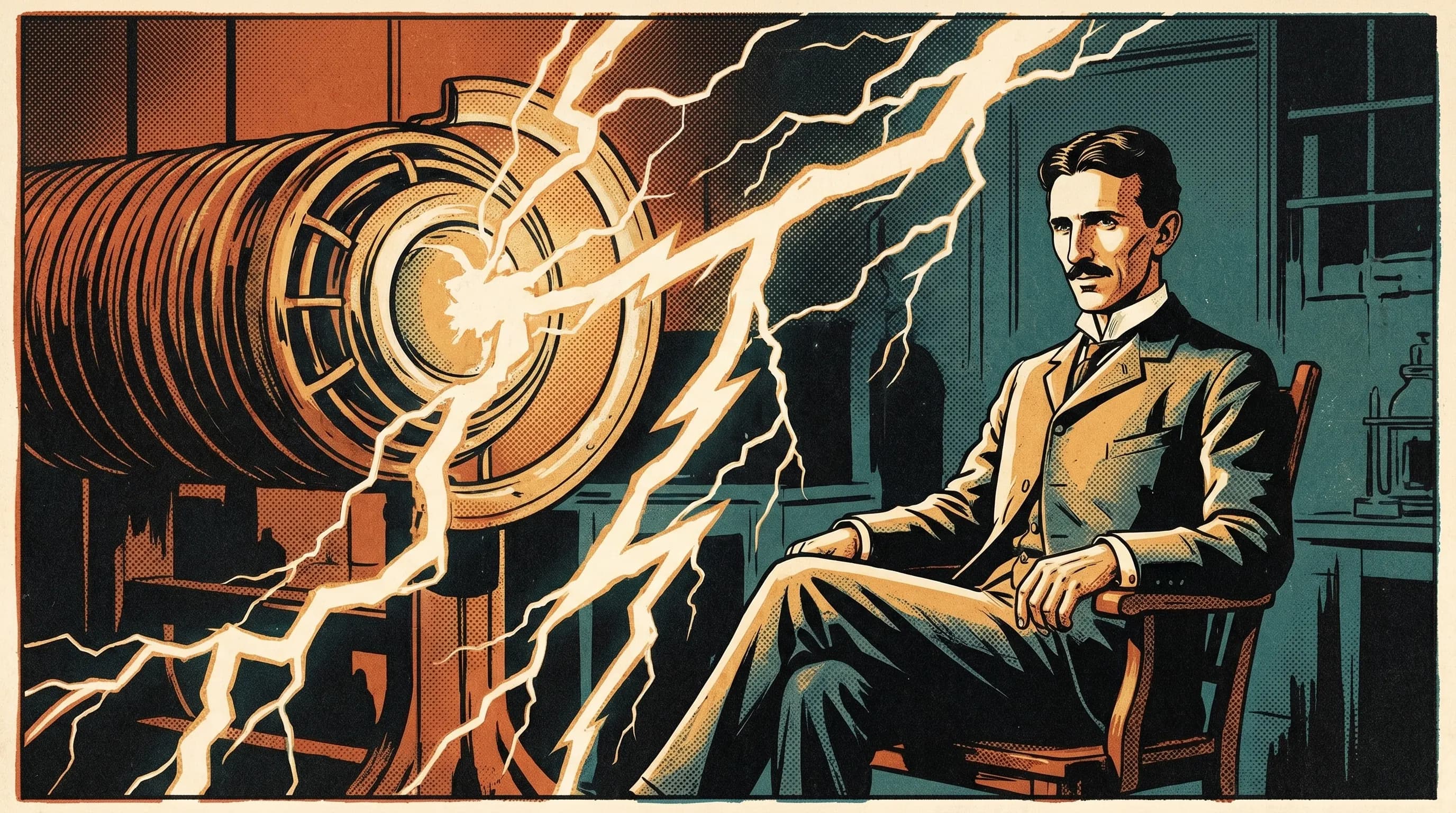
In the winter of 1891, a tall, gaunt Serbian engineer stood before an audience and let electricity pass through his own body. Lamps glowed in his hands. Current arced visibly around him. The crowd — reporters, industrialists, fellow inventors — watched a man who appeared to have domesticated lightning itself. This was not a carnival trick. Nikola Tesla was demonstrating principles of high-frequency alternating current that he had spent years refining, and the theatricality was deliberate. He understood, perhaps better than any inventor of his era, that the future had to be performed before it could be financed.
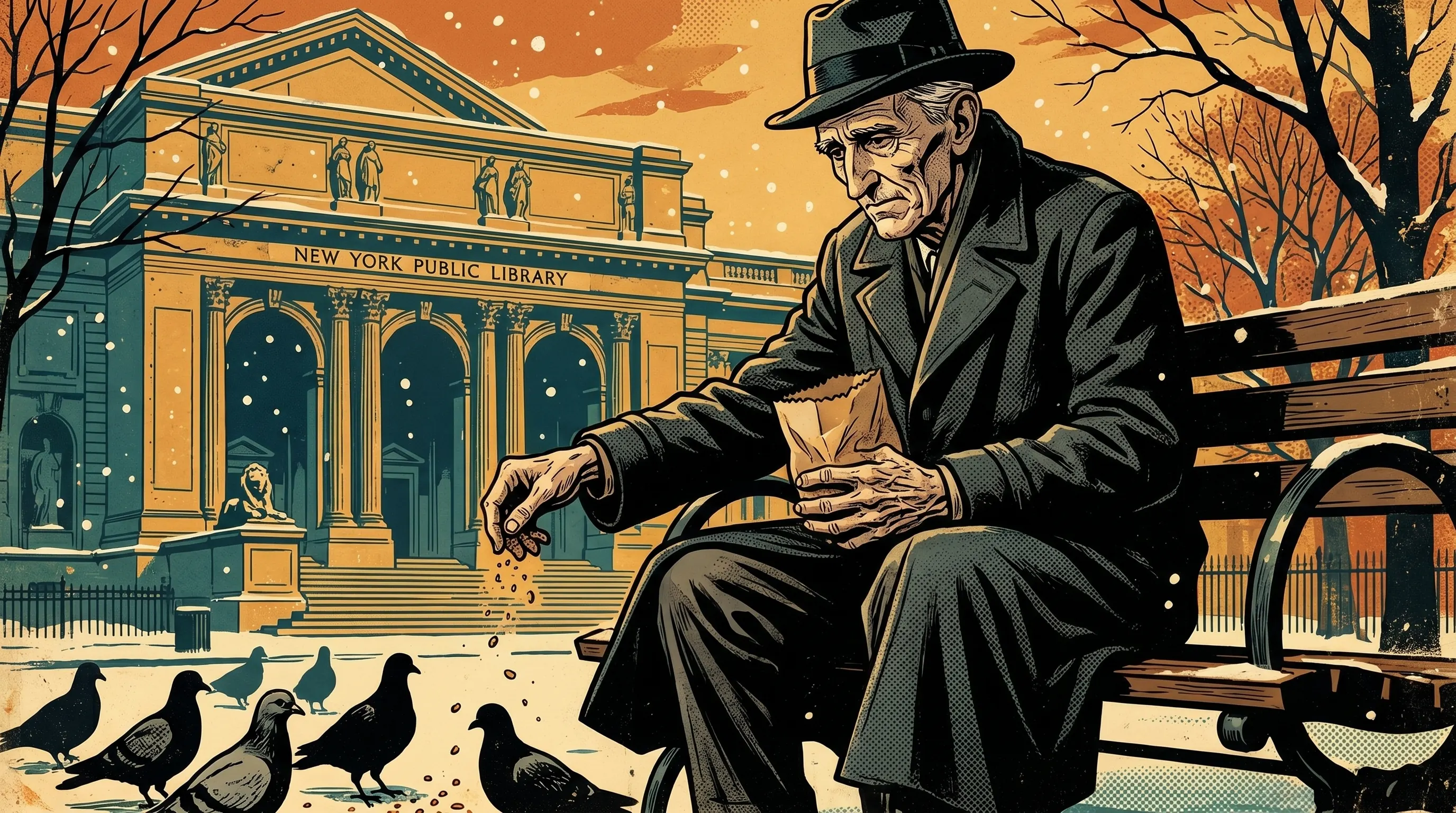
What makes Tesla's life extraordinary is not the mythology that has calcified around it — the "mad genius," the "forgotten wizard" — but the documented reality, which is stranger and more instructive than the legend. He was a man who saw the architecture of the modern electrical grid decades before it existed, fought to build it against ferocious opposition, succeeded on a scale that reshaped civilisation, and then spent his final years alone in a New York hotel room, feeding pigeons and speaking of weapons that would end all war.
The Priest's Son Who Saw Rotating Fields
Tesla was born in 1856 in Smiljan, a village in what was then the Austrian Empire and is now part of Croatia. He was of Serbian origin, the son of an Orthodox priest. His mother, though without formal technical education, was practically inventive — a woman who fashioned household tools and devices with her hands. Tesla would later credit her influence on his own instinct for mechanism and design. The boy inherited both impulses — the intellectual tradition and the instinct for making things — and would spend his life trying to reconcile them.
He studied engineering-related subjects in Graz and Prague, though he did not complete a conventional degree path. This is worth pausing on. Tesla entered the world of professional invention without the institutional stamp that credentialled most of his peers. He was, from the beginning, operating slightly outside the system — absorbing its knowledge, rejecting its gatekeeping. Whether this was by choice, by circumstance, or by temperament is unclear. What is clear is that he learned enough to see something that eluded the formally trained engineers around him: the rotating magnetic field.
The concept was foundational. A rotating magnetic field could drive an induction motor without the sparking, unreliable commutators that plagued direct-current machines. It was elegant, efficient, and — crucially — it pointed toward a fundamentally different way of generating, transmitting, and using electrical power. Tesla didn't just imagine the rotating field. He understood its implications for an entire system: polyphase alternating-current transmission, from generator to wire to motor. He saw the whole circuit before most engineers had grasped the first principle.
Edison, Westinghouse, and the War of Currents
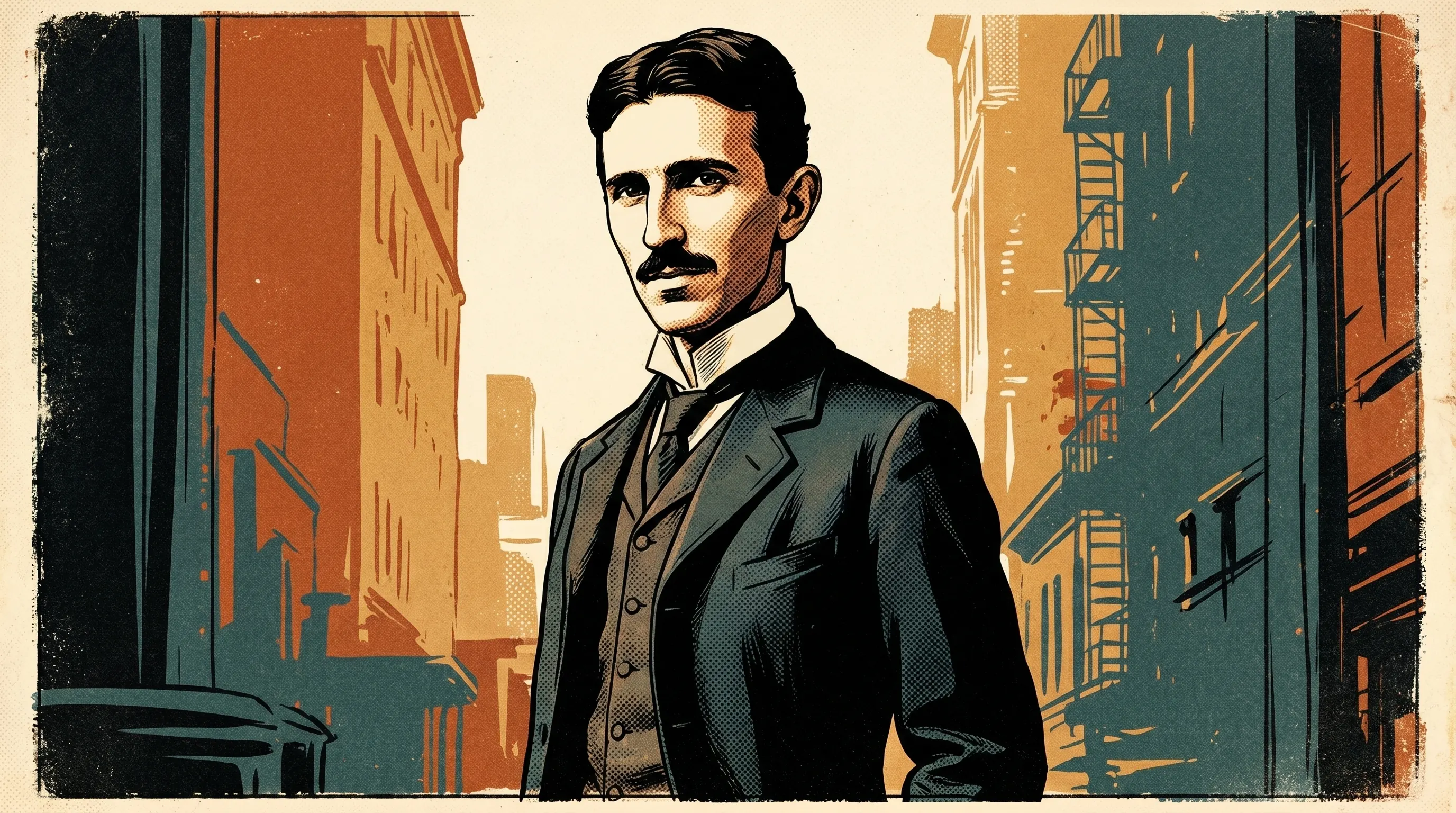
Tesla emigrated to the United States in 1884 and briefly worked for Thomas Edison. The partnership failed quickly. The reasons have been mythologised into a personal grudge, but the deeper incompatibility was philosophical. Edison was a committed advocate of direct current — a system that worked, that he had invested in, and that he understood intimately. Tesla believed alternating current was superior for the problem that mattered most: transmitting electrical power over long distances. DC lost energy rapidly over distance. AC, with transformers stepping voltage up for transmission and down for use, could move power efficiently across miles. The physics was on Tesla's side. The money, at first, was not.
What changed was George Westinghouse. The industrialist recognised the commercial potential of Tesla's AC patents and acquired the rights to them. This alliance — Tesla's inventions, Westinghouse's capital and manufacturing capacity — created the infrastructure to challenge Edison's DC empire directly. The contest that followed, often called the War of Currents, was bitter, public, and consequential. Edison campaigned against AC as dangerous. Westinghouse and Tesla pressed forward with demonstrations and deployments.
Two moments crystallised the victory. The 1893 World's Columbian Exposition in Chicago was illuminated using Tesla's AC system, a spectacle that made alternating current visible to millions. And the Niagara Falls AC power project proved the technology could work at industrial scale, generating and transmitting hydroelectric power in a way that DC simply could not match. AC became the global standard for electrical distribution. It remains so. Every light switch, every wall socket, every power grid on earth descends from the system Tesla envisioned and patented.
Staging the Invisible
Tesla's public demonstrations — current flowing through his body, lamps blazing without wires — were not vanity. They were strategic. He was, at various points in his career, highly visible, socially connected, and acutely aware of the power of public image. In an era when investors funded what they could see and reporters shaped what the public believed, Tesla's ability to stage the impossible was a genuine professional skill. He made the invisible — electromagnetic fields, resonant frequencies, wireless transmission — visible and visceral.
The Tesla coil, which he invented in 1891, was both a serious instrument and a perfect stage prop. It produced spectacular high-voltage, low-current discharges that looked like captured lightning. But beneath the spectacle, the coil had real technical importance. It became a key component in radio development and electrical experimentation, a tool for exploring the behaviour of high-frequency currents that would occupy Tesla for the rest of his working life.
His contributions to remote control and radio-related development extended the implications of his electrical work into communication and signal transmission. Tesla was not the only figure working in this space — the history of radio is crowded with competing claims — but his experimental work was substantive, not speculative. He built devices, filed patents, demonstrated results. The problem was never whether Tesla could invent — it was what happened after.
Colorado Springs and the Edge of the Possible
Tesla relocated to Colorado Springs for a period of intensive experimental work that remains among the most remarkable episodes in the history of electrical engineering. Working in a purpose-built laboratory, he produced giant electrical discharges — artificial lightning bolts that reportedly crackled across dozens of feet. He conducted experiments in resonance, exploring how electromagnetic energy could be amplified and transmitted. And he pursued, with increasing ambition, his vision of wireless transmission: the idea that electrical energy itself could be sent through the earth or atmosphere without wires.
Colorado Springs was Tesla at his most characteristic. The experiments were genuinely novel. The scale was extraordinary. The underlying physics was real. And the practical path from experiment to deployable system was never quite established. Tesla's gift was seeing the destination; his weakness was underestimating the distance between a laboratory demonstration and a working commercial technology. In Colorado Springs, both qualities operated at full intensity.
What he achieved there was enough to convince himself — and, for a time, his investors — that wireless power transmission on a global scale was achievable. This conviction led directly to the most ambitious and most devastating project of his career.
Wardenclyffe: The Tower That Fell
Tesla built the Wardenclyffe facility on Long Island as the centrepiece of what he called a "world system" — a network for wireless communication, signal transmission, and, in his most expansive descriptions, the global distribution of electrical energy without wires. The tower was designed to transmit through the earth itself, using the planet as a conductor.
The concept was breathtaking. It was also, in its full scope, beyond what the technology of the era could deliver. Rival technologies — particularly Marconi's more modest but functional radio systems — were advancing in practical, fundable directions. Tesla's vision required patience, sustained capital, and tolerance for uncertainty that his investors did not possess. Wardenclyffe lost its financing. The project collapsed. The tower was eventually demolished.
The failure of Wardenclyffe is often narrated as a tragedy of genius denied by philistine capitalists. The reality is more interesting and more useful. Tesla struggled throughout his career with sustained financing, institutional control, commercial protection, and disciplined execution within business constraints. He was not merely unlucky. He was constitutionally ill-suited to the compromises that turn inventions into industries. Edison, for all his technical limitations, built an industrial empire. Westinghouse built Westinghouse. Tesla built astonishing prototypes and then watched other people build the systems that used his ideas.
Tesla's mind worked at a level of abstraction and ambition that made the incremental, political, organisational work of commercialisation feel beneath him — or simply invisible to him. The rotating magnetic field was a complete vision. The AC system was a complete vision. Wardenclyffe was a complete vision. Tesla could see the future. He could not always administer it.
The Long Diminishment
Tesla's later years were marked by financial trouble, increasing eccentricity, and isolation. The man who had once dined with the wealthy and commanded front-page coverage found himself living in a succession of New York hotels, often behind on his bills. He developed compulsions and unusual habits that attracted attention and, increasingly, pity. He made claims about futuristic weapons and dramatic technological visions that grew more grandiose as his practical circumstances shrank.
The honest reading of this period is sadder and less satisfying than the myth. Tesla's decline was not simply the world's failure to recognise his brilliance. It was the consequence of a life organised around invention without adequate attention to the structures that sustain inventors. He had no institution behind him, no university post, no corporate laboratory, no pension, no intellectual estate managed for long-term value. He had patents, many of which had expired. He had ideas, many of which could not be tested without resources he did not have. He had his name, which still carried weight but no longer opened chequebooks.
He died in New York in 1943, alone in a hotel room. He was eighty-six years old.
The Unusual Quality
What made Tesla genuinely extraordinary was not eccentricity, and it was not suffering. It was the quality of his technical imagination. He thought in complete systems. The rotating magnetic field was not, for Tesla, a clever piece of physics. It was the key to a new way of organising electrical power generation, transmission, and use — an integrated architecture that replaced Edison's model not component by component but wholesale. He saw the polyphase AC system the way an architect sees a building: as a unified structure in which every element serves every other.
This systems-level vision is rare in any era. It was extraordinary in the 1880s, when electrical engineering was still a young discipline and most practitioners were working empirically, solving individual problems without a governing framework. Tesla supplied the framework. Tesla saw the right answer first, saw it whole, and fought to make it real.
His other quality — the one that both enabled and eventually undermined him — was an absolute refusal to think small. Every problem Tesla encountered was, in his mind, a doorway to a larger problem. The rotating field led to AC transmission. AC transmission led to wireless experimentation. Wireless experimentation led to the vision of a global energy network. Each step was technically grounded. Each step was also more ambitious than the last. And at some point, the ambition outpaced the available technology, the available capital, and the available patience of the world around him.
What Tesla Surfaces
The life of Nikola Tesla poses a question that has only grown more urgent in the century since his death: what do we owe to the kind of mind that sees furthest but finishes least? The modern innovation economy is built, in many ways, on Tesla's AC system — and equally on Edison's ability to commercialise, manufacture, and sell. We celebrate the visionary. We fund the executor. And we have never quite figured out how to build institutions that serve both.
Tesla's tragedy was not that the world ignored him. For decades, the world paid close attention. His tragedy was that the distance between what he could see and what he could build grew wider with each passing year, and no structure existed to bridge the gap. He was not an academic, not a corporate researcher, not an entrepreneur in any modern sense. He was an independent inventor in an age that was rapidly making independent invention impossible at the scale he demanded.
The electrical grid that powers the world is his monument — invisible, ubiquitous, and taken entirely for granted. The tower on Long Island that might have changed communication forever is rubble and memory. Between those two facts lies everything interesting about genius, ambition, and the machinery we build — or fail to build — to catch the people who see what the rest of us cannot.