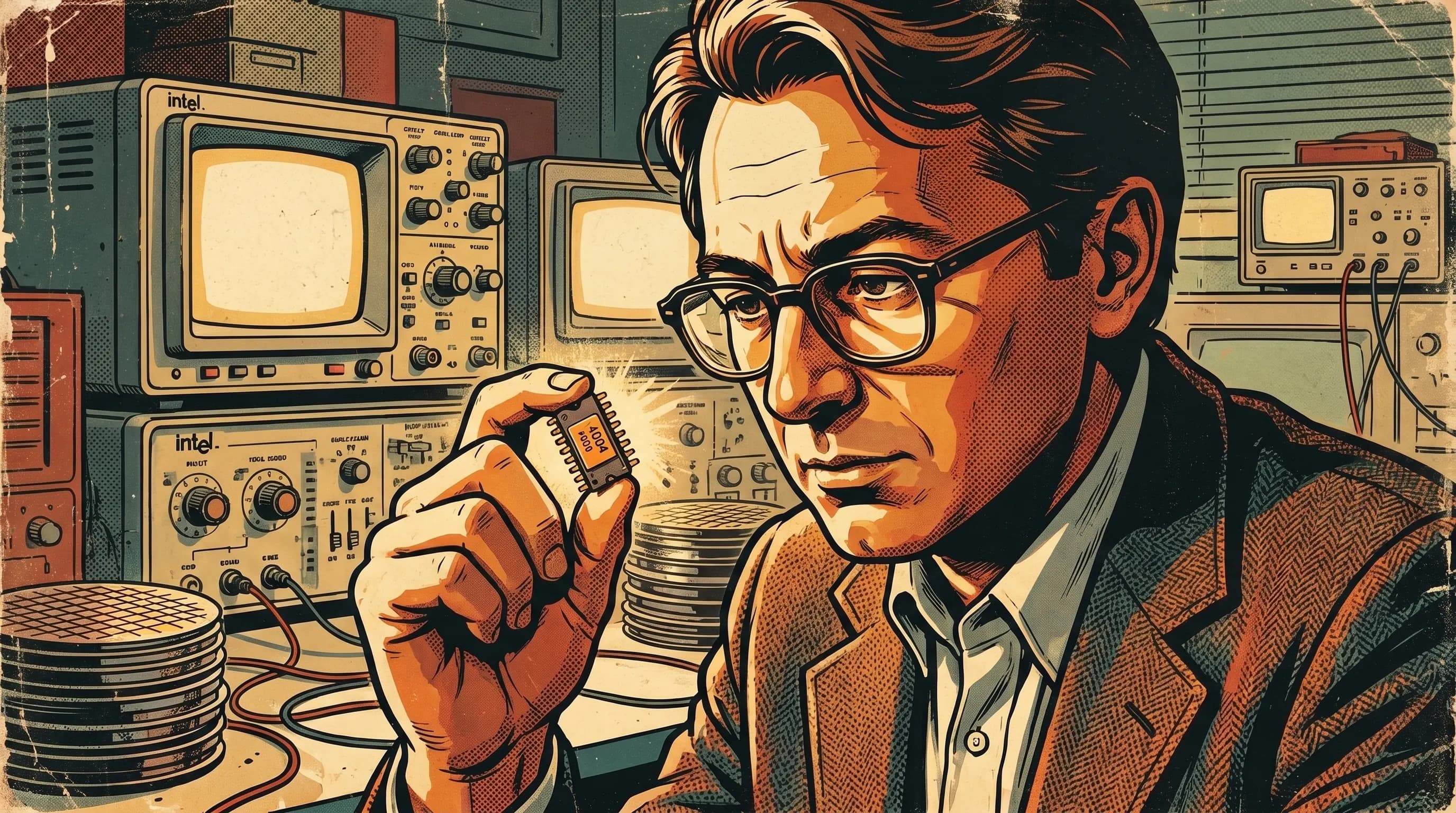
There is a photograph of Federico Faggin holding a chip between his thumb and forefinger, squinting at it the way a jeweller examines a setting. The chip is tiny. The implications were not. Faggin had just led the effort to build the Intel 4004, the world's first commercial microprocessor, and in doing so had compressed onto a sliver of silicon the logic architecture that would eventually underpin every phone, laptop, server farm, and autonomous vehicle on earth. And the object between his fingers would, over the next half-century, become the substrate on which an entire civilisation would attempt to build a thinking machine.
What nobody in that room could have predicted — least of all the semiconductor industry that would lionise him — is that Faggin would spend the latter decades of his life arguing, with increasing precision and stubbornness, that the machine he helped birth cannot think at all. Not "not yet." Not "not in the way we do." Cannot. Faggin is not a philosopher parachuting into the AI debate from the humanities department. And he is telling anyone who will listen that what silicon does is not what consciousness is.
This is the story of how the man who gave the world the microprocessor came to regard the world's most powerful metaphor — the brain as computer — as the real bug in the system.
Vicenza to Padua: The Physicist Who Wanted to Touch Things
Faggin was born in 1941 in Vicenza, a city in the Veneto region of northeastern Italy, closer to Venice than to Rome, and shaped by the particular post-war Italian mixture of classical education, industrial ambition, and Catholic metaphysics. He studied physics at the University of Padua, graduating in 1965 — a choice that mattered, because physics, unlike electrical engineering, forced a reckoning with foundations. Padua doesn't just teach you to build circuits; it teaches you to ask what matter is. That question would take forty years to detonate, but it was planted early.
His first professional work was with MOS (metal-oxide-semiconductor) process technology at SGS Fairchild in Italy, where he got his hands on the fabrication techniques that were, at the time, the bleeding edge of solid-state electronics. MOS technology was the route to miniaturisation — the path from room-sized machines to pocket-sized ones — and Faggin was learning its grammar at the source. But Italy in the mid-1960s was not where the semiconductor revolution was going to happen. California was. In 1968, Faggin moved to the United States, joining Fairchild Semiconductor in Silicon Valley.
At Fairchild, he did something foundational: he developed MOS silicon gate technology, a process innovation that became the basis for modern integrated circuits and, eventually, CMOS electronics — the architecture that runs virtually everything digital today. This was not a theoretical contribution. It was a manufacturing breakthrough, the kind of work that requires a physicist's understanding of materials and an engineer's obsession with yield and reproducibility. Faggin could think abstractly and build concretely, and that combination would define everything that followed.

The 4004: Compressing Logic Onto a Fingernail
In 1970, Faggin joined Intel. The company was young, the industry was younger, and the problem on the table was audacious: could you put an entire central processing unit onto a single chip? The project that became the Intel 4004 is often told as a team story — and it was. The Kyoto Prize, which Faggin received in 1997, was shared with Ted Hoff, Stan Mazor, and Masatoshi Shima, each of whom contributed essential pieces. But Faggin's role was implementation and development leadership — he was the one who turned the architecture into working silicon. Faggin built the building.
The 4004, released in 1971, was the world's first commercial microprocessor. — numbers that are laughable now but were, at the time, a compression of capability that redefined what was possible. A general-purpose processor on a single chip meant that computing could escape the mainframe. It could become personal. It could become ubiquitous. The 4004 did not merely advance an industry; it created the conditions for an entirely new relationship between humans and machines.
Faggin didn't stop there. He played a key role in the Intel 8008 and 8080 — processors that pushed the architecture further toward what would become the personal computer. But by 1974, he had left Intel, frustrated, as many founders-within-companies eventually are, by the gap between what he had built and the credit and autonomy the institution afforded him.
Zilog, Synaptics, Foveon — The Serial Builder
What Faggin did next confirms something about his temperament: he was not a one-chip man. He co-founded Zilog, where he conceived and led the development of the Z80 microprocessor — a chip that became one of the most influential of the personal computing era, powering early machines and embedded systems across the globe. The Z80 was elegant, practical, and absurdly widely adopted. If the 4004 proved the concept, the Z80 proved the market.
Later, Faggin co-founded Synaptics, a company that pioneered touchpads and touchscreens — the interface technology that made laptops feel navigable and, eventually, made smartphones possible. He also led Foveon, which worked on image sensor technology. The pattern is striking: Faggin kept moving toward the boundary between silicon and human experience. Each venture brought the machine closer to the body, closer to the senses, closer to the question he had not yet articulated but was clearly circling: what happens at the interface between a signal and a feeling?
The accolades accumulated. The Kyoto Prize in 1997. The National Medal of Technology and Innovation in 2009. The Enrico Fermi Prize in 2014. Recognition from the Computer History Museum. Faggin had, by any measure, one of the most consequential careers in the history of computing. He had built the foundation, then built on the foundation, then watched others build on what he had built on the foundation, until the entire digital world rested, in some traceable sense, on work his hands had touched.
And then he turned around and said: none of this is consciousness.

The Pivot: When the Builder Questions the Blueprint
Faggin experienced a period of personal dissatisfaction despite extraordinary professional success, and that some form of transformative inner experience reoriented his priorities. The details are his own. The result is public.
Faggin began to argue — in interviews, in his book Silicon: From the Invention of the Microprocessor to the New Science of Consciousness, and through the Federico and Elvia Faggin Foundation, which he co-founded to support consciousness research — that the prevailing scientific worldview had made a catastrophic category error. The error, as he frames it, is this: materialism assumes that consciousness is produced by the brain, the way heat is produced by combustion. Faggin says no. Consciousness, he argues, is not an output of physical processes. It is a primitive or foundational aspect of reality itself — something that was there before brains evolved to channel it, and something that will be there when every chip he ever designed has corroded to dust.
This is not mysticism dressed in a lab coat. Faggin's argument is philosophically specific. He points to qualia — the felt texture of taste, love, pain, joy, presence — as evidence that consciousness is deeper than any physical description can capture. You can describe every wavelength of light that enters the eye when you see red, map every neuron that fires, trace every signal to every cortical region, and you will still not have explained what it is like to see red. The "what it is like" is the hard problem of consciousness, and Faggin believes it is not a problem that more computation will solve, because computation is not the kind of thing that has a "what it is like."
The AI Argument: Symbol-Shuffling Is Not Understanding
This is where Faggin's biography collides with the present moment, and where the editorial angle sharpens. We are living through the most aggressive deployment of artificial intelligence in history. Large language models produce text that reads like thought. Image generators produce art that looks like vision. Autonomous systems make decisions that feel like judgement. The implicit claim is that these systems are approaching something like understanding.
Faggin says they are not. His argument is precise: AI is deterministic or probabilistic computation. It processes symbols and probabilities. It does not experience meaning. Statistical fluency — the ability to predict the next word, the next pixel, the next move — creates the illusion of understanding, but the illusion is on our side, not the machine's. The computer can process symbols without knowing what the symbols mean. This is not a limitation of current hardware or current algorithms. It is a limitation of the category. Meaning, Faggin argues, is not present inside computation itself.
He goes further. Private conscious experience — the thing that makes you you and not a very sophisticated recording of you — cannot be copied the way software can be copied. You can duplicate a program perfectly. You cannot duplicate a self. The asymmetry is not a technical challenge awaiting a clever solution. It is a signpost pointing toward a fundamentally different ontology, one in which matter, mind, and spirit are intertwined rather than isolated.
This puts Faggin in direct opposition to the working assumptions of most of the AI industry — and, more pointedly, in opposition to the metaphor that industry has used since Turing: the brain is a computer, the mind is software, and intelligence is computation. Faggin built the computer. He is now telling you the metaphor is broken.
The Heresy and Its Limits
It is worth being honest about the contested ground here. Faggin's views on consciousness are philosophically disputed. The hard problem of consciousness is genuinely hard — there is no consensus, and the positions range from eliminative materialism (consciousness is an illusion) to panpsychism (consciousness is everywhere) to various intermediate positions that try to rescue physicalism without ignoring qualia. Faggin leans toward something in the panpsychist neighbourhood, though his framing — consciousness as foundational, reality as irreducible to deterministic mechanism, free will as a real feature of conscious being — is his own synthesis, not a straight import from any single philosophical tradition.
His critique of scientism — the civilisational worldview that mistakes measurable mechanism for the whole of reality — is sharp and, in certain quarters, unwelcome. Scientism is not the same as science, and Faggin is careful about the distinction: he is not anti-science. He is anti the claim that science, as currently practised, has the tools to explain everything that matters. Whether you find this liberating or frustrating depends largely on your prior commitments. But it is difficult to dismiss the argument when the person making it spent fifty years inside the machine and is not arguing from ignorance of how it works. He is arguing from intimate, grain-level knowledge of exactly how it works — and from the conviction that what it works with is not what we are.
The blind spot, if there is one, is specificity of mechanism. Faggin is brilliant at saying what consciousness is not — not computation, not mechanism, not reducible to physics as currently understood. He is less precise about what consciousness is, in a way that would allow the claim to be tested, falsified, or built upon by others. The foundation he established funds research, which is admirable. But the hard sciences advance by producing predictions, not only by producing critiques of other predictions. The question is whether Faggin's framework will generate new science or remain a powerful philosophical objection to someone else's science.
The Fracture in the Founding Generation
What makes Faggin's late-career stance genuinely significant — beyond the philosophical interest — is what it reveals about a fracture in the founding generation of the digital age. The people who built the infrastructure of modern computing are not unanimous about what they built. Some, like many in the current AI industry, see the trajectory as clear: more computation, more data, more parameters, and eventually something that deserves to be called intelligence. Others — and Faggin is the sharpest, most credentialled voice among them — see the trajectory as a category error compounding at scale.
This is not a disagreement about engineering. It is a disagreement about ontology — about what kind of thing a mind is, and whether the word "intelligence" means anything when divorced from experience. Faggin's career gives him a unique authority to press the question, because he cannot be accused of not understanding the technology. He is the technology, or at least its earliest and most consequential physical expression. When he says the machine does not understand, he is speaking as the machine's maker, not its competitor.
The immigrant physicist from Vicenza who moved to California in 1968, who compressed logic onto a fingernail, who built the chip that built the industry that built the world we now inhabit — that man is now eighty-four years old, and his answer is no. The answer may be wrong. But an industry that has spent sixty years building minds out of sand is only now being forced to reckon with whether sand is enough — and the person forcing the reckoning is the one who taught the sand to think. That is the central drama of an industry that has spent sixty years building minds out of sand and is only now being forced to reckon with whether sand is enough.