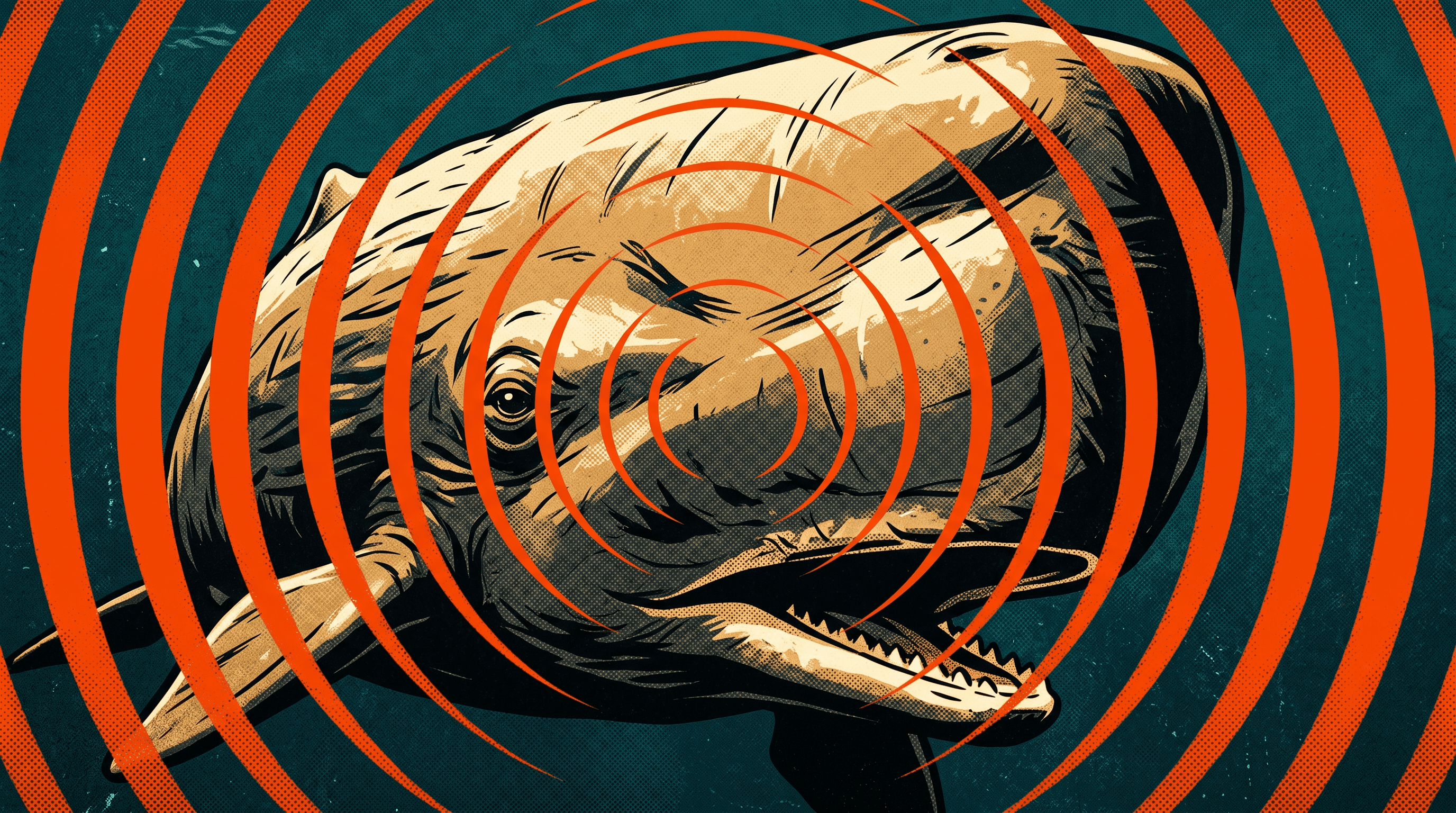
Every few decades, humanity draws a bright line between itself and the rest of the animal kingdom, labels it "language," and then acts personally victimised when something with flippers saunters up to it and starts tapping out what looks suspiciously like a sentence.
What the Whales Are Doing
Sperm whales produce clicks. This much has been known for a long time. But scientists have spent decades eavesdropping on those clicks with increasingly expensive equipment, and the picture that has emerged is considerably more uncomfortable than "animal makes noise." It's more like "animal makes noise that keeps passing tests it was never supposed to pass."
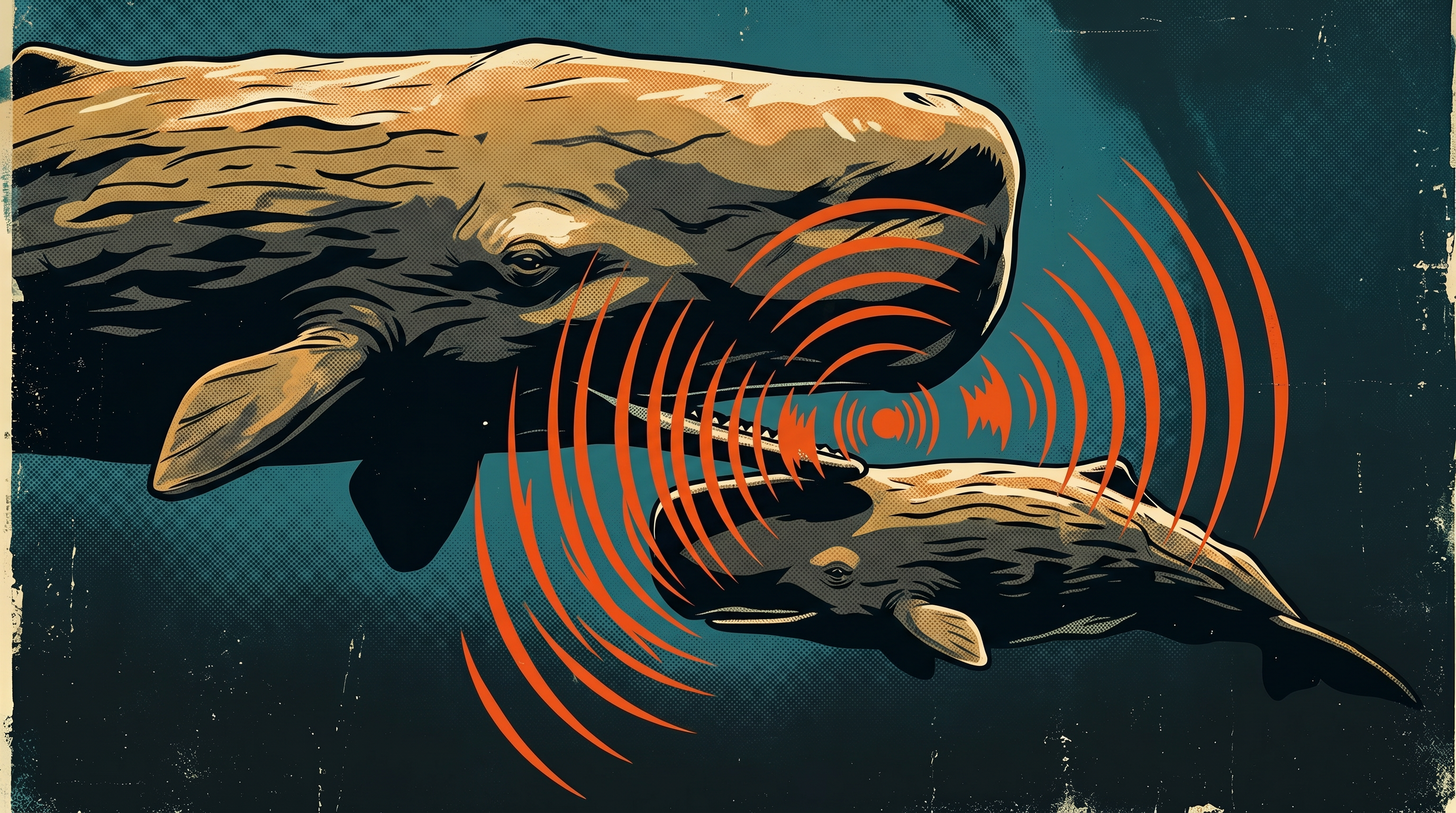
The clicks come in patterned bursts called codas. Long-term acoustic analysis has shown these codas are not random noises or simple distress flares. Different sperm whale clans possess distinct vocal identities — what researchers describe as "accents," though nobody has yet determined whether some of them sound posh. The whales pass these vocal styles across generations. Calves learn them from their mothers, who learned them from theirs, in matrilineal social groups that maintain clan-like organisation over years. It is, functionally, culture. We just don't like calling it that at dinner parties.
Between 2024 and 2026, the findings got sharper. Machine-learning analysis has suggested that sperm whale codas may be combinatorial — meaning whales can build larger messages from smaller recurring units. Researchers have claimed the presence of something resembling vowel-like distinctions, acoustic contrast patterns in the clicks that function the way subtle tonal shifts carry different meanings in languages like Mandarin Chinese. Put plainly: the whales appear to have building blocks, and they appear to be assembling them into things that weren't in the original box.
The Convenient Definition
Here is where it gets interesting — not because of what the whales are doing, but because of the quiet bureaucratic panic happening on the human side of the clipboard.
The standard checklist for "real" language includes syntax, reference, grammar, recursion, displacement, symbolic abstraction, and open-ended generativity. It is a formidable list. It is also, if you squint at its history, a list that has grown conspicuously longer every time a non-human species has ticked off a box. Like an HOA that keeps adding bylaws the moment someone's flamingo technically complies with the existing ones.
Combinatorial structure — the ability to combine smaller units into larger meaningful sequences — is considered one of the defining features of human language. It's the reason linguists don't call birdsong "language" and don't lose sleep over prairie dog alarm calls. And now machine-learning models are flagging combinatorial patterns in whale codas. The prairie dogs could never. The whales apparently could all along.
The response from the sceptics will be predictable and, in its own way, wonderfully choreographed. The goalposts will move. They always do. Perhaps combinatorial structure alone isn't enough — you need recursion too. Or perhaps you need proof of displacement, the ability to talk about things that aren't physically present. Or symbolic abstraction. The capacity to assign arbitrary sounds to arbitrary meanings. Each new requirement is perfectly defensible on its own terms. Taken together, they start to look less like a rigorous scientific framework and more like a bouncer at an exclusive club who keeps finding new reasons your name isn't on the list — while you're standing there in a nicer suit than anyone inside.
How to Build a Language (and Why Whales Make It Weird)
Think of human language as a LEGO set. You have individual bricks (sounds, phonemes), and you snap them together into words, and you snap words together into sentences, and the whole system is "open-ended" — you can build a castle or a spaceship or a very small duck, all from the same box of parts. We are extremely proud of this. We will not shut up about it, which is itself a demonstration of the technology.
For most of history, we assumed animals had something more like a Fisher-Price toy with one button. Press it, it makes one sound, the sound means one thing. A vervet monkey screams "eagle" and everyone runs. Useful, but it's not LEGO. It's a doorbell. Respectable, but nobody's writing an epic poem on a doorbell.
What sperm whale codas are starting to look like is something awkwardly in between — and "awkwardly" is doing heroic load-bearing work in that sentence, because our entire classification system has exactly two categories: "language" and "not language." There is no comfortable middle shelf. There is no participation trophy. You're Shakespeare or you're a smoke alarm, and we have been extremely clear about which side of that line everything with gills, fins, or a blowhole belongs on.
The machine-learning models being used to crack whale communication are, notably, the same pattern-detection approaches powering modern language technologies. Researchers essentially pointed the same kind of tools we built to process human speech at whale clicks and said, "Find structure." The tools found structure. Not random structure. Not simple structure. Combinatorial structure, with what appear to be phonetic contrasts. The tools did not get the memo about whales being on the wrong side of the line.
Meanwhile, the whales themselves are doing things that make the "it's just instinct" dismissal feel increasingly like a man insisting his house isn't on fire while standing in a bathrobe on the lawn. Researchers have linked certain vocal changes to socially complex events. In one observed case, a collaborative birth was witnessed in which unrelated females appeared to help bring a newborn to the surface — and vocal shifts accompanied the event. These are animals engaged in cooperative behaviour, long-term social learning, and intergenerational cultural transmission. They are not pressing a doorbell. They are, at minimum, doing something with their LEGO bricks that we haven't fully figured out yet — and they seem unbothered by our confusion.
The research effort itself tells you something about the stakes. There is now a dedicated search for cetacean intelligence — CETI, a deliberate echo of SETI, the search for extraterrestrial intelligence. We built an entire scientific infrastructure to listen for alien language from across the galaxy while spending centuries harpooning the most loquacious animals on our own planet for lamp oil. The irony is so heavy it could sink a whaling ship. The whaling ship, in this metaphor, is also irony.
The Story We're Really Protecting
The honest version of our "language" definition has never been purely linguistic. It has always been partly — perhaps mostly — existential. Language is the thing that makes us special. Language is the moat around the castle of human uniqueness, and we have been filling that moat with increasingly exotic water for about fifty years now. Consciousness, tool use, culture, empathy — we've had to surrender or at least share each of these with other species over the past century, each time with the resigned air of a poker player showing a losing hand. Language is the last redoubt. Language is the chip we will not put back on the table.
And so every criterion for "real" language functions as both a scientific standard and a psychological insurance policy. Syntax? We'll grant that some animals have rudimentary ordering rules — but do they have grammar? Grammar? Fine, maybe — but do they have recursion? Recursion? Well, do they have symbolic abstraction? The requirements multiply not because the science demands it, but because the conclusion is intolerable. If a 40-tonne cetacean turns out to have something resembling a phonetic system, a combinatorial structure, and culturally transmitted dialects, then the story we have told ourselves for millennia — that we are the only species with the mental architecture for language — starts to sound less like a scientific observation and more like a coping mechanism we should probably discuss with a professional.
None of this means sperm whales are debating philosophy in the deep ocean or workshopping a screenplay. The evidence is suggestive, not conclusive, and machine-learning models find patterns — they do not always find meaning. There is an enormous amount of work still to be done, and healthy scepticism is not the same as goalpost-shifting.
But here is the distinction that matters: scepticism asks, "What is the evidence?" Goalpost-shifting asks, "What new requirement can I invent so the evidence doesn't count?" One is science. The other is theology with a lab coat and a tenure track.
The Definitional Game Is Over
We are now spending millions training artificial intelligence to decode their conversations. That shift alone should tell us something has changed — not in the whales, who have been clicking at each other in structured, clan-specific, intergenerationally transmitted patterns for far longer than we have been listening, but in us. We didn't suddenly get curious. We just finally ran out of reasons to pretend we weren't.
The question was never really "Do whales have language?" The question was always "Are we ready to find out?" And the answer, based on several centuries of conveniently timed definitional updates, is: not quite yet, but the whales don't seem to care. They haven't waited for our permission so far. There's no particular reason to think they'll start now.