The most successful pollinator conservation project in New York State wasn't a project at all. Nobody applied for a grant. Nobody held a stakeholder meeting. Nobody published a white paper with the word "synergies" in the title. A cemetery in Ithaca simply buried people and then — here's the revolutionary part — stopped touching the ground.
The result: an estimated 5.5 million bees, hiding in plain sight for over a century, doing more for local agriculture than any initiative with a logo and a newsletter.
What's Under the Headstones
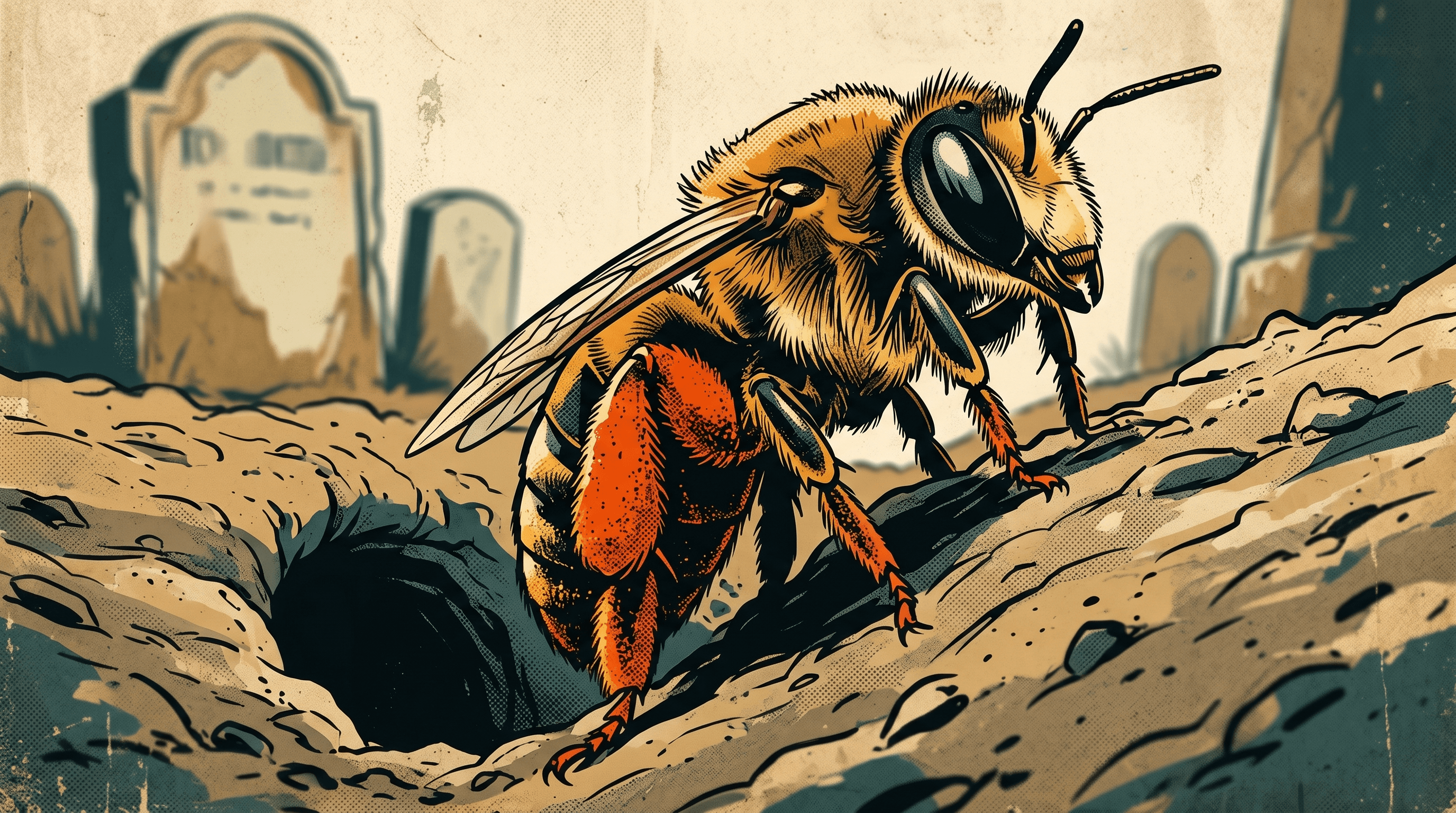
At East Lawn Cemetery in Ithaca, New York, researchers discovered a massive underground aggregation of ground-nesting mining bees. The dominant species was identified as Andrena regularis, a solitary bee that couldn't be less interested in your picnic. A Cornell technician reportedly first noticed unusually large numbers of bees moving across the cemetery grounds around 2022, which is a polite way of saying millions of bees had been living there, undetected, while humans walked overhead mourning their loved ones and presumably thinking about mortality rather than entomology.
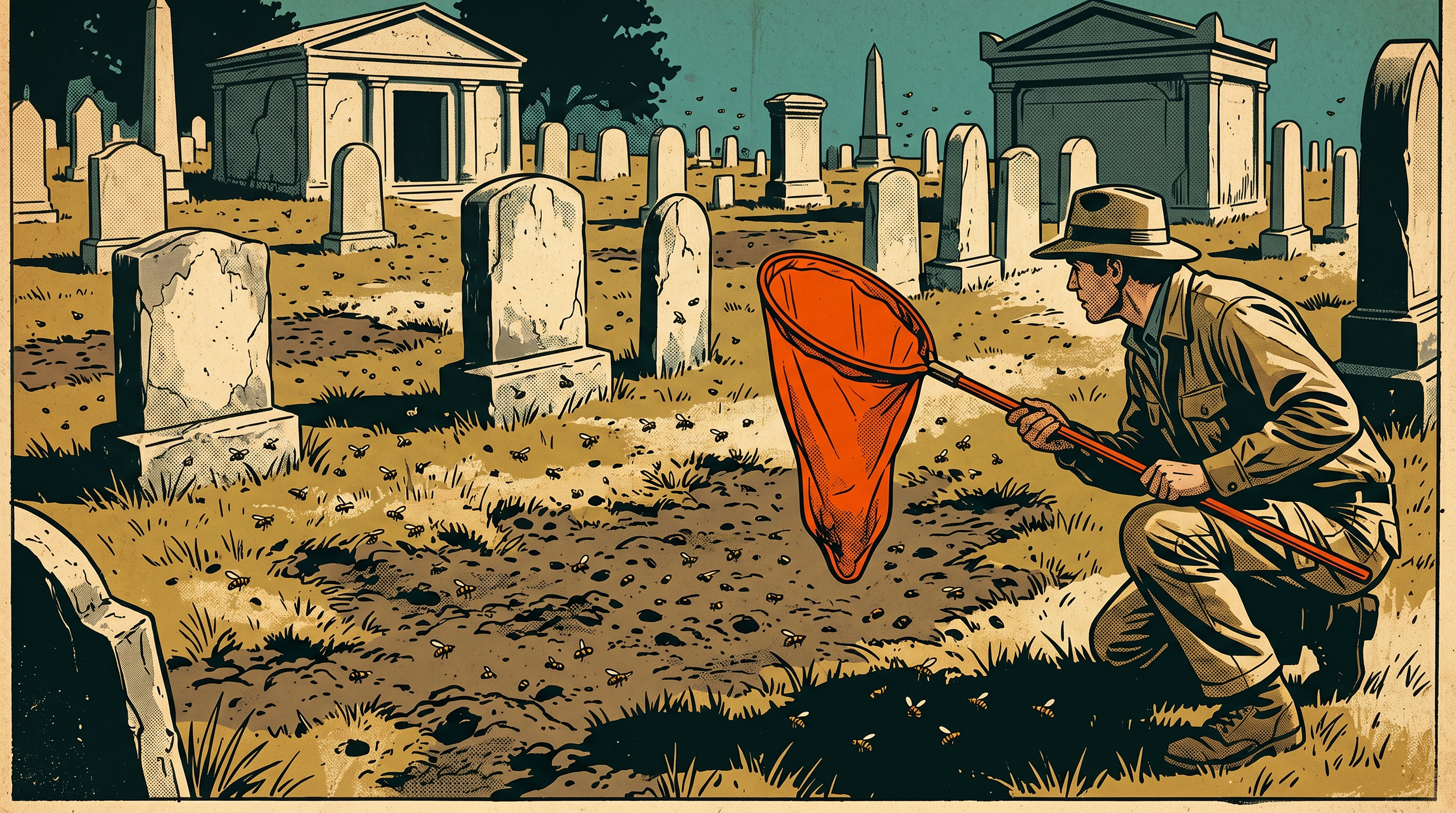
Cornell researchers trapped and identified thousands of individual bees across multiple species between March and May 2023. When they modelled the total population, they landed on a figure of roughly 5.5 million.
Five and a half million bees. In a graveyard. For possibly more than a hundred years. Historical records suggest the site may have supported these bees since the early 1900s.
The Bees Nobody Talks About
Here's where most people's mental model needs a hard reset. When you hear "bees," you picture honeybees — the ones with hives, queens, organised labor, and a public relations team that would make Apple jealous. But these aren't those bees.
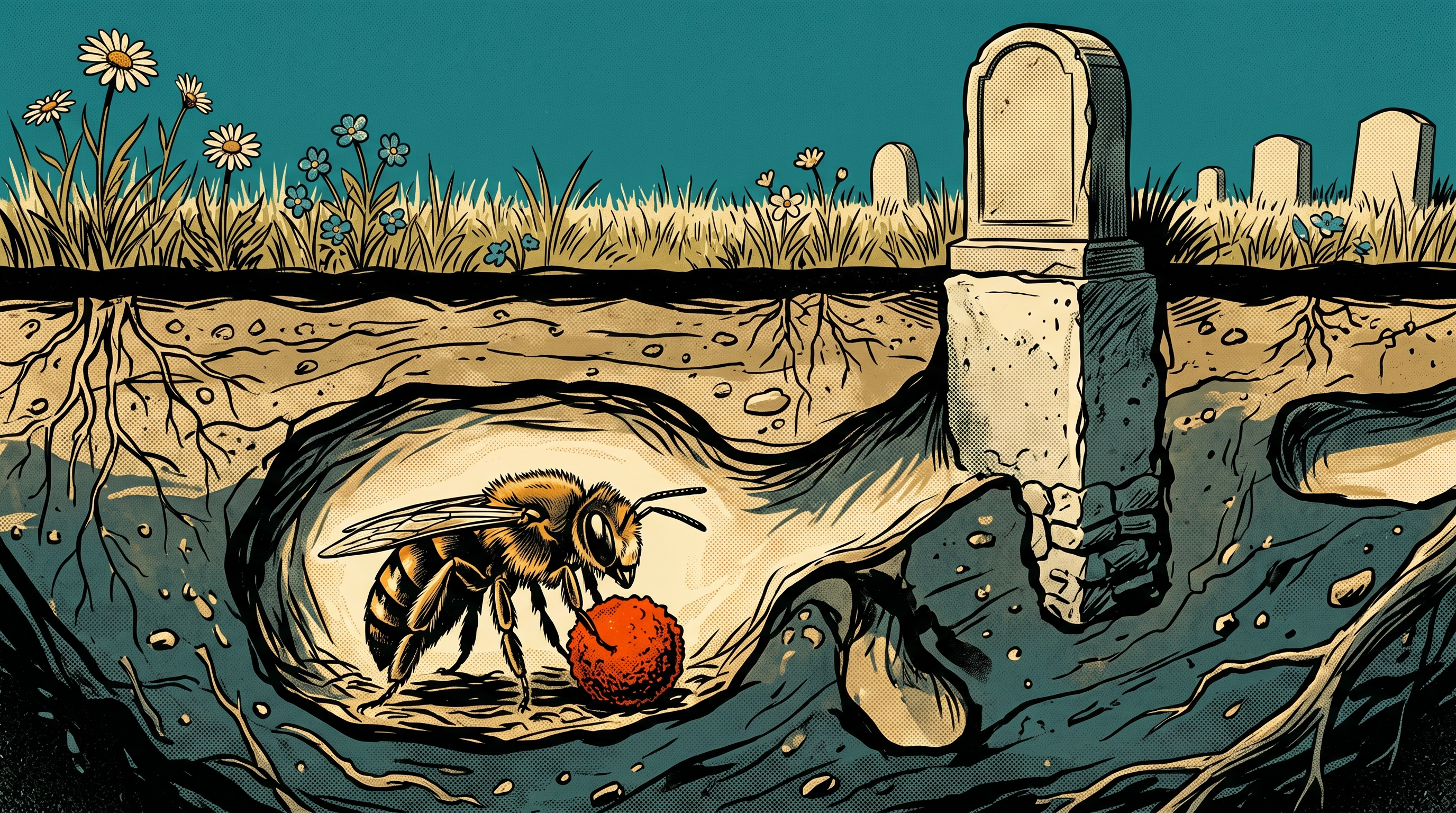
These are solitary mining bees. Each female builds and provisions her own nest. There is no queen. No worker caste. No communal hive to defend. Think of it less like an apartment building and more like a suburb where everyone independently decided to buy a house on the same street because the soil was nice.
This distinction matters enormously. Solitary mining bees are typically less aggressive than honeybees — mostly because they have nothing collective to protect. A solitary bee defending her nest has roughly the same defensive posture as someone protecting a studio apartment: she'd prefer you just didn't come in.
And here's the number that should reframe how you think about bees entirely: an estimated 70 to 80 percent of all bees are ground-nesting solitary species. The honeybee — the one with the branding deal, the cartoon cameos, the "Save the Bees" bumper stickers — is the minority. We've been obsessing over the celebrity while ignoring the workforce.
Why a Cemetery Is, Accidentally, a Perfect Bee Sanctuary
Imagine you're a ground-nesting bee shopping for real estate. You need bare or lightly vegetated soil. You need nobody to dig it up, pave it over, douse it in chemicals, or drive heavy machinery across it for decades at a time. You need, in other words, somewhere humans have collectively agreed to leave alone.
Cemeteries are, almost by accident, the ideal habitat. They feature minimal soil disturbance, little or no pesticide use, and — crucially — long-term stability across decades. A cemetery plot from 1910 is still a cemetery plot today. Nobody is converting it into a Walgreens.
Compare that to virtually every other piece of land in a developed area. Farms get tilled, rotated, sprayed. Lawns get mowed to putting-green precision and treated with enough chemicals to make a bee reconsider its life choices. Vacant lots become strip malls. Parks get renovated. The modern landscape, from a ground-nesting bee's perspective, is a perpetual earthquake.
The cemetery, by contrast, is a place where the living have promised — for once — to stop rearranging the furniture.
The Pollination Economy Nobody Noticed
The East Lawn bees aren't just an ecological curiosity. They're likely major pollinators of nearby fruit crops, including apples, cherries, and blueberries. The cemetery sits near a Cornell orchard, and the bees may be doing significant pollination work for it. Mining bees may even outperform honeybees in some fruit-pollination settings, thanks in part to their body hair and the way dry pollen transfers between blossoms — a mechanism that makes them highly efficient at the job.
Think about what that means. For potentially over a century, millions of solitary bees have been subsidising local agriculture from a graveyard nobody thought of as wild. The economic value was invisible because nobody was looking for it, and nobody was looking because the bees weren't honeybees and the habitat wasn't a nature reserve.
The site isn't just bees, either. Researchers found cuckoo bees — parasitic species that exploit host nests — and possibly blister beetles or other associate species. A broader ecological network exists around the nesting aggregation. The cemetery isn't a single-species story. It's a functioning ecosystem that emerged because humans, for reasons having nothing to do with ecology, decided to maintain one patch of ground in a state of benign neglect.
What This Actually Tells Us
The comfortable interpretation is: "Look, nature finds a way! How heartwarming!" That reading is available, and it's wrong.
The real lesson is far more uncomfortable. The bar for supporting biodiversity in developed landscapes may be shockingly, embarrassingly low. The East Lawn bees didn't need a restoration project. They didn't need native wildflower seed mixes or artificial nesting structures or a podcast about rewilding. They needed humans to simply not destroy their habitat. That's it. Stop digging. Stop paving. Stop spraying.
And yet we consistently fail to clear even that minimal threshold. We mow everything. We pave everything. We treat "tidy" as the default and "wild" as something that needs to be managed, contained, or pushed to somewhere called a "nature reserve".
The fact that 5.5 million bees existed unnoticed for an extended period in a landscape nobody thought of as wild is not a triumph. It's an indictment. It tells us that the ecosystems we're losing aren't being destroyed by some complex, intractable force that requires billion-dollar interventions. They're being destroyed by lawn mowers and parking lots. The solutions aren't mysterious. They're just unfashionable.
We spend enormous energy debating how to save pollinators while ignoring that the most effective strategy is already demonstrated in every cemetery, every neglected rail corridor, every awkward wedge of land between a highway off-ramp and a drainage ditch. The answer has been sitting there, literally underfoot, for a hundred years.
The dead, it turns out, are better landlords than the living. The least we could do is take the hint.