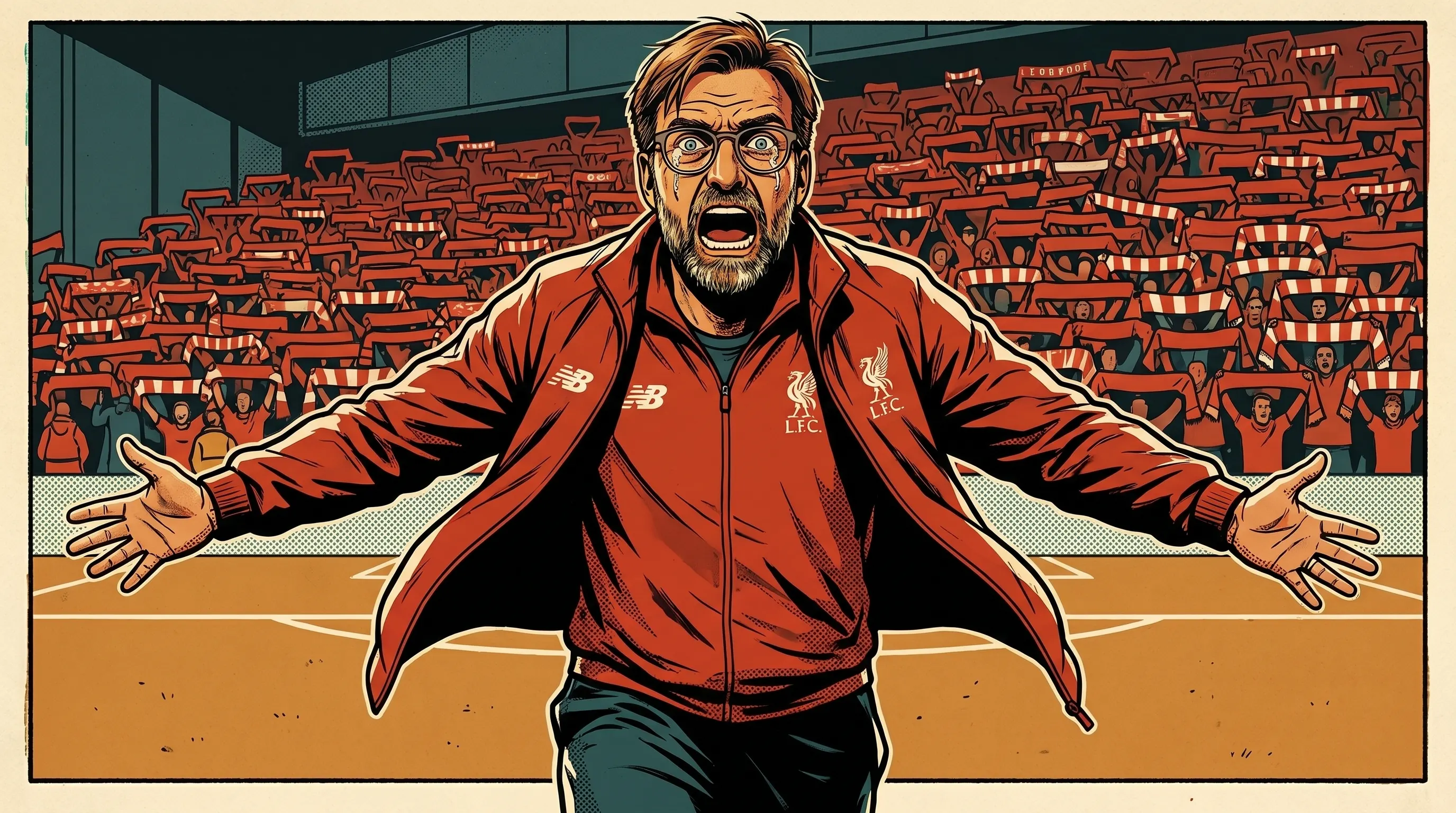
There is a particular way Jürgen Klopp stands on a touchline. Feet planted wide, jaw working, arms conducting invisible orchestras — the whole body a broadcast tower for whatever emotion the last ten seconds of football have produced. For nearly a quarter century, that image was the most legible thing in European football: a man who appeared to feel every tackle, every misplaced pass, every goal, as if it were happening to him personally rather than to eleven employees in matching shirts. It was magnificent theatre. It may also have been, in the deepest sense, real. The trouble is that nobody — possibly including Klopp himself — can say with certainty where the performance ended and the person began. And now, installed as global head of soccer at Red Bull, he has arranged matters so that the question can no longer be avoided.
Stuttgart, Mainz, and the Long Apprenticeship
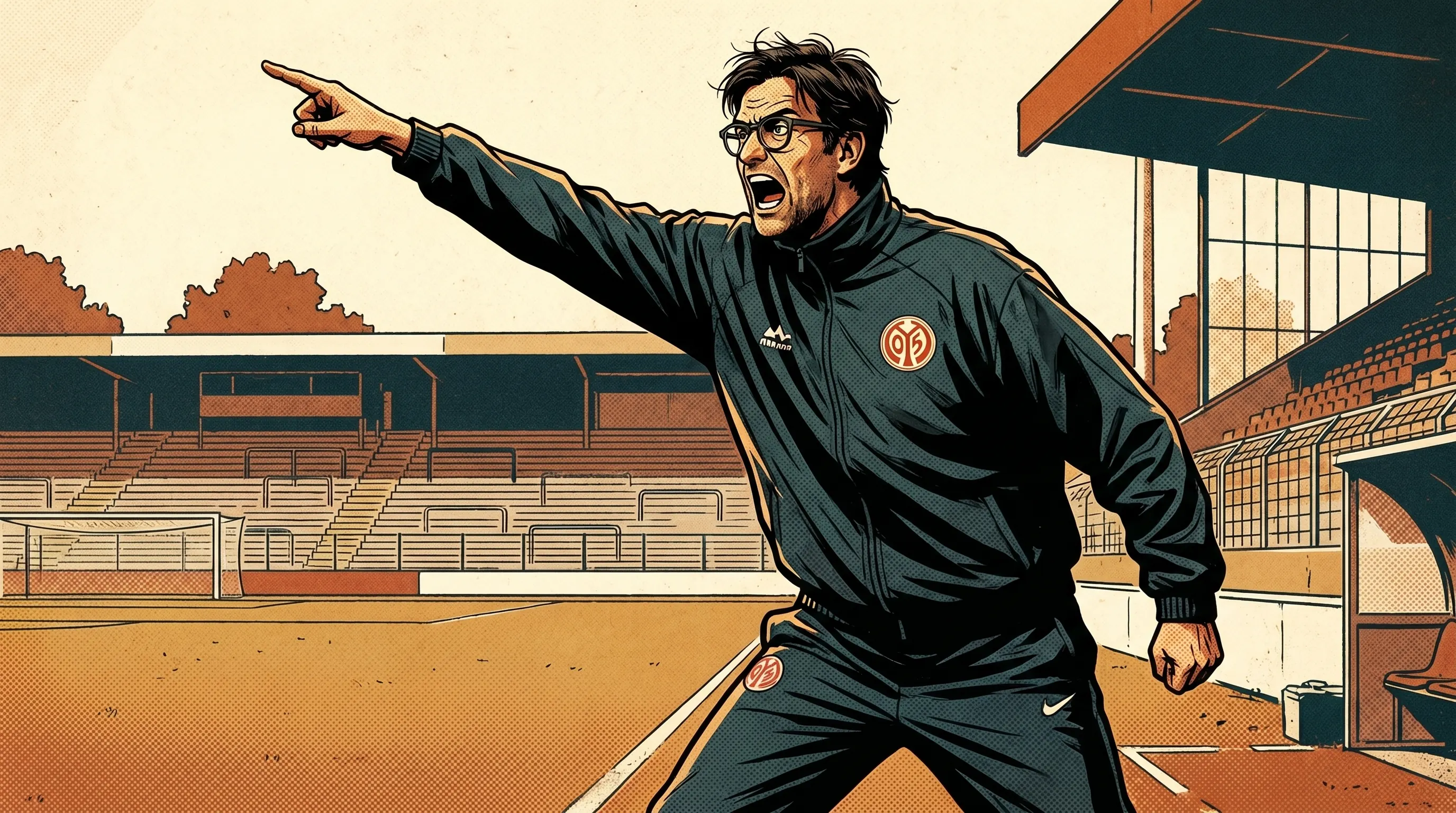
Klopp was born on 16 June 1967 in Stuttgart, in what was then West Germany — a city that builds cars and footballers with roughly equal efficiency. He was not one of the better footballers. His playing career unfolded almost entirely at Mainz 05, a club whose principal charm was its lack of pretension. Mainz were modest. Klopp was modest. The fit was natural, and he stayed long enough to understand something that more talented players rarely bother learning: how a small club actually works, from the inside, at every level.
This matters because it established the template. He stuck around, paid attention, and began to see patterns — in how teams were organised, in what effort could compensate for, in the emotional infrastructure that determined whether a group of adequate players could occasionally produce inadequate results or, with the right pressure applied in the right places, something genuinely surprising.
When he moved directly from the end of his playing career into management at Mainz in 2001, it was less a glamorous appointment than a logical continuation. Nobody outside Mainz paid much attention. This was a second-division club handing the job to a recently retired player of no particular distinction. The football industry processes hundreds of these transitions every decade, and most of them lead nowhere.
Building Mainz, and the First Version of the Method
What happened next was the first evidence that Klopp possessed an unusual gift — not tactical genius in the classical sense, but something harder to coach: the ability to make a group of players believe they were capable of more than their CVs suggested, and then to provide a system that made the belief rational rather than delusional.
By 2004, Klopp had guided Mainz to their first-ever Bundesliga promotion. This was not a feat that shook European football. It was, however, the kind of achievement that reveals character through context. Mainz had no history of top-flight football. They had no financial leverage, no transfer market muscle, no inherited infrastructure of excellence. What they had was a manager who could generate intensity — emotional, physical, tactical — and sustain it long enough to overperform the budget.
The method was already recognisable in outline: coordinated pressing, quick transitions after winning the ball, a vertical attacking threat that made organised defending feel like trying to hold water in open hands. The phrase "gegenpressing" would later be attached to this approach, and eventually the more evocative label "heavy metal football" — loud, fast, relentless, and slightly dangerous to everyone involved, including the performers. But at Mainz, it was simply what happened when Klopp's teams played. It wasn't yet a brand. It was just football coaching, applied with uncommon conviction.
Dortmund: Breaking the Monopoly
In 2008, Klopp became manager of Borussia Dortmund, and the scale of the stage changed everything. Dortmund were a bigger club than Mainz by every measure — history, stadium, fanbase, financial capacity — but they were not, at that point, competing seriously with Bayern Munich for domestic supremacy. Bayern's grip on the Bundesliga was the sport's most reliable fact. Challenging it required not just good coaching but a kind of institutional audacity, a willingness to believe that the gap was closable.
Klopp closed it. Back-to-back Bundesliga titles in 2011 and 2012 broke Bayern's domestic monopoly, at least temporarily, and did so with a style of play that felt ideologically opposed to Bayern's wealth-backed certainty. Dortmund under Klopp were fast, furious, collectively organised, and visibly enjoying themselves — a combination that made them not just successful but sympathetic. He won the DFB-Pokal. He reached the 2013 UEFA Champions League final. For a concentrated period, his Dortmund were the most exciting team in European football, and Klopp himself became the sport's most compelling managerial figure: the anti-corporate coach, the man who proved that passion and system and collective commitment could outperform chequebooks.
This is the period that built the myth. And it is worth being precise about what the myth actually was. It was not simply that Klopp was a good manager. Plenty of managers are good. The myth was that Klopp was authentic — that the touchline emotion, the bear hugs, the press-conference laughter, the refusal to speak in clichés, all of it was the unmediated expression of a genuine human being rather than a calculated performance. In an industry saturated with guardedness, Klopp appeared to have no filter. The crowd loved it. The media loved it. The players, by every available account, loved it most of all.
Liverpool: The Proving Ground for Belief
Klopp left Dortmund in 2015 and arrived at Liverpool the same year, inheriting a club whose recent history was defined by a single, agonising absence: no league title for thirty years. Liverpool had won European Cups, had produced iconic teams, had maintained one of football's most intense supporter cultures through decades of relative domestic disappointment. What they lacked was not ambition or resources or passion. What they lacked was someone who could convert all of that latent emotional energy into a functioning system.
The pattern held. At each of his three clubs — Mainz, Dortmund, Liverpool — Klopp arrived to build upward rather than maintain an existing dynasty. He was not a caretaker of success. He was a constructor of it, and the construction always followed the same emotional logic: arrive, connect, intensify, believe, win. The tactical specifics evolved. His approach at Liverpool shifted over time as the squad changed, as the Premier League's tactical demands shifted, as the physical cost of gegenpressing at the highest level became clearer. But the underlying principle remained constant: make the collective greater than the sum of the individuals, and make the effort feel like joy rather than obligation.
In 2019, Klopp won the UEFA Champions League with Liverpool. In 2020, he won the Premier League — ending that thirty-year wait with a points total that left no room for argument. He added the FIFA Club World Cup and domestic cup honours. The CV was now unanswerable. Three clubs, three upward trajectories, two countries, the two biggest trophies in European football. Whatever Klopp was doing, it worked at every level of the game.
The Exit That Changed the Story
And then he did something that almost no manager in football history has done convincingly: he left on his own terms, before the decline, with his reputation not just intact but enhanced by the leaving.
Klopp's departure from Liverpool was self-declared. He was not sacked. The team had not collapsed. There was no boardroom power struggle, no dressing-room mutiny, no tabloid scandal. He simply said — and this is the version he offered publicly — that his energy was running low, that he could no longer do the role at the required level indefinitely, and that the honest thing was to step away before the intensity that defined him began to curdle into something less effective.
This was, on its face, the most authentic act of his career. Football managers do not voluntarily surrender power. They are dragged from their positions by results or politics or exhaustion, but they do not, as a rule, stand up and say "I've given what I can give." Klopp did exactly that, and the football world responded with something close to reverence. Here was the proof: the man really was what he appeared to be. Not a careerist, not a power-hoarder, but someone who understood his own limits and respected the institution enough to leave before he damaged it.
It was a beautiful narrative. It lasted about six months.
Red Bull: The Corporation Calls
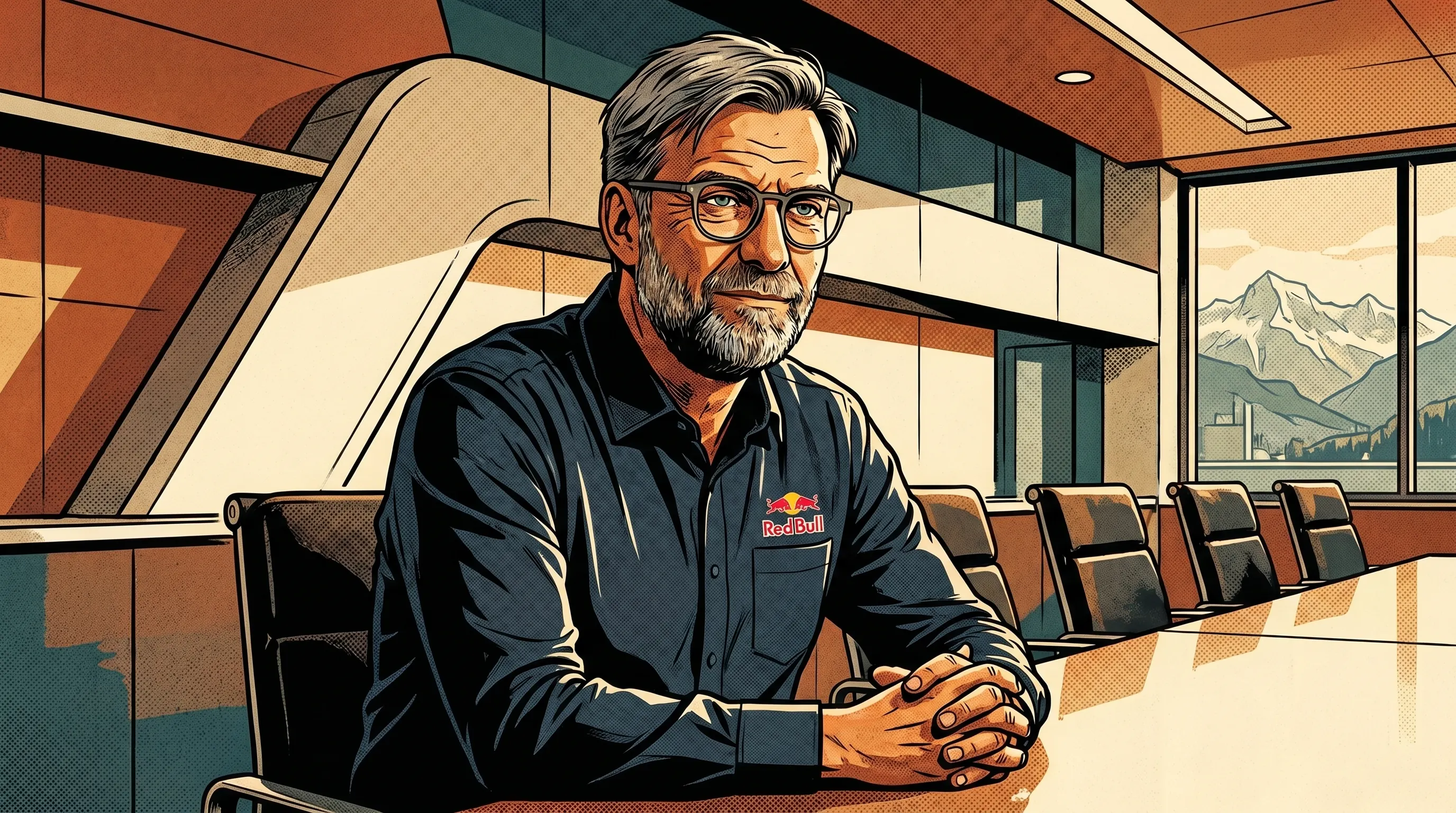
In 2025, Klopp became global head of soccer at Red Bull, and the story broke open.
Red Bull operates a multi-club football ecosystem — a network of clubs across multiple countries, linked by shared ownership, shared philosophy, shared scouting infrastructure, and a shared commitment to the proposition that football can be optimised like any other product line. It is the purest expression of football's capture by corporate capital — and it is not, by any stretch, authentic in the way that Klopp's career had taught people to understand authenticity. Red Bull's football operation is a brand exercise. The clubs exist, in part, to sell energy drinks. The scouting networks exist, in part, to generate transfer profits. The coaching philosophies exist, in part, to create a replicable product that can be deployed across markets.
Klopp's role — focusing on philosophy, scouting, transfer strategy, and coaching development rather than day-to-day management — is precisely the kind of position that a corporate football structure creates for a figure of enormous credibility. It is an ambassadorial-strategic hybrid, a role that leverages Klopp's reputation and football intelligence without requiring him to stand on a touchline and feel every tackle. It is, in other words, a role that separates the man from the performance that made him famous.
The reaction was predictable and fierce. Supporters who had celebrated Klopp's Liverpool exit as proof of his integrity now reframed it as a prelude to a corporate payday. The energy-running-low narrative looked, in retrospect, less like radical honesty and more like a graceful transition between acts. The man who had built his legend on emotional authenticity — on the idea that football should be felt, not managed — had joined the organisation that most visibly treats football as a management problem.
The Question Beneath the Backlash
The backlash, though, may be less interesting than the question it obscures. The real issue is not whether Klopp sold out. People change their minds, accept new challenges, and discover that the principles they held at forty-five look different at fifty-seven. That is ordinary human development, and holding a football manager to a higher standard of ideological consistency than we hold anyone else is a peculiar form of sentimentality.
The real issue is what the Klopp-to-Red Bull arc reveals about the concept of authenticity itself — specifically, about the version of authenticity that elite sport has been selling for the past two decades.
Consider what made Klopp's authenticity so convincing. It was not that he was unpolished. He was, in fact, extraordinarily skilled at communication — the timing of his jokes, the calibration of his emotional displays, the instinct for when to be serious and when to be playful. His authenticity was real — and it was also, unavoidably, part of a professional toolkit. The means by which a manager generates belief, commands loyalty, and builds the emotional infrastructure that turns talented individuals into a team.
This is not a criticism. It is, if anything, an acknowledgment of how sophisticated Klopp's leadership actually was. But it does mean that the authenticity was always, to some degree, functional. It served a purpose. It produced results. And when the context changed — when the purpose shifted from winning football matches to overseeing a corporate football network — the authenticity adapted with it.
What the Experiment Reveals
The deeper pattern in Klopp's career is not authenticity versus corporate compromise. It is something more interesting: a sustained demonstration that the most powerful force in professional sport is the ability to make people believe that what they are doing matters beyond the transactional. At Mainz, he made second-division players believe they belonged in the Bundesliga. At Dortmund, a good squad believed they could beat Bayern Munich — and did. At Liverpool, he converted thirty years of institutional hurt into fuel. In each case, the belief was not irrational — he provided the tactical and organisational framework to support it — but the belief came first, and the framework was built to serve it.
At Red Bull, the test is whether that same gift operates at a structural level. Can Klopp make a corporate football network believe in something beyond efficiency? Can he inject the emotional dimension — the sense of meaning, of purpose, of collective identity — into an organisation that was designed, from the ground up, to function without it?
These are not questions that Klopp needs to answer in a press conference. They are questions that his career, taken as a whole, poses to an industry that has become increasingly dependent on the narrative of the authentic leader — the manager who is more than a tactician, who represents values, who stands for something beyond winning. Football has invested enormous emotional and commercial capital in this narrative. Klopp was its most successful practitioner. And now, inside the gleaming, soulless efficiency of Red Bull's multi-club empire, that narrative faces its most rigorous examination.
A man who spent two decades making people believe is now asking us to believe one more time, in the most improbable setting imaginable. The answer will say more about football than it does about him.