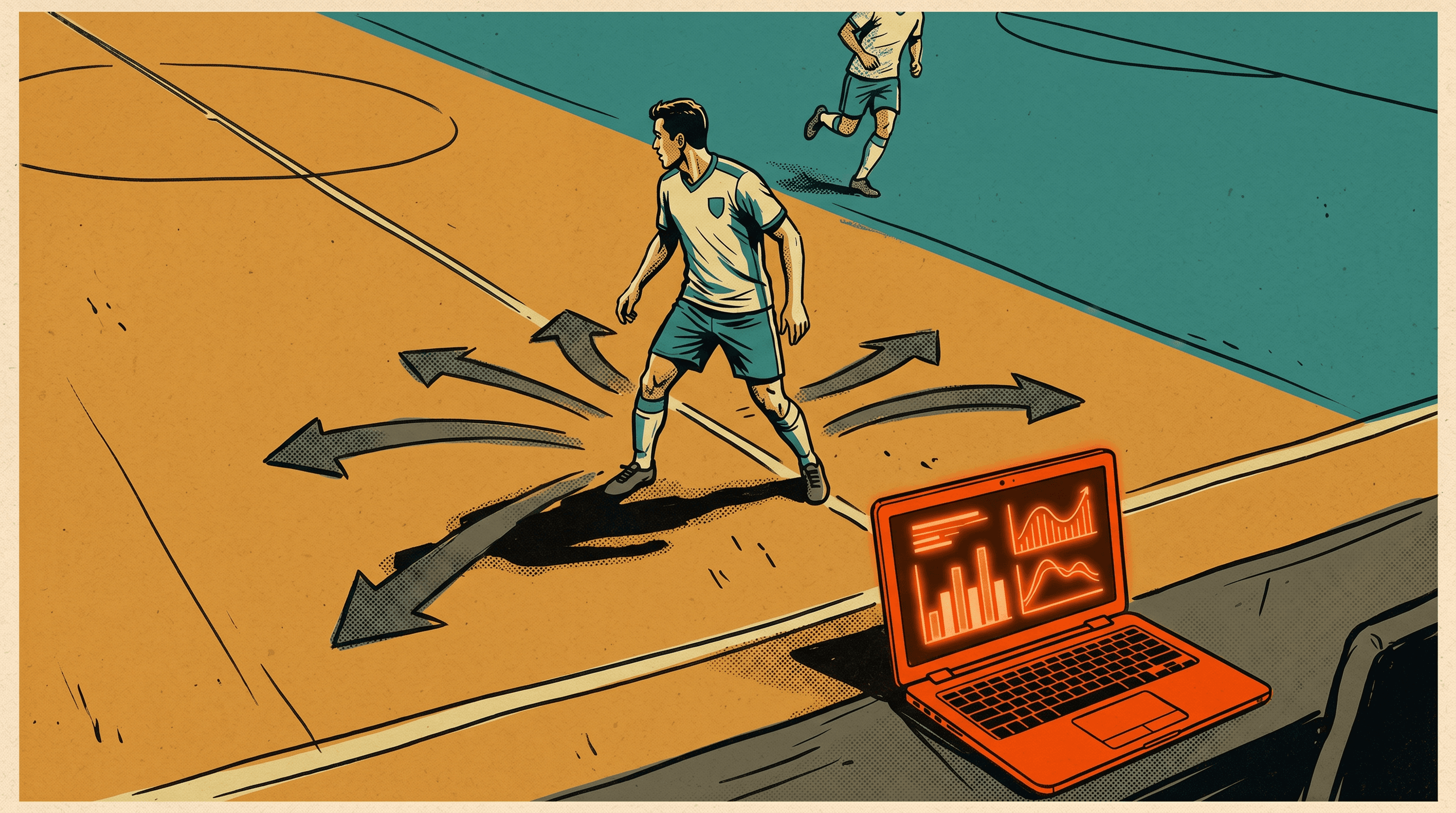
A midfielder who completes 92% of his passes sounds like a metronome of precision. He sounds like the kind of player you build a team around. He sounds, in the language of the transfer market, expensive. But Kevin De Bruyne has effectively said what anyone watching with their eyes already knew: high pass completion alone can be meaningless if the passes are harmless. The stat that was supposed to measure quality is now manufacturing a new species of footballer. One who is built to be sold, not to win.
The Safe Pass Industrial Complex
Here is what a midfielder has to do to post 92–95% pass completion: recycle possession. Refuse ambitious vertical balls. Avoid crowded central zones. Choose safe lateral options. In other words, do nothing difficult, do nothing risky, and do nothing that might actually hurt the opposition.
This would be a curiosity — a minor flaw in a measurement system — if it stayed inside the analyst's laptop. It didn't. That number now lives in recruitment databases, agent pitch decks, media narratives, and fan discourse. Players know their output will be assessed by analysts, recruitment teams, and agents. Coaches under pressure value control over ambition. And so the incentive structure bends the behaviour of everyone on the pitch.

What Gets Measured Gets Gamed
Think of it like a school that starts publishing exam pass rates. The schools don't get better at teaching. They get better at selecting which students sit the exam. The metric improves. The education doesn't.
Football has done the same thing, but with boots on.
Clubs that believe a player is a future saleable asset now have a clear incentive to put him in a role where measurable strengths show up clearly, reduce his exposure to actions that make his profile look messy, and accentuate visible, exportable output. A winger gets more transition opportunities. A midfielder gets placed in a progression-heavy role. A full-back inverts into midfield to boost technical metrics. A centre-back receives more on-ball touches to appear as an elite distributor. The player hasn't improved. His database profile has.
And the players most susceptible to this warping? Central midfielders, full-backs in build-up structures, centre-backs asked to circulate, and — most troublingly — young players. In data-heavy development environments, young players may become more conservative specifically to avoid errors that get replayed in performance review meetings. Failed risky passes are visible and countable. Turnovers are easily flagged in clips and reviews. The message received, whether intended or not, is clear: don't try anything hard.
The Invisible Footballer Problem
Here's where it gets properly unfair. Some playing roles are inherently glamorous in data. Others are invisible.
A midfielder who accumulates progression counts looks marketable. A midfielder who covers space, plugs gaps, and protects structure — the human equivalent of a load-bearing wall — may be doing the most important job on the pitch while producing the least impressive spreadsheet. A winger who obeys shape and pins a full-back may be tactically vital but statistically quiet. He is the drummer in a band where scouts only listen to guitar solos.
Modern young players are now described through sortable attributes: percentile-ranked for progression, pressure-resistant, high-volume final-third passer, low-turnover ball carrier, out-of-possession contributor. They exist not as footballers but as filterable database entries. And the filters reward what's countable, not what's valuable.
This creates a bizarre inversion. For years, players were overrated because they looked elegant, attempted hard things occasionally, had aesthetic aura, or fit the old language of "flair" and "presence." Data was supposed to fix that — to strip away the narrative and find the truth. And it did, for a while. But now we've simply replaced one set of illusions with another. Instead of being fooled by a player who looks good, we're fooled by a player who reads good. The fraud changed clothes, not careers.

The Smarter Numbers Are Coming (Slowly)
The good news — and it is genuinely good — is that top-end analytics departments know all of this. They've moved well beyond raw pass completion, raw tackle totals, raw possession counts, and simple goal-and-assist tallies.
The metrics that serious clubs now pursue read like a graduate seminar: line-breaking passes, expected threat, bypassed defenders, expected possession value models, and decision quality relative to available options.
Modern scouting increasingly combines video, event data, tracking data, and predictive modelling. At the elite level, the picture is richer, more contextual, and vastly more honest than the public discourse suggests.
But here's the catch. The public discourse is where agents operate. It's where fan pressure builds. It's where mid-table clubs with smaller analytics budgets make decisions. And it's where a 23-year-old midfielder with a 93% pass completion rate and a highlight reel of progressive passes — accumulated in a role specifically designed to produce those numbers — gets a €20 million price tag attached to his name.
A player who attempts hard, vertical, defence-splitting passes may have lower raw completion but superior value creation. Data, done properly, can reveal whether a "brave" player is actually productive or just chaotic. But data done lazily — or data done cynically — rewards the safe and punishes the ambitious.
The Overlapping Markets of the Modern Footballer
Footballers now exist in multiple overlapping markets simultaneously: the actual football match, the coaching model, the recruitment database, the media narrative, the fan stat discourse, and the transfer market. A player's true football value and his database value are not always identical. Sometimes they're not even in the same postcode.
Analytics has genuinely helped clubs identify undervalued players, measure actions beyond goals and assists, scout across leagues more intelligently, understand style fit and tactical translation, and reduce superstition in recruitment. These are real achievements. Nobody sensible wants to go back to the era of scouts saying a lad "has good feet" and leaving it at that.
But the tool that was built to see past illusions has become the raw material for new ones. Shallow stat culture rewards safety. Contextual analytics can reward risk with purpose. The gap between those two things is where fortunes are wasted and careers are distorted.
The Verdict
The problem was never analytics versus the beautiful game. The real problem is that football imported a measurement revolution without fully reckoning with the oldest truth in measurement: the act of observing changes the thing observed. A pass completion percentage, the moment it became a career currency, stopped describing how a player plays and started prescribing it. The number didn't capture reality. It created one — and that reality is a generation of footballers trained to be excellent at being measured, which is not the same thing as being excellent at football.