The most terrifying predator of the Cretaceous didn't have bones, didn't have teeth, and left almost nothing behind when it died. Which is exactly why we spent a hundred million years not knowing it existed.
What 27 Beaks Tell You About a Monster
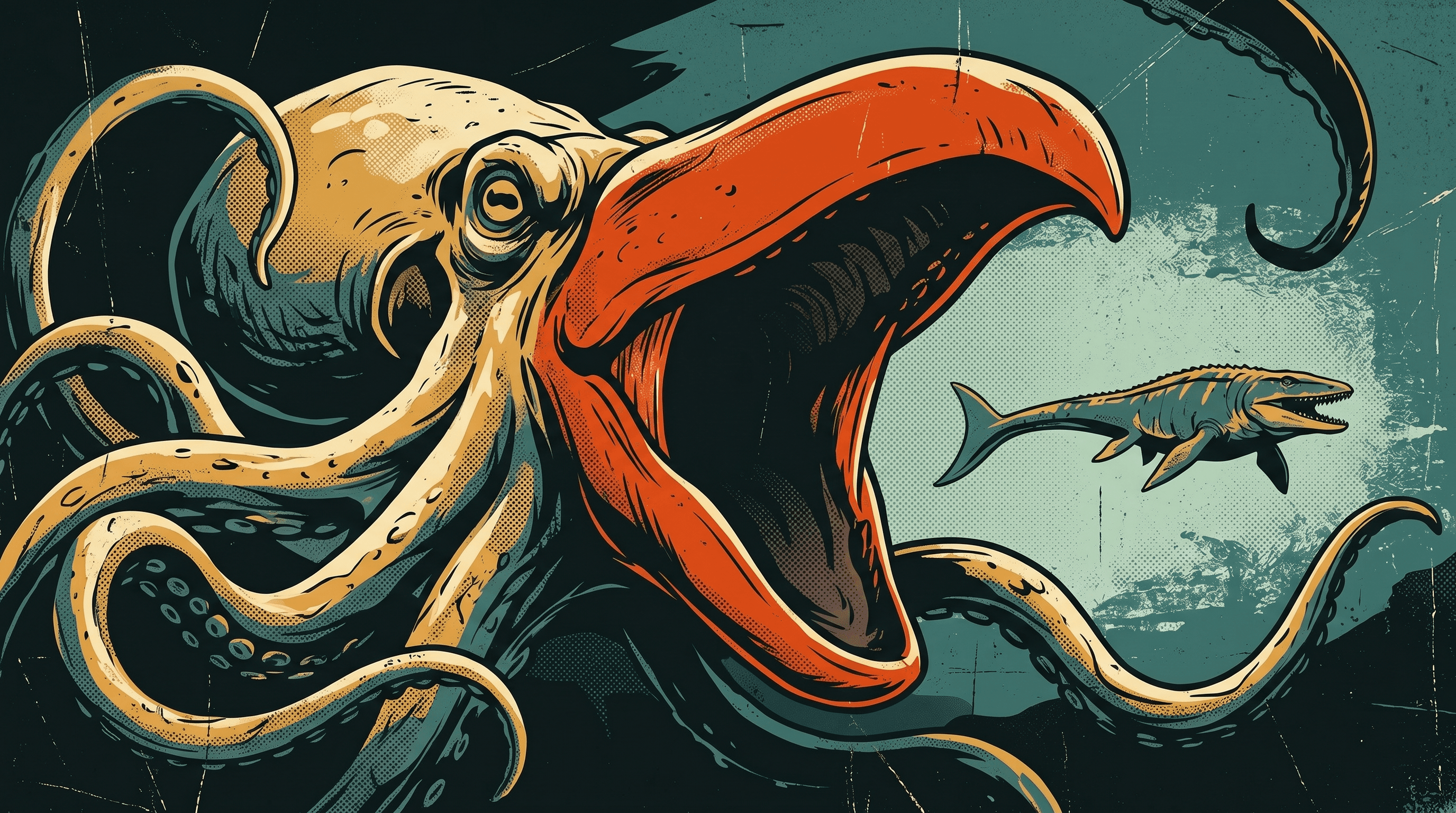
A team of palaeontologists has described Nanaimoteuthis haggeri, a giant cephalopod that lived during the late Cretaceous, roughly 100 to 72 million years ago. Estimated at around 19 to 20 metres — about 62 feet — it would dwarf the modern giant squid and, in some comparisons, rival or exceed famous marine reptiles like mosasaurs.
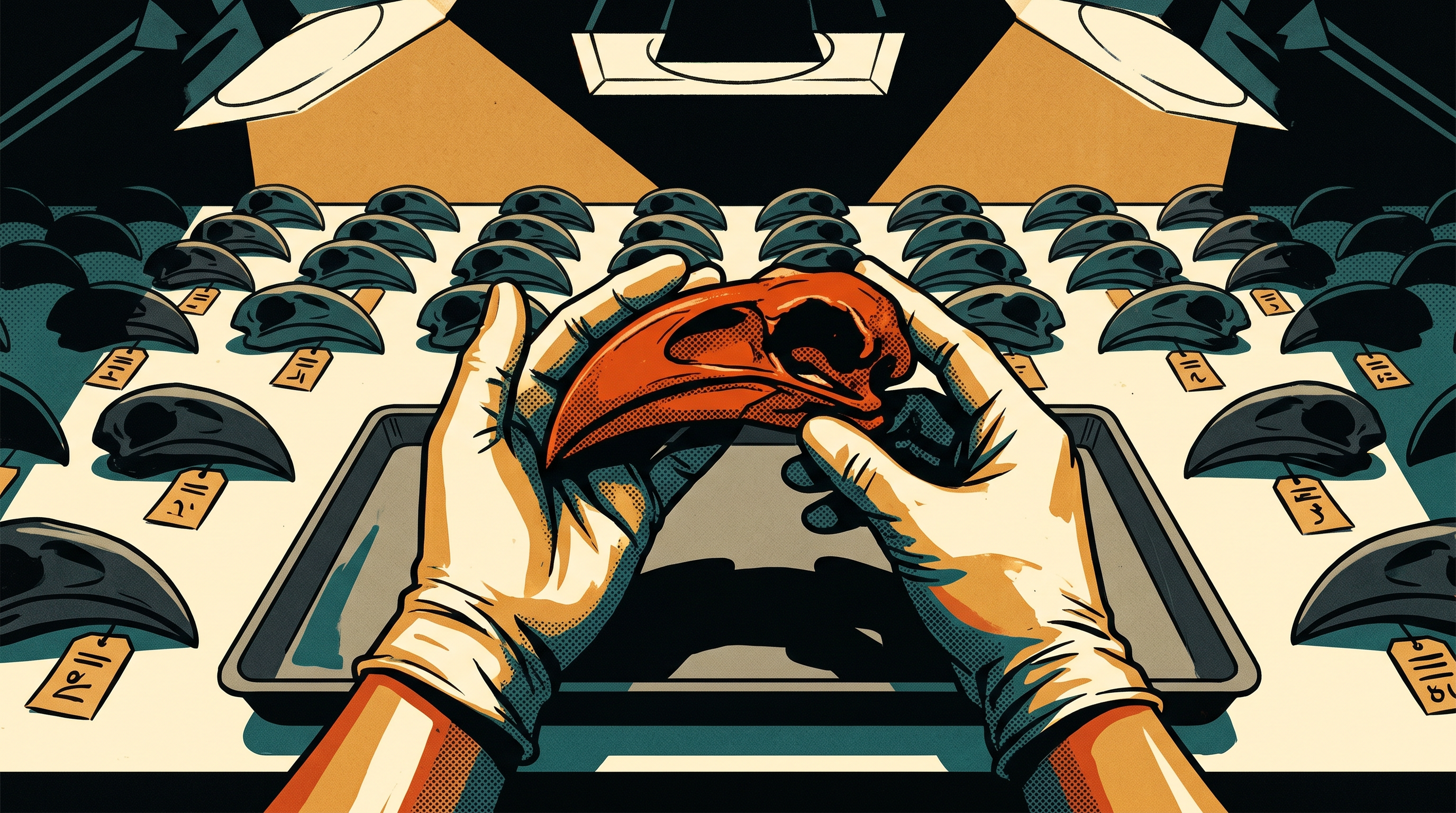
The entire case rests on 27 fossil beaks found in Japan and Vancouver Island. That's it. Twenty-seven beaks. No tentacles, no mantle, no suckers, no dramatic skeleton mounted in a museum lobby. Octopus-like animals are soft-bodied; the beak is one of the few parts capable of fossilising. Everything else rots, dissolves, and vanishes — as if the animal were designed by an engineer who hated palaeontologists.
To identify and model the fossil structures, the team used high-resolution grinding tomography and machine learning. They identified two species in the genus Nanaimoteuthis: the previously known N. gilletki and the new, vastly larger N. haggeri.
The Fossil Record Has a Soft-Body Problem
Here's the thing that should genuinely unsettle anyone who thought we had a reasonable picture of ancient oceans: soft-bodied animals may be systematically undercounted in the fossil record precisely because their evidence is harder to preserve.
This isn't a minor bookkeeping error. This is a fundamental bias in how we reconstruct the history of life on Earth. We've built our understanding of ancient ecosystems around creatures polite enough to leave skeletons behind — dinosaurs, trilobites, fish with bony plates. Meanwhile, the soft-bodied majority of ocean life has been slipping through the geological cracks for hundreds of millions of years.
Imagine trying to reconstruct the history of a city using only things made of stone. You'd find buildings and statues and conclude the place was mostly empty monuments. That's roughly what we've been doing with ancient oceans.
Nanaimoteuthis haggeri got lucky — if you can call it luck — because cephalopod beaks are hard enough to fossilise. Without those beaks, a 20-metre apex predator would have lived and died and been entirely erased from history. Not because it was rare or unimportant, but because it was made of the wrong materials.
How Do You Measure an Animal That Left No Body?
This is the part where healthy scepticism earns its keep. No pristine or complete fossil body of Nanaimoteuthis has been found. The 19-to-20-metre size estimate is derived indirectly, using allometric scaling — comparing the fossil beak dimensions with beak-to-body ratios from modern octopus species.
Allometric scaling works like this: in living octopuses, there's a reliable mathematical relationship between the size of the beak and the size of the whole animal. A bigger octopus has a proportionally bigger beak, and the ratio is consistent enough to be predictive. So if you find a fossil beak and measure it carefully, you can run the numbers backward — plugging in the beak dimensions and extrapolating the body size using those modern ratios.
The method is indirect. It involves modelling and scaling rather than measuring an actual fossil body. But it's the best tool available when the animal left no body to measure.
A Predator With Preferences — and Possibly a Dominant Hand
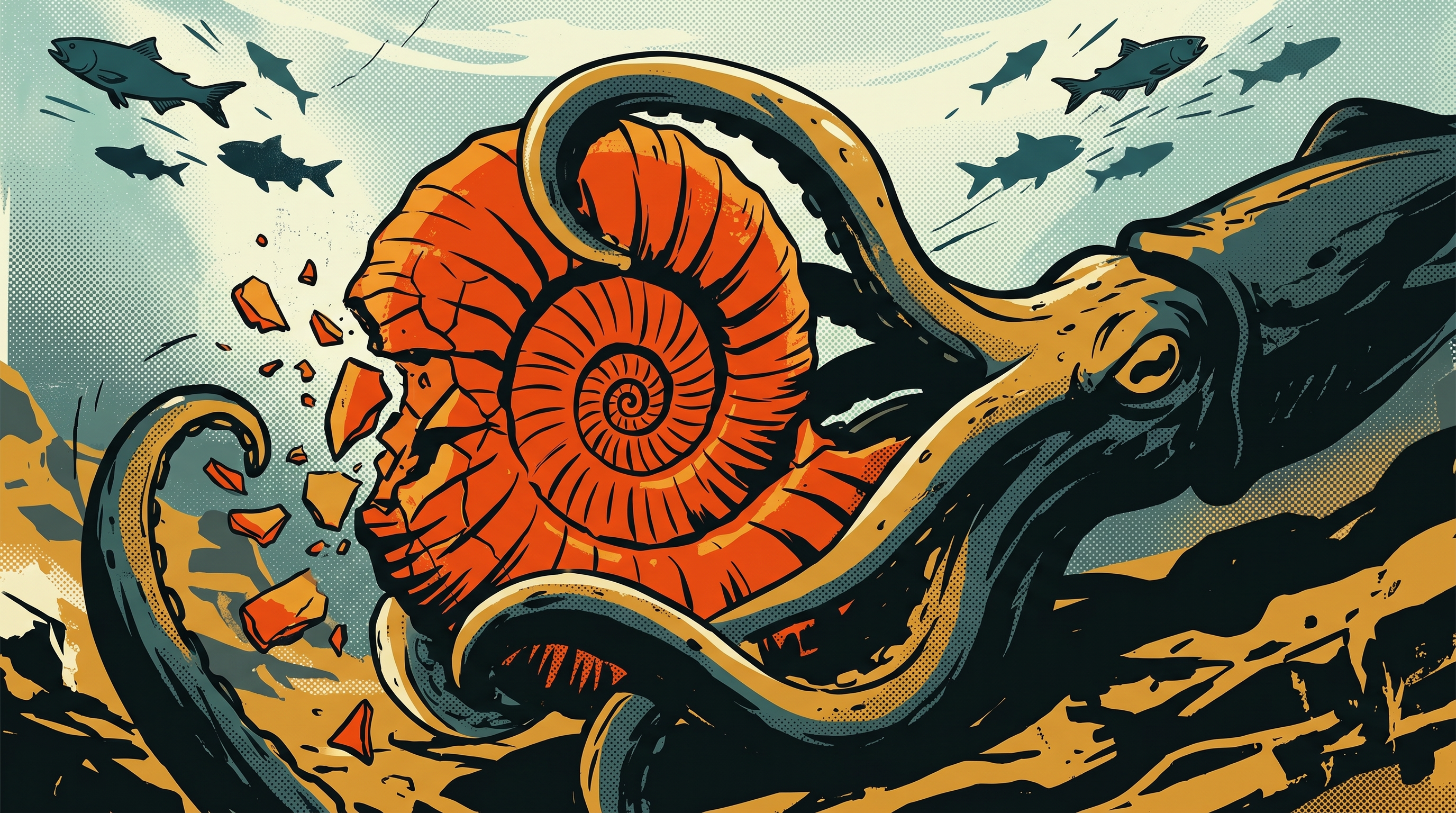
The beaks tell us more than just size. Wear patterns suggest durophagy — crushing hard prey like shelled animals and likely hard-bodied vertebrate prey. This was not a filter feeder drifting through the Cretaceous like an enormous, tentacled cloud. Something that size, actively hunting and crushing things with armour, had to be fast and deliberate.
The beaks also show asymmetrical wear, hinting at lateralisation — a preferred side, the cephalopod equivalent of handedness. That's a tell. In living animals, lateralisation tracks with complex neural processing, the kind of brain architecture that goes beyond simple stimulus-response and edges toward what we'd reluctantly call thinking.
Which fits a broader pattern. Both vertebrate and cephalopod lineages independently moved toward speed, predation, and bigger brains. Vertebrates and cephalopods even independently developed jaws. Two completely separate branches of the tree of life, arriving at the same conclusion: be fast, be smart, eat things.
Modern octopuses solve problems, escape tanks, manipulate objects, and behave in ways that seem disturbingly deliberate. Now scale that intelligence up to 20 metres and set it loose in a Cretaceous ocean. The result is less Kraken myth and more genuine ecological nightmare — an intelligent, building-sized predator that crushed armoured prey and may have had a preferred tentacle for doing it.
The Invisible Apex
The editorial temptation here is to marvel at the size. Twenty metres! Bigger than a mosasaur! But the size is the second most important part of this story.
The most important part is the silence. For roughly 72 million years — at minimum — this animal left almost no trace. A creature the length of a bowling lane, an apex predator of its ecosystem, nearly vanished from the record of life on Earth because it was soft-bodied. And it was only dragged back into the light because 27 beaks happened to survive, happened to be found on two sides of the Pacific, and happened to be examined with machine learning and grinding tomography sophisticated enough to identify what they were.
That should make you wonder: how many other giants are missing? How many other apex predators — soft-bodied, boneless, ecologically dominant — lived and died without leaving a single hard part behind? Not 27 beaks. Not one. Zero. Animals that shaped entire ocean ecosystems for millions of years and left behind exactly as much evidence as if they'd never existed at all.
We tend to treat the fossil record like a complete library with a few missing pages. Nanaimoteuthis haggeri suggests it's more like a library where entire shelves were printed on paper that dissolves in water. The pages we have are real. But the gaps between them aren't empty — they're full of things we can't see.
The Cretaceous oceans were ruled, at least in part, by a 20-metre intelligent predator with a favourite hand and a taste for armoured prey. We know this only because of 27 beaks and some very patient scientists. The honest conclusion isn't wonder at what we found. It's humility about what we haven't.