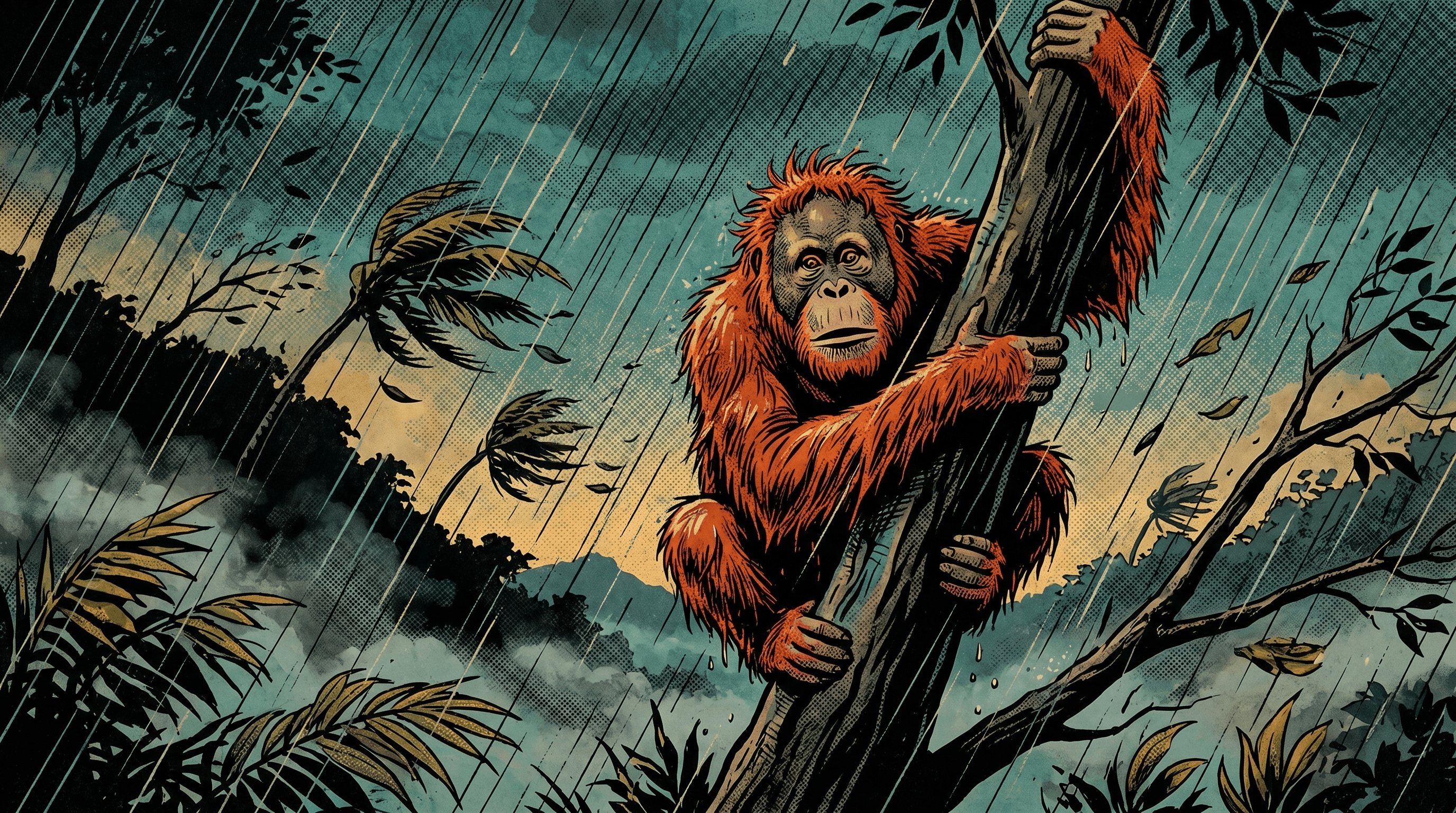
We found the Tapanuli orangutan in 2017. By late 2025, a single storm had killed off 7% of them in roughly the time it takes to get over a bad cold.
Science formally described this animal as its own distinct species in 2017 — a great ape, our cousin, hiding in plain sight on the Indonesian island of Sumatra. Eight years later, four days of extreme rain and landslides killed about 58 of them. There were fewer than 800 to begin with. This is the world's most endangered great ape, and a weather event just deleted a chunk of it before most people had learned how to pronounce its name.
What Actually Happened
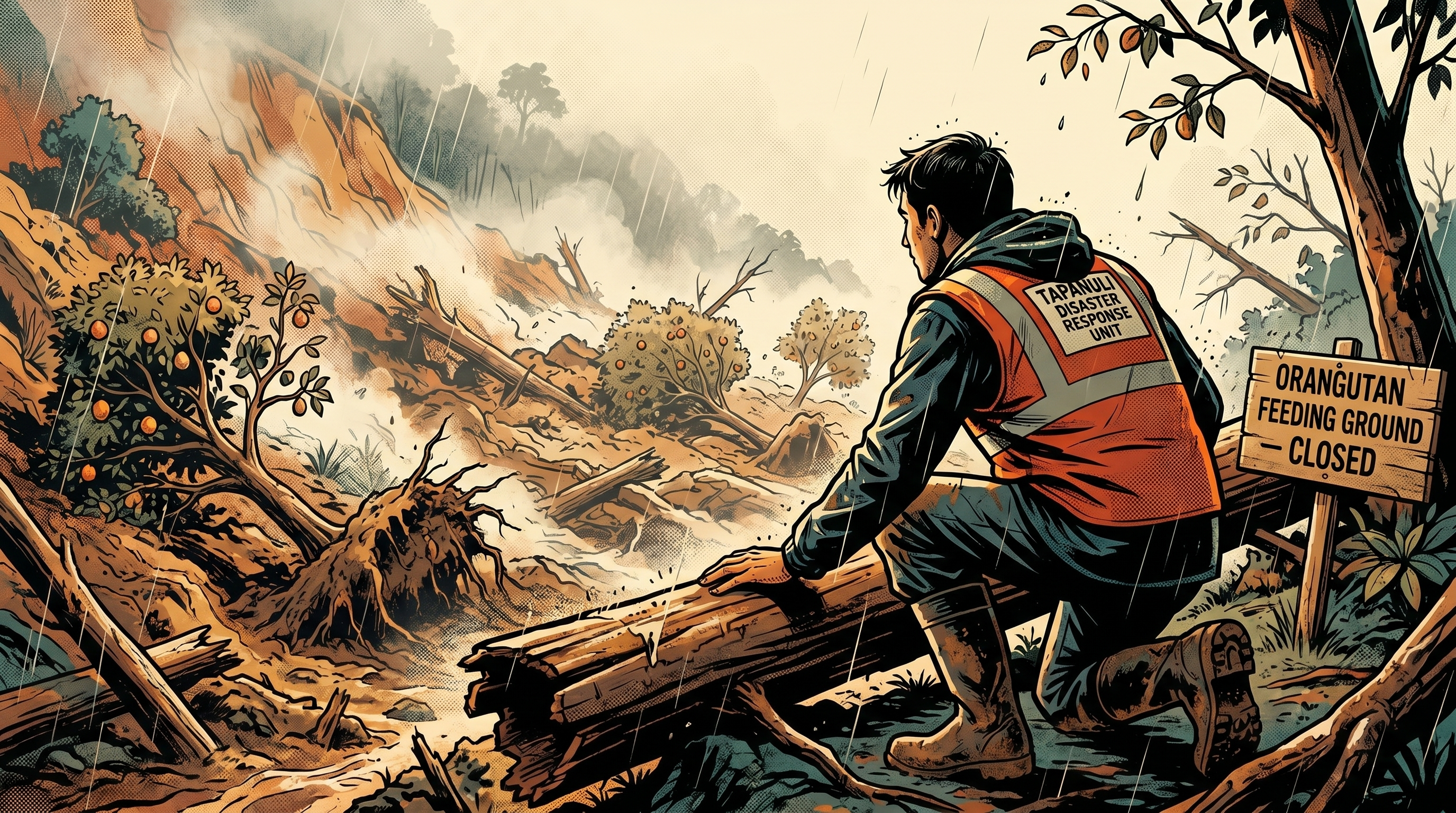
In late November 2025, Cyclone Senyar hit Sumatra. It killed more than 1,000 people, making it Southeast Asia's deadliest natural disaster of the year. Buried inside that human catastrophe was a quieter one.
Conservationists first sensed something was wrong the way you sense an empty house — orangutan sightings simply dissipated after the storm. Then the carcasses turned up. A humanitarian worker named Deckey Chandra found one suspected Tapanuli orangutan in the village of Pulo Pakkat in central Tapanuli, semi-buried in mud and logs. He described the feeding ground there as having become "their graveyard."
A study published this week put the toll at roughly 58. The author, Professor Erik Meijaard, had estimated about 35 back in December. That he had to revise the number upward by two-thirds tells you everything about how badly we understand what just happened. And 58 is the conservative figure — it leaves out the slower deaths to come from smashed canopy and the food that's no longer there.
The Math Nobody Wants to Do
Here is the number that should end the conversation. Studies say that losing more than 1% of this population per year would push the species toward extinction. One percent. That's the speed limit, and the species was already flirting with it.
Senyar caused a 7% loss. In four days. That is seven times the annual rate that conservation biologists consider a one-way ticket to oblivion — and it didn't take a year, it took a long weekend.
So let's be honest about what conservation has been doing. For years the entire enterprise has been organized around fighting slow killers: mining, oil palm plantations, hydropower dams. These are real threats, and the people fighting them are not fools. But they are all chronic threats — the kind that nibble. You can lobby against a nibble. You can hold a meeting about a nibble. You can commission a ten-year impact assessment about a nibble.
What you cannot do is hold a meeting about a cyclone. And that is the uncomfortable insight here: the conservation playbook is built almost entirely for diseases of attrition, while the thing that just did seven years of damage in four days isn't even on the actuarial table. Meijaard, looking at the photos, noted the flesh had been "ripped off the face" of one animal. He pointed out that violent landslides leave even powerful apes "helpless." A 200-pound ape that can bend steel is no match for a hillside coming down on it. Neither is a spreadsheet of mining permits.
Think of It Like a Hospital
Picture conservation as a hospital with a fixed budget. For decades, that hospital has poured nearly all its money into the chronic ward — diabetes, high blood pressure, the slow stuff. Sensible, on paper. Most species do die slowly, by a thousand cuts of habitat loss.
So the hospital gets very, very good at chronic care. It has protocols. It has paperwork. It has a guy whose entire job is filling out the palm-oil forms. The whole building is optimized for the long, grinding decline.
Then a bus crashes outside the front door and forty patients arrive at once with massive trauma — and the hospital discovers it has no emergency room. No trauma surgeons. No triage. Everyone's trained for the slow death, nobody's trained for the sudden one, and the budget has a line item for "decade-long monitoring" but nothing for "the hillside fell on the patients."
That's where we are. Acute climate shocks are the bus crash. And the brutal thing about a small population — fewer than 800 individuals — is that it can't absorb trauma. A species of millions shrugs off a bad storm. A species of 800 holds its losses forever, because there's no surplus to replace the dead. Each one is load-bearing.
It gets worse, because this wasn't a fluke we can file under bad luck. The researchers called Senyar anomalous, but they also said human-induced climate change played a significant role — and warned that the frequency and intensity of extreme rainfall in the region will likely keep climbing. So the bus is going to keep crashing, and the hospital still hasn't built the ER.
The Punchline Is Also the Only Good News
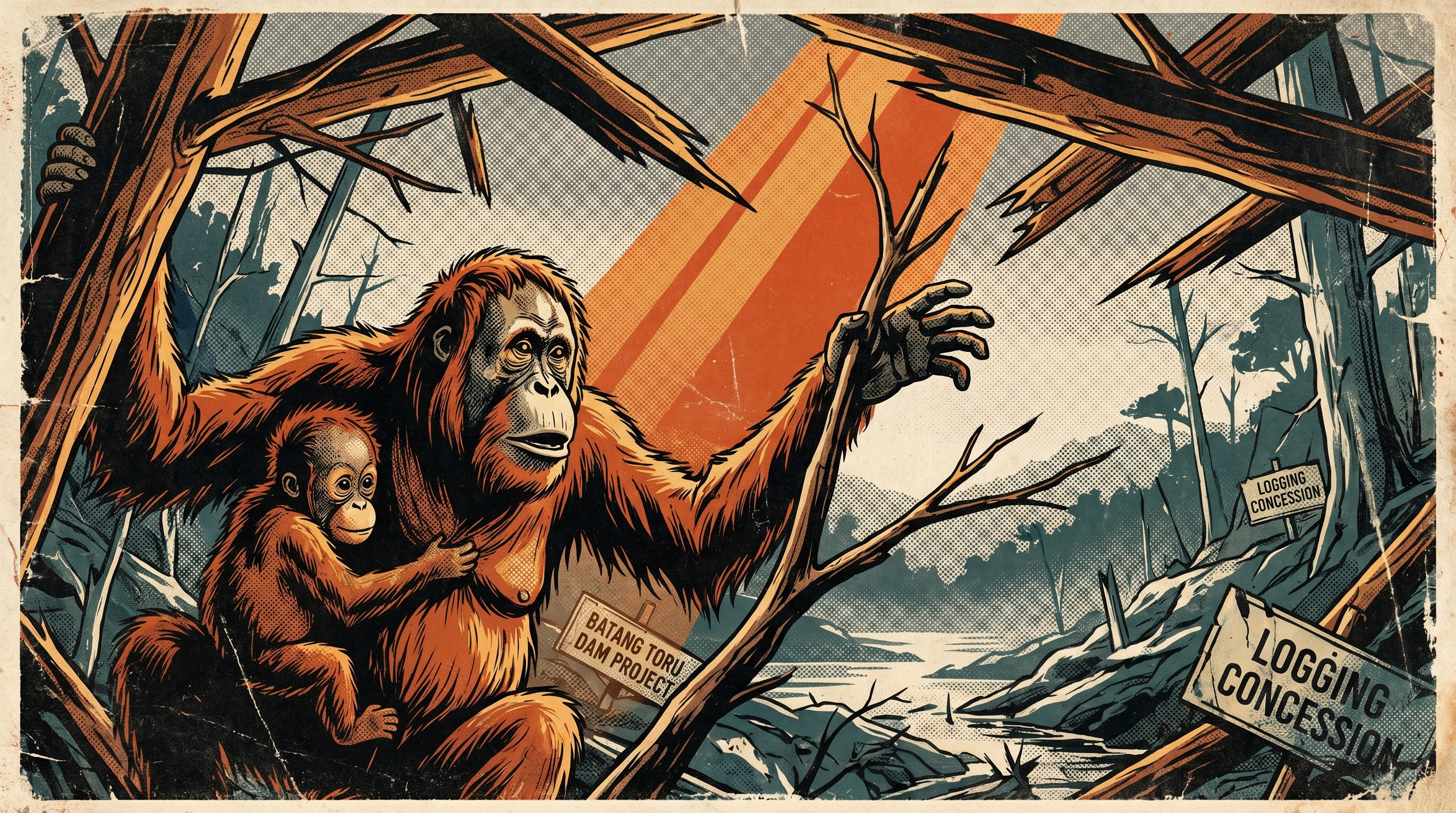
For years, conservationists fought to halt mining, oil palm, and hydropower expansion in the protected Batang Toru forest — the orangutan's home. They lobbied. They published. They made the careful, patient case against the slow killers.
And then the cyclone did their lobbying for them. In the wake of the disaster, the Indonesian government temporarily halted those exact major developments, handing researchers a window to assess the ecological risk. The moratorium that years of advocacy couldn't secure arrived in the luggage of a catastrophe that killed 58 orangutans and more than a thousand people.
This is conservation's grimmest joke: the most effective campaigner for the Tapanuli orangutan in 2025 was the weather system actively wiping it out. The threat that nobody priced into the strategy turned out to be the only thing that could move the policy. We protected the forest from the bulldozers right after the sky did far more damage than any bulldozer ever managed.
Guarding the Wrong Door
The authors of the study used a phrase that should be impossible to write about an animal we met in 2017: this could become "the first modern extinction of a great ape species." Not a frog. Not a beetle. A great ape — the club we ourselves belong to — gone, inside a single human lifetime of being discovered.
The lesson isn't that fighting mining and palm oil was wrong. It's that it was never enough, because it was always aimed at the wrong tempo of threat. We built a defense against the slow bleed and got blindsided by the heart attack. As long as conservation keeps treating acute climate shocks as background noise rather than the main event, it will keep showing up to count carcasses after the fact, revising the number upward, and calling it research.
The Tapanuli orangutan took millions of years to become its own species and humans seven years to name it. The cyclone needed four days to start the ending. If we let that be the whole story, we won't have lost a species to ignorance. We'll have lost it to a strategy that was busy guarding the wrong door.