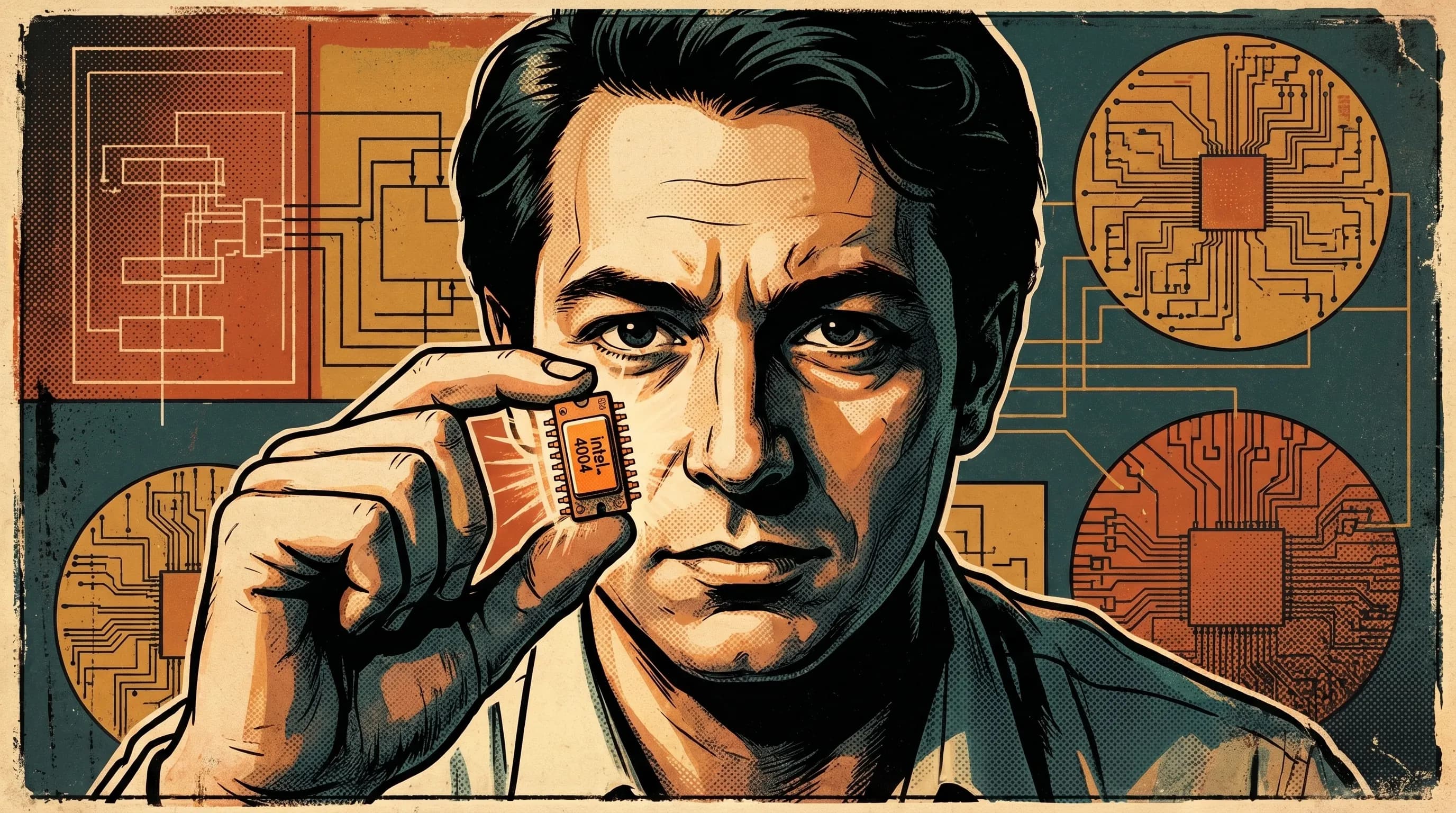
The person most qualified on Earth to tell you whether a computer can think has spent the last two decades insisting it cannot. Not because he's a Luddite, not because he fears the future, but because he designed the thing. Federico Faggin led the creation of the first commercial microprocessor. He knows what silicon does. And he is certain it does not experience anything at all.
The Chip That Ate the World
In 1970, a young Italian physicist walked into Intel's offices in Santa Clara and started building what would become the Intel 4004 — the world's first commercial microprocessor. Faggin had already developed silicon gate MOS technology at Fairchild Semiconductor, a breakthrough that would become the foundation of virtually all modern integrated circuits. The 4004 was the next logical step, and it changed everything. Every phone in your pocket, every server humming in a data centre, every GPU rendering an AI chatbot's response — all of it traces a direct line back to what Faggin and his colleagues built.
He didn't stop there. After leaving Intel in 1974, he co-founded Zilog and created the Z80, one of the most influential processors of the personal computing era. Then he co-founded Synaptics and helped pioneer the touchpad and touchscreen technology you're probably using to read this. The man's fingerprints — sometimes literally — are on the entire arc of modern computing.
He collected the prizes you'd expect: the Kyoto Prize in 1997, the National Medal of Technology and Innovation in 2009, the Enrico Fermi Prize in 2014, and recognition from the Computer History Museum. By any reasonable measure, Faggin had won. He'd built the tools that built the modern world.
And then he walked away from the victory lap to ask a question nobody in Silicon Valley wanted to hear.

The Heretic of Santa Clara
Here is what makes Faggin interesting rather than merely impressive: he became dissatisfied. Not with money or status — he had plenty of both — but with the explanatory power of the worldview his own inventions seemed to validate. The materialist picture, the one where consciousness is just neurons firing in patterns not so different from transistors switching on and off, struck him as incomplete. Not wrong in its parts, but catastrophically wrong in its conclusions.
What followed was a rupture. Faggin has described a transformative experience that reoriented his life away from building hardware and toward understanding what hardware cannot do. Through the Federico and Elvia Faggin Foundation, he began funding research into consciousness, free will, qualia — the squishy, philosophically treacherous territory that most engineers treat like a conversation about astrology at a physics conference.
But Faggin isn't most engineers. He published Silicon: From the Invention of the Microprocessor to the New Science of Consciousness, a book whose title alone is a kind of intellectual autobiography — the man who gave us silicon now arguing that silicon's story is radically incomplete.
Why the Guy Who Made Your Chip Thinks Your Chip Can't Think
Faggin's critique lands harder than the usual humanities-department objection to artificial intelligence.
When a philosopher argues that ChatGPT doesn't really understand language, the tech industry shrugs. Philosophers, they figure, don't understand code. When a novelist worries that AI will hollow out human meaning, engineers smile politely and go back to optimising parameters. But when the man who designed the first microprocessor tells you that computation cannot produce consciousness — that meaning cannot be reduced to symbol manipulation, that statistical correlations between tokens are not understanding — the shrug gets a little harder to pull off.
Faggin's argument is precise because he knows the substrate. A computer processes symbols according to rules. It manipulates representations of things. What it does not do, and what Faggin insists it cannot do, is experience anything. There is no inner life behind the output. The chatbot that says "I understand how you feel" is doing something closer to a very elaborate mail-sorting operation than to empathy. It has identified statistical relations among symbols. It has not felt a single thing.
Imagine you built the world's most sophisticated weather simulation — every molecule of air modelled, every pressure gradient tracked, every thermal current rendered with perfect fidelity. You'd have something extraordinarily useful. You would not have wind. The simulation of weather is not weather. Faggin is making the equivalent claim about minds: the simulation of understanding is not understanding. And no amount of additional computing power changes the category.
The Real Danger Isn't Skynet
Faggin's position leads to a warning that is more unsettling than the standard AI doom scenario. He is not particularly worried about machines becoming conscious and turning on us. He is worried about something that is already happening: humans looking at fluent AI output and concluding that fluency equals mind.
This is the category mistake he keeps pointing to. When a chatbot produces grammatically perfect, contextually appropriate, emotionally resonant text, people increasingly treat that as evidence of understanding. Faggin says it is evidence of engineering — good engineering, his kind of engineering — but engineering nonetheless. The danger is not sentient machines. The danger is humans adopting a thinner concept of themselves to match what machines can do.
If you define "thinking" down until it just means "producing plausible output," then sure, computers think. They also "feel" and "want" and "believe." But you haven't elevated the machine. You've flattened the human. You've performed a definitional sleight of hand and called it progress.
Faggin calls this a failure of scientism — a worldview that mistakes mechanism for the whole of reality. He is not anti-science; he is a physicist who spent his career turning scientific understanding into world-changing products. But he draws a sharp line between studying mechanisms and claiming that mechanisms are all there is. Consciousness, free will, the felt quality of experience — these are real, he argues, and they are not reducible to computation. Matter, mind, and spirit cannot be cleanly separated, and any framework that tries is leaving out the most important part.
The Stubborn Fact of Experience
He was born in Vicenza, Italy, in 1941, studied physics at the University of Padua, moved to California in 1968, and spent the next several decades building the foundations of the digital world. He has earned the right to be taken seriously when he says the digital world has limits.
Consciousness is fundamental — that is his core claim. It is not a byproduct of sufficiently complex information processing. It is not an emergent property that appears when you wire enough transistors together. Something deeper is at work — something physics and engineering have not yet learned to describe — and pretending otherwise is not rigour. It is denial.
In an era when the most powerful companies on Earth are racing to build systems that imitate human cognition, the man who started that race is standing at the finish line, waving his arms, and telling everyone they've misunderstood what they're running toward. You don't have to agree with him. But you shouldn't ignore the guy who built the track.