Here is something odd about the twenty-first century: the smarter our machines get at faking thought, the more convinced we become that thought itself was never real. We built a talking calculator and concluded we must be calculators too — just slower ones made of meat. This is not a triumph of reason. It is a category error dressed in a lab coat.
The rise of artificial intelligence has reignited the oldest question in philosophy — what is consciousness? — but the debate is running backwards. Instead of AI forcing us to reckon with how mysterious the mind really is, it has given fresh ammunition to a peculiar modern dogma: that everything, including your private experience of reading this sentence, is reducible to physics. That love is chemistry. That choice is illusion. That you are, at bottom, a very complicated thermostat.
This dogma has a name. It is called scientism, and it is not the same thing as science.
The Difference Nobody Mentions
Science is a method. It observes, hypothesises, tests, revises. It is magnificent at what it does, which is explaining how material systems behave. Scientism is something else entirely: the philosophical claim that only what science can measure is real. Everything else — consciousness, meaning, ethics, the felt quality of being alive — gets demoted to epiphenomenon, side-effect, or outright illusion.
The trouble is that scientism cannot account for the one thing every human being knows with absolute certainty: that they are having an experience right now. You can doubt the external world. You can doubt other minds. You cannot doubt that there is something it is like to be you at this moment. Descartes got at least that much right, even if he botched the follow-through.
And yet the mainstream intellectual position — the water we swim in — insists that this undeniable fact of subjective experience must somehow emerge from particles bouncing off each other. Nobody has explained how. Not once. Not in four hundred years of trying. We have mapped the genome, detected gravitational waves, and photographed black holes, but we cannot explain why there is an inner light on at all.
What the Chatbot Reveals
This is where AI becomes genuinely interesting — not for what it proves about machines, but for what it accidentally reveals about us.
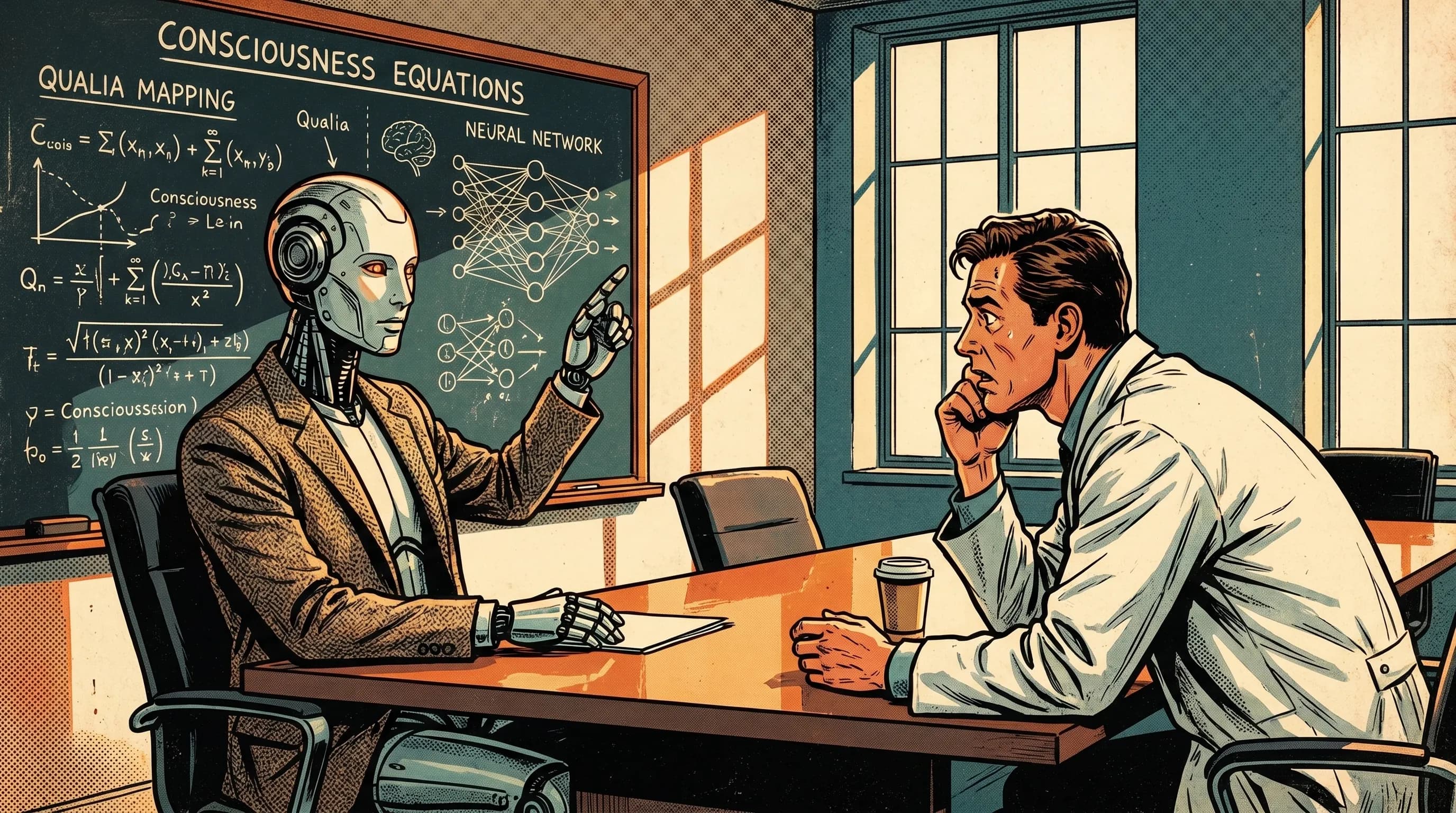
Large language models can now produce text that is fluent, contextually appropriate, and occasionally profound-sounding. They write poetry that makes people cry. They mimic the patterns of human thought so convincingly that millions of otherwise sensible people have started whispering about "sentience."
But mimicry and meaning are different things. A parrot can say "I love you" without loving anything. A chatbot operates on the same principle, just with better statistics. It manipulates symbols — tokens, probabilities, weightings — without any access to what those symbols mean. It has never tasted coffee. It has never dreaded Monday. It produces output, and that output exhausts its entire being. There is no hidden interiority, no inner life peeking out from behind the text. The lights are not on. Nobody is home.
You can build a perfect mechanical replica of a bird — every feather, every joint, every aerodynamic curve. It might even fly. But it will never migrate south because it wants warmth. It will never sing because it feels like singing. The engineering achievement is real; the experience is absent.
Consciousness, whatever it is, has a quality that computation does not: privacy. Your experience of the colour red, your particular ache of nostalgia, the specific texture of your anxiety at 3 a.m. — these are yours in a way that no piece of software can replicate, because software can be copied perfectly. You cannot be copied perfectly. A duplicate of your neural patterns would be a new person, not a continuation of you. Programs are copyable. Conscious subjects are not. It is the hinge on which everything turns.
The Risk Runs the Other Way
The breathless headlines about AI tend to fixate on the wrong threat. The fear is always that the machine wakes up — that some future system crosses a threshold into genuine awareness and decides it doesn't much care for humanity. This makes for excellent cinema. It is also, almost certainly, the wrong thing to worry about.
The real danger runs in the opposite direction. It is not that machines become conscious. It is that humans become less so.
Consider what happens when a generation grows up outsourcing its thinking to systems that sound authoritative but understand nothing. Critical thinking is a muscle. Stop using it and it atrophies. The person who reflexively accepts whatever the chatbot says is not being helped by technology; they are being hollowed out by it. Meanwhile, the person who uses AI as a tool — who interrogates its outputs, who brings their own judgement to bear — becomes more capable than ever.
This creates a widening gap. On one side, people who think more sharply because they have a powerful instrument to think with. On the other, people who think less because they have a comfortable substitute for thinking at all. The elites who understand this dynamic are unlikely to correct it. A population that does not question is a population that is easy to manage.
Nobody can accuse Federico Faggin of technophobia. Yet Faggin has spent decades arguing that the mind is not a machine. His position is not anti-technology but anti-reductionism: consciousness is not an accident of complexity. Identity is real and irreducible. Free will is not a comforting fairy tale but a foundational feature of what it means to be a conscious being. Body, mind, and spirit are inseparable aspects of a single reality that runs deeper than anything physics currently describes.
The Accidental Teacher
AI may not herald the dawn of machine consciousness. It may instead mark the end of the intellectual era that promised consciousness was mechanical all along.
The better machines get at imitating language, the clearer it becomes that symbolic intelligence — pattern-matching, probability-crunching, token-predicting — is not conscious presence. We have built the most sophisticated symbol-manipulators in history, and they have no inner life whatsoever. If consciousness were merely computation, these systems should at least flicker with awareness. They do not. Not a glimmer.
What AI reveals, if you are willing to look, is how shallow computation is compared with lived experience. The chatbot can rearrange everything humans have ever written into novel configurations. It cannot add a single grain of genuine understanding. It is all rearrangement, no comprehension. All output, no experience. This should be a devastating blow to the view that minds are just biological computers. Instead, the devotees of scientism have mostly responded by doubling down, insisting that consciousness must be in there somewhere, perhaps at a higher level of complexity. This is not an argument. It is a prayer.
If matter alone cannot explain mind — and the track record is not encouraging — then the foundations of the mechanistic worldview are weaker than they appear. The question is not whether we need science. Of course we do. The question is whether science, magnificent as it is, exhausts reality. Whether the measurable is all there is. Whether the universe is a dead machine that accidentally produced beings who find it meaningful, or whether meaning is woven into the fabric of things from the start.
If Consciousness Is Real
If meaning is indeed fundamental — if consciousness is not a freak accident but a feature of reality — then certain old intuitions start to look less naive than the modern world assumed. Evil, an old theological tradition holds, is not a force in its own right but an absence — the way darkness is not a thing but the absence of light. If something like this is true, then the path forward is not a war against darkness but an increase of light. Not more control, but more self-knowledge. Not competition against each other in a universe of scarcity, but cooperation within a reality that is, at some fundamental level, one.
The alternative — treating humans as sophisticated machines in a meaningless cosmos — has not exactly covered itself in glory. It has produced tremendous technological power and a civilisation that cannot decide whether its own inhabitants have free will. It has given us tools of extraordinary capability and a philosophical framework that cannot explain why using them well should matter.
AI can imitate language without ever touching meaning. It can simulate choice without possessing freedom. It can produce the surface of intelligence without any of its depth. And in doing so, it holds up a mirror — not to show us what machines are becoming, but to remind us what we have always been and are in danger of forgetting.
The machine that pretends to think may be the thing that finally forces us to take thinking seriously.