Real Madrid didn't implode. They leaked. Slowly, persistently, and in a dozen places at once — until someone finally ended up in hospital, and the whole thing became impossible to ignore.
What Happened
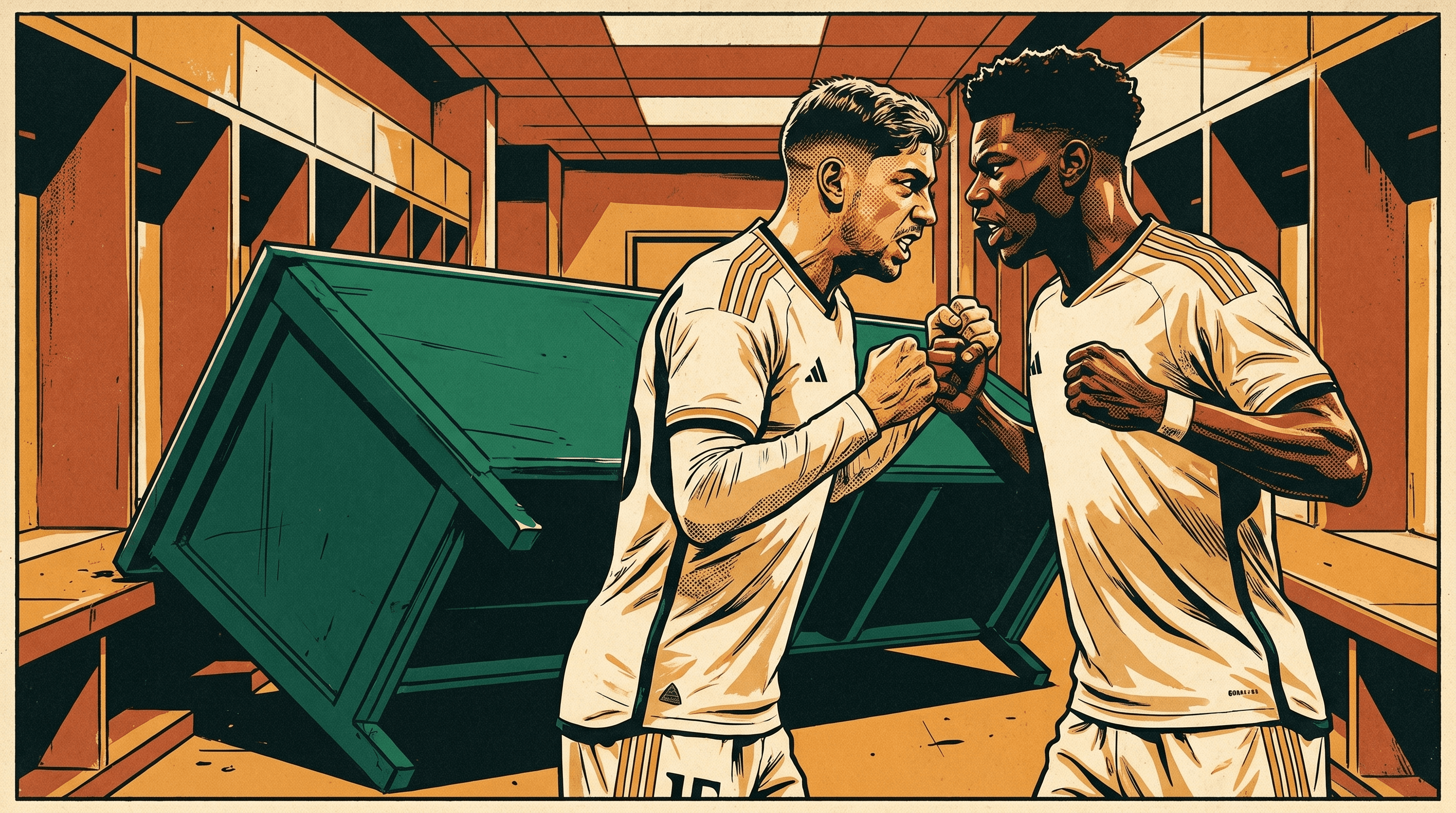
Federico Valverde and Aurélien Tchouaméni were reportedly involved in two separate training-ground altercations on consecutive days. The second incident allegedly left Valverde needing hospital treatment, with reports describing stitches after a fall into a dressing room table. This wasn't a scuffle between strangers on a Tuesday. It happened days before El Clásico — the fixture that is supposed to make every internal grievance temporarily irrelevant.
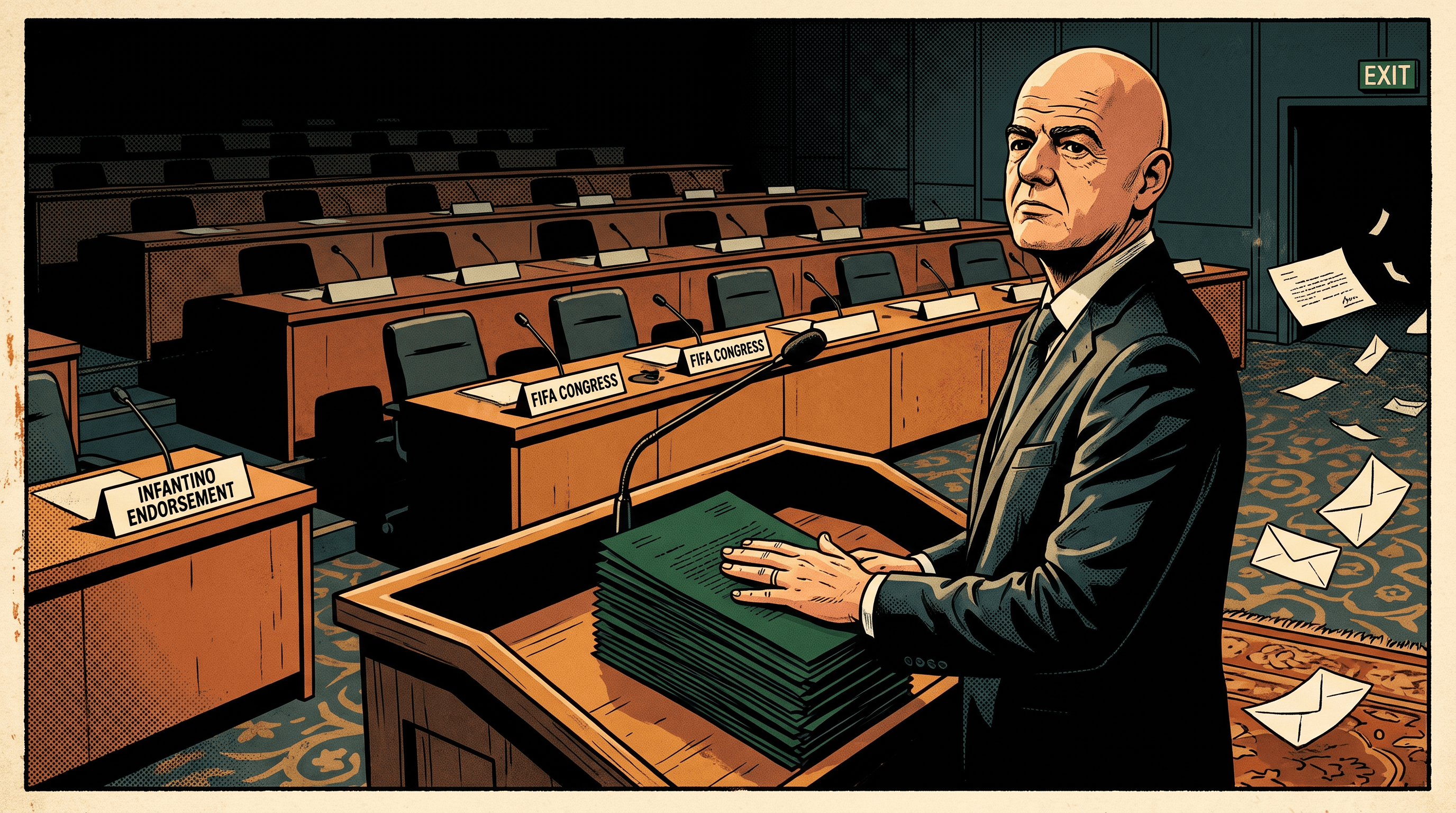
Separately, Antonio Rüdiger was reportedly involved in his own altercation with a teammate. Disagreements between manager Álvaro Arbeloa and multiple players have surfaced. Friction between Arbeloa's staff and Kylian Mbappé has been reported. None of this has been officially confirmed by Real Madrid — the club's preferred posture being, as always, the dignified silence of an institution that considers itself above the need to explain anything.
But the volume of reports tells its own story. This is not one incident. It is a pattern across the squad and the staff structure, and it has produced a trophyless 2025–26 season that now serves as both cause and consequence.
The Trophy Was the Duct Tape
Here's what most analysis of dressing room dysfunction gets wrong: it treats the fight as the problem. Valverde needed stitches, so obviously that's the crisis. Fix the fight, fix the team.
But the fight is never the problem.
At Real Madrid, that thing is winning. Always has been. The club has historically operated less like a football team and more like a coalition government — rival egos held together by the shared project of collecting silverware. When the trophies keep coming, nobody asks hard questions about who should be starting, whose tactical preferences are being ignored, or whose authority is being undermined. You simply cannot stay angry at a man when you're both holding a Champions League medal.
A trophyless season removes that adhesive entirely. And what you're left with is not a team that suddenly developed problems. You're left with a team whose problems suddenly became visible.
The tension between Valverde and Tchouaméni reportedly dates back to the beginning of the season. That's not a flash of temper. That's a slow burn — months of friction that, in a title-winning year, would have been metabolized by the machinery of success. Instead, it festered until a dressing room table became collateral damage.
Dressing Room Thermodynamics
Think of a football squad like a pressure cooker. You've got twenty-odd highly competitive, absurdly wealthy young men crammed into a space together for ten months a year. They disagree about tactics. They disagree about who deserves to start. Some of them probably disagree about where to eat lunch. The pressure is constant and rising.
Now, a pressure cooker works fine — brilliantly, even — as long as the valve is functioning. At Real Madrid, the valve has always been results. Win La Liga, and the steam escapes harmlessly. Win the Champions League, and you could have a fistfight every Wednesday and nobody outside the building would ever hear about it.
But seal that valve shut — say, by failing to win a single trophy — and the physics become unforgiving. The pressure doesn't disappear. It finds the weakest points in the container and blows through them. One weak point was the Valverde-Tchouaméni relationship. Another was Rüdiger and his unnamed sparring partner. Another still was the increasingly strained dynamic between Arbeloa's coaching staff and Mbappé.
The container failed because the valve stopped working.
The Arbeloa Question
Álvaro Arbeloa managing Real Madrid is a bit like asking the building's most loyal security guard to suddenly run the entire corporation. His credentials are institutional — he knows the culture, he bleeds white — but managing a dressing room full of Ballon d'Or-adjacent egos requires something beyond institutional loyalty. It requires the kind of authority that makes a player think twice before airing a grievance, let alone throwing a punch near furniture.
Reports of disagreements between Arbeloa and multiple players suggest that authority has not materialized. The reported friction between his staff and Mbappé — arguably the single most expensive human asset in the building — indicates something worse: the coaching structure and the squad's most prominent figure aren't pulling in the same direction.
When a manager loses the room, you can sometimes win it back with a trophy run. But we've already established that the trophy run didn't happen. Which means Arbeloa is trying to restore order with the one tool that actually works taken away from him.
What the Summer Is Actually About
The conventional take will be that Real Madrid need to buy better players this summer. Upgrade the midfield. Add depth. Perhaps find a centre-back who settles disputes with match-winning headers rather than with his fists.
This misses the point entirely.
Real Madrid's squad, on paper, does not lack talent. You do not acquire Mbappé, Valverde, and Tchouaméni — a player widely regarded as one of the highest-value international midfielders in the game — because you're short on ability. The talent was always there. What wasn't there, apparently, was cohesion.
The summer transfer window for Real Madrid is therefore less a talent exercise and more a conflict resolution exercise. The question isn't "who do we buy?" It's "who can still be in the same room together by August?"
Valverde is culturally embedded in Real Madrid's identity — the kind of player the club keeps not for what he does on the pitch alone, but for what he represents. Moving him would be like renovating a cathedral by removing the foundation stones because they've developed a crack. Tchouaméni represents significant financial investment and international pedigree. Clubs don't dispose of assets like that because of a dressing room scuffle. They find ways to make it work. Usually.
But "usually" presupposes that someone in the building has the credibility and authority to broker that peace. Whether Arbeloa is that person remains, charitably, an open question.
The Lid Is Off
The most damning detail in all of this isn't the stitches. It isn't the table. It isn't even the timing — though getting into a physical altercation days before El Clásico shows a squad whose competitive focus has been replaced by something much less useful.
The most damning detail is that every reported incident points in the same direction: a squad fractured across every axis that matters — player to player, player to coach, coach to star. This is not a crack in the wall. This is structural.
Real Madrid has survived internal chaos before, because Real Madrid has almost always had the one thing that makes internal chaos survivable: a trophy at the end of it. Take that away, and you discover what was always underneath — a collection of extraordinary individuals who were never quite a team, held together by results that are no longer arriving.
The summer won't fix this with a chequebook. You cannot buy chemistry. You cannot sign trust. And you certainly cannot install authority through a transfer portal. Someone at Real Madrid needs to do the unglamorous, unflashy, deeply human work of making grown men cooperate — and that job description has never once appeared on Transfermarkt.