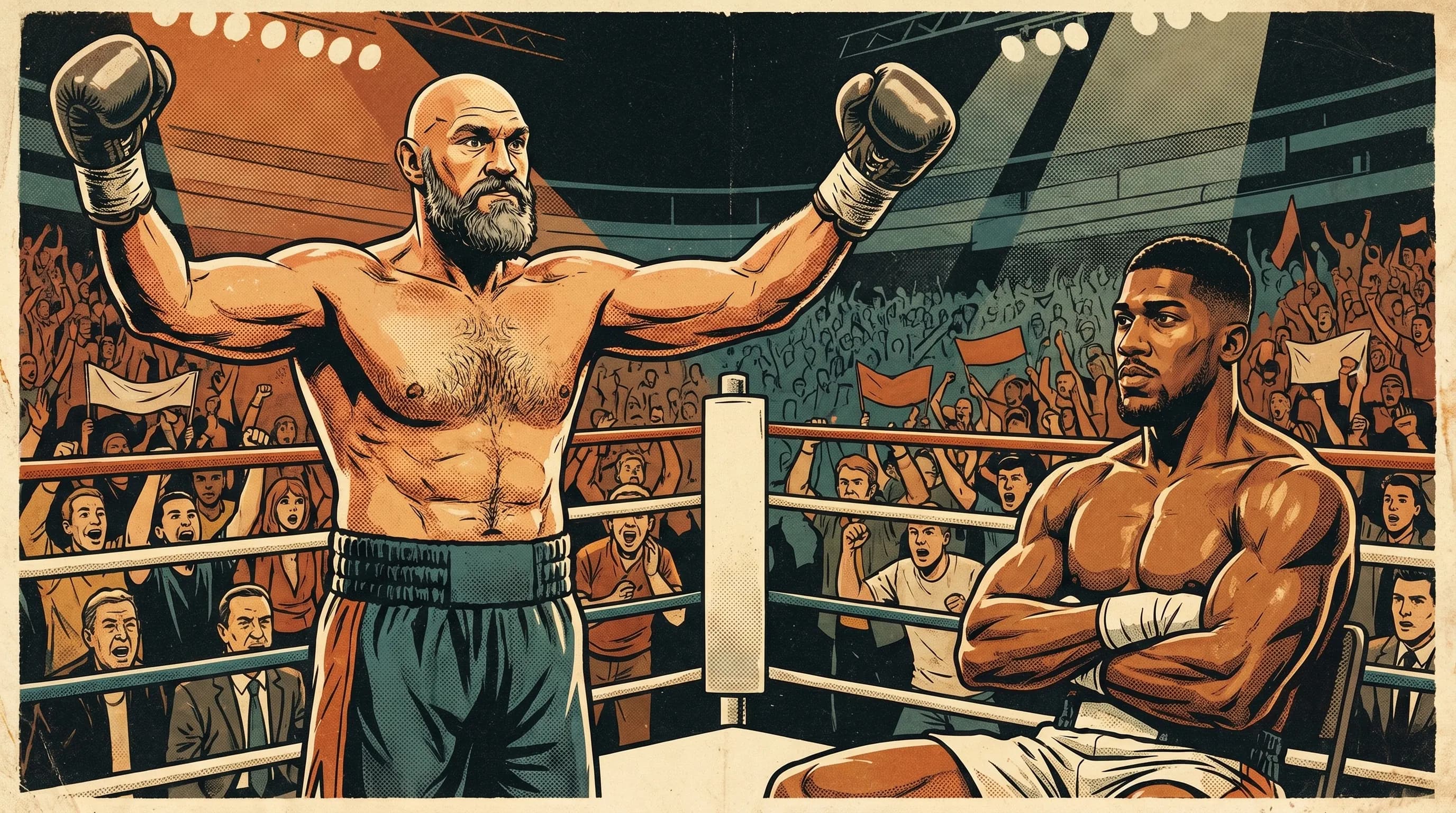
Tyson Fury stood in the ring at Tottenham Hotspur Stadium, having just beaten a man most casual fans couldn't name, and issued a challenge to Anthony Joshua with all the theatrical urgency of someone who knows the phone won't ring. "I challenge you, Anthony Joshua, to fight me next. Do you accept?" Joshua, sitting ringside — close enough to smell the sweat — did not accept. He called Fury a "clout chaser." And with that, the longest-running bluff in heavyweight boxing entered its second decade.
Two Men Shouting Across a Room Neither Will Cross
The facts are plain. Fury is 37 years old. He'd been out of boxing for 15 months before beating Arslanbek Makhmudov by wide decision. His record now carries two defeats, both to Oleksandr Usyk. Joshua was right there at ringside, presumably paying good money to watch a fight he could have been in. Talks apparently exist for a September meeting at Croke Park in Dublin. They are, as always, unconfirmed.
Negotiations for Fury-Joshua have collapsed multiple times over the past decade.
Joshua's response told the whole story in a single sentence: "You aren't going to tell me what to do — I've been chasing you for 10 years." That's not the language of a man eager to sign. That's the language of a man building an alibi.
The Prisoner's Dilemma in 10-Ounce Gloves
Here's what makes Fury-Joshua genuinely fascinating — and it has nothing to do with who would win. It's a textbook case of a fight where the downside of losing vastly outweighs the upside of winning.
Think of it like two restaurant owners on the same street. Both are famous. Both have loyal customers. If they merge, one of them is going to end up washing dishes. Better to stay on opposite sides of the road, talk loudly about how the other guy's food is terrible, and let the legend of the rivalry do the marketing.
For Fury, winning would confirm what his fans already believe — that he's the best heavyweight of his generation. Nice, but redundant. Losing, however, would mean his third defeat, his second in a row if you count the Usyk losses, and this time to a domestic rival who'd never let him forget it.
For Joshua, the calculus is even worse. Beat Fury and you've beaten a 37-year-old coming off a year-and-a-half layoff with two recent losses. The headline writes itself: "Joshua Beats Diminished Fury." Lose to that same Fury and your legacy as a serious heavyweight contender is functionally over. There is no version of this fight where the winner's stock rises as much as the loser's stock falls. It's a legacy destruction device disguised as a sporting event.
This is why the negotiations keep collapsing. Not because the money isn't there. Not because the venues aren't available — Croke Park in September sounds lovely, weather permitting. The negotiations collapse because both camps are engaged in an elaborate kabuki performance where the goal is to look willing while ensuring the other side pulls out first. It's the heavyweight division's longest-running game of chicken, played by two men in Range Rovers who both secretly want to take the exit ramp.
The Division Is Leaving a Voicemail They Won't Check
While Fury and Joshua rehearse their lines for the next round of "will they, won't they," the heavyweight division is quietly reorganising itself around younger, hungrier fighters who didn't get the memo that they were supposed to wait.
Oleksandr Usyk — the man who beat Fury twice, unified the heavyweight titles, and remains unbeaten — defends his WBC title against Rico Verhoeven on 23 May in Egypt. Verhoeven is a kickboxing champion making a rare switch to boxing, which tells you something about how thoroughly Usyk has cleared out the division's credible threats. When you're fighting kickboxers, you've either run out of boxers or you're collecting experiences like stamps.
More telling is what Usyk did with the WBO title: he vacated it rather than face Fabio Wardley. That belt now lives in a different ecosystem entirely. Wardley defends it against Daniel Dubois on 9 May in Manchester, with Moses Itauma — who recently beat Jermaine Franklin — sitting as WBO No. 1 challenger. Lawrence Okolie fights Tony Yoka on 25 April. Even Derek Chisora has hinted at a return, which is the heavyweight division's equivalent of your dad saying he could still run a marathon if he really wanted to.
The point is this: the division is moving. Titles are changing hands. Young fighters are climbing rankings. And Fury and Joshua are standing in the car park arguing about who was supposed to book the table.
The Comfortable Prison of "What If"
Fury has stated he is not interested in fighting anyone except Anthony Joshua. Read that again. A 37-year-old heavyweight with two recent defeats and a 15-month layoff has publicly declared that the only fight he wants is the one that has failed to materialise for a decade. That's not ambition. That's a retirement plan with better PR.
By naming Joshua as his sole target, Fury accomplishes something clever: he gets to remain "active" in the public conversation without having to fight anyone dangerous. If Joshua says no — and Joshua keeps not saying yes — Fury can shrug, blame the other man, and maintain the fiction that he was ready and willing.
Joshua, for his part, gets a mirror-image benefit. By showing up ringside, by engaging publicly, by firing back with "clout chaser," he stays relevant to the Fury conversation without committing to anything. Both men are feeding off the same myth: that this fight is always just around the corner. The myth is more valuable than the reality could ever be.
Because the reality — two ageing fighters, one with consecutive losses, the other with nothing to gain — would be a Wednesday night on a streaming service within three years of actually happening. The fantasy, though? The fantasy is eternal. The fantasy sells out Croke Park in September. In theory. Always in theory.
The Verdict
Fury-Joshua is not a fight that keeps falling apart. It's a fight that keeps succeeding at exactly what it's designed to do: not happen. Both men have more to lose from fighting each other than from spending another decade explaining why they haven't. The September date at Croke Park will join the graveyard of previous September dates, December dates, and springtime dates before it.
Meanwhile, Wardley will defend his title. Itauma will keep climbing. Usyk will keep winning. The division will crown new stars, tell new stories, and fill new arenas. And Fury and Joshua will still be standing across the ring from each other at press conferences in 2028, jabbing microphones instead of each other, performing outrage for cameras, absolutely certain that this time it's really happening.
It isn't. And both of them know it. That's the whole point.