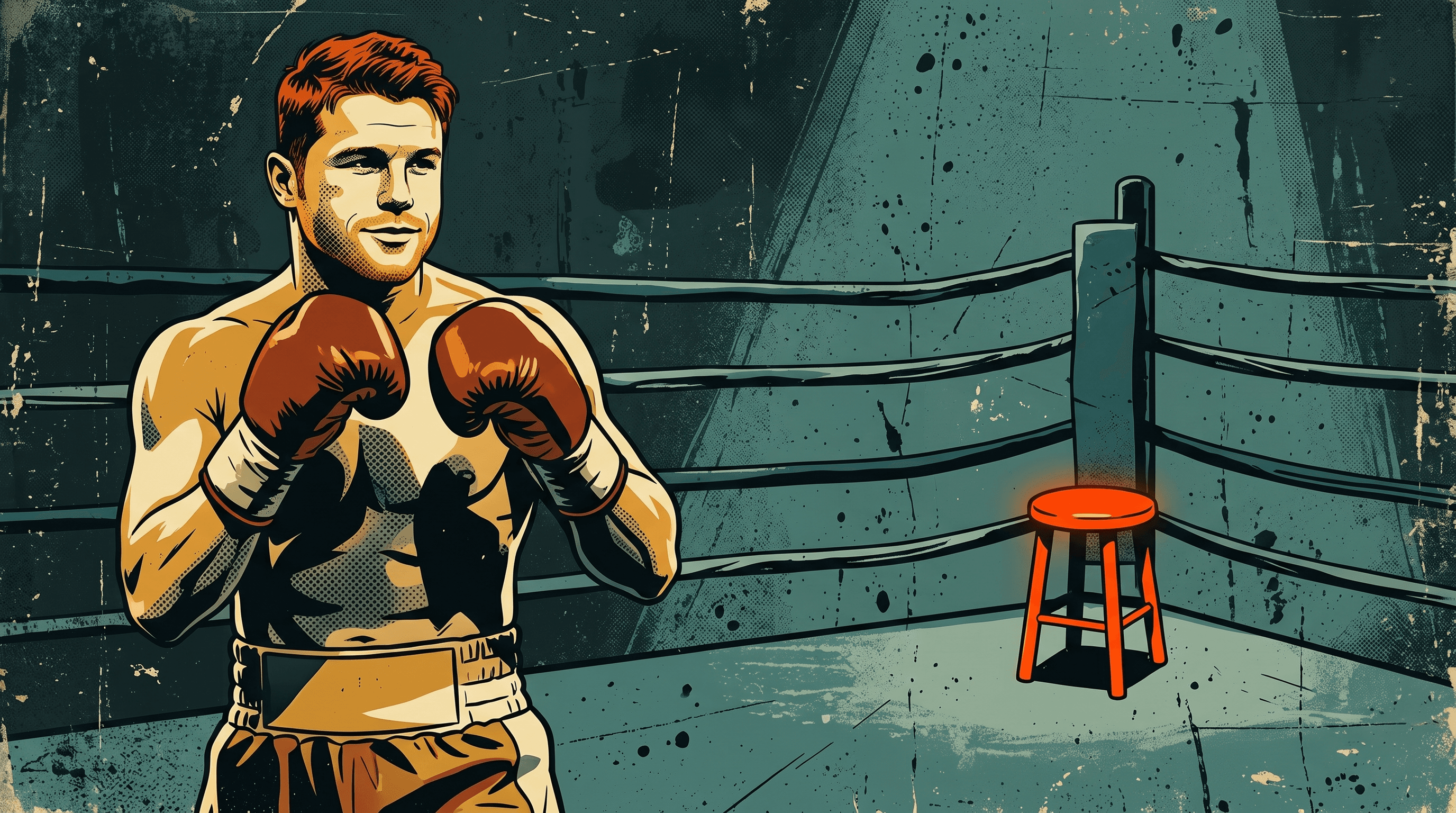
The Longest "No" in Boxing
Canelo Álvarez doesn't need to lose to David Benavidez. He already has. Not in the ring — in the court of public opinion, where the verdict was delivered slowly, over years of silence, and is now essentially irreversible. The most commercially dominant figure in modern boxing has spent so long not fighting one man that the avoidance itself has become the answer to the question everyone was asking.
What We Know
Here is what is not in dispute. Canelo Álvarez is a multi-division champion with a career built on timing, upper-body defence, body punching, compact counters, ring IQ, and a composure that borders on eerie. He fights in measured bursts — controlled exchanges where he slips and rolls at close range, finds leverage in the pocket, and makes opponents pay for every committed punch. By any honest measure, one of the most technically refined fighters of his generation.
Then there's Benavidez. Younger. Physically larger. Heavier. Fast hands for a big man, sustained offensive pressure, high-volume punching, and combinations that carry genuine spite. He has operated around super middleweight and the lighter edge of light heavyweight territory. He is also — and this matters — hittable during exchanges, offering openings in rhythm that a counter-puncher of Canelo's calibre would, in theory, feast on.
And yet.
Canelo has historically controlled his own career path and opponent selection. The Benavidez fight has been publicly demanded by fans for years. It comes up every time Canelo announces a next fight, and the name across from him isn't Benavidez. As of today, the fight has not been signed. The matchup exists in a permanent state of "being discussed," which in boxing is a polite way of saying "not happening."
The Tell
The conventional framing treats this as a superfight waiting to happen — two Mexican-heritage warriors, a proposed twelve-round war, the old king versus the young challenger. It's a compelling narrative, and it's also the wrong one.
The real story is simpler and more damning: a fighter who controls his own opponent selection has chosen, repeatedly, not to select the opponent everyone wants him to face. That's not a scheduling conflict. That's information.
Consider the logic. Canelo's style is built for exactly this type of opponent. Benavidez comes forward, throws in volume, and opens himself up during exchanges. Canelo is a counter-puncher with elite timing and defensive movement in the pocket. On paper, this is a stylistic gift. A pressure fighter who's hittable walking into the most precise counter-puncher of the era? Canelo should be requesting this fight with the enthusiasm of a man who's found a twenty-pound note on the pavement.
Instead, we get years of silence punctuated by vague references to future possibilities.
The Boogeyman Theory
Benavidez has been called a "boogeyman" opponent for Canelo, and the label sticks because it captures something the technical analysis misses.
Think of it like this. Imagine you're very good at chess. World-class, even. You've beaten grandmasters. You know every opening, every endgame technique. Now imagine someone challenges you to a chess match, but their pieces are 30% bigger than yours, and every time they take one of your pieces, they slam it off the board hard enough to rattle the table. You might still be the better chess player.
That's the Benavidez problem. Canelo's entire system — the compact counters, the leverage in the pocket, the controlled exchanges — depends on operating at close range against opponents whose physical dimensions he can manage. His upper-body defence works because he's calibrated it over years of training camps and title fights against fighters he could read and absorb. Benavidez is bigger, heavier, and throws with a volume and pressure that doesn't pause for Canelo to find his rhythm.
The technical response is obvious: Benavidez is hittable. He gives openings. A counter-puncher should exploit those. And that's true — in the same way that it's true that a matador should be fine against a slightly larger bull. Technically correct. Emotionally unconvincing.
Canelo fights in measured bursts. Benavidez fights in sustained storms. The question isn't whether Canelo can land clean counters — he almost certainly can. The question is whether measured bursts are enough against a man who doesn't stop throwing, who's bigger in every dimension, and who hits with combinations that don't politely wait for the defensive response.
Public perception has drifted in a revealing direction. For years, the default assumption was Canelo's class would prevail. But as the delay has stretched on — years now, not months — more and more observers have begun to interpret the avoidance itself as evidence. Not proof that Canelo would lose, but proof that Canelo thinks he might.
Strategic Genius or Strategic Cowardice?
Here's where the framing matters. Canelo's supporters would argue — and they're not entirely wrong — that controlling your opponent selection is smart business. You protect your legacy, maximise your earnings, and fight on your terms. Every great champion has done it to some degree. This isn't avoidance; it's career management.
Fine. But career management has a shelf life. When you've managed your career so carefully that the biggest fight available to you goes unmade for years, the management starts to look less like strategy and more like confession. It's the difference between a CEO who "strategically restructures" and one who's clearly just afraid of the quarterly earnings call.
The beautiful irony is that Canelo doesn't need to beat Benavidez to silence the critics. He just needs to fight him. Show up, take the risk, and either win on skill or lose on his shield. Boxing fans forgive losses. They don't forgive ducking. The sport's history is littered with fighters who lost and gained more respect than they'd ever earned winning.
And Benavidez, for his part, doesn't need to win to answer the question that's been hanging over Canelo's legacy. He just needs to show up and be what everyone suspected he was: the fight Canelo couldn't control. If Benavidez pushes Canelo to uncomfortable places — makes him survive rather than manage, forces the measured bursts into something desperate and ragged — then the years of avoidance retroactively become the most honest thing Canelo ever communicated. His silence was his scouting report, delivered to the public in real time, and we just didn't want to read it.
The Verdict Is Already In
Every month this fight remains unsigned, Canelo's position weakens. Not because Benavidez is getting better — though youth and size aren't depreciating assets — but because the narrative has already calcified. The commercial face of modern boxing spent years choosing who he fought, and the one name he kept not choosing told us everything we needed to know.
Canelo Álvarez may well be the better fighter. He may walk into a ring against Benavidez someday and prove every doubter wrong with twelve rounds of technical mastery. But he's already lost the only fight that mattered: the one against the clock. The window where beating Benavidez would have been proof of greatness has closed. Now it would just be damage control.
The longest tell in boxing history has already been read. The cards are face up on the table. The only question left is whether Canelo will play the hand anyway — or fold, and confirm what the silence has been saying all along.