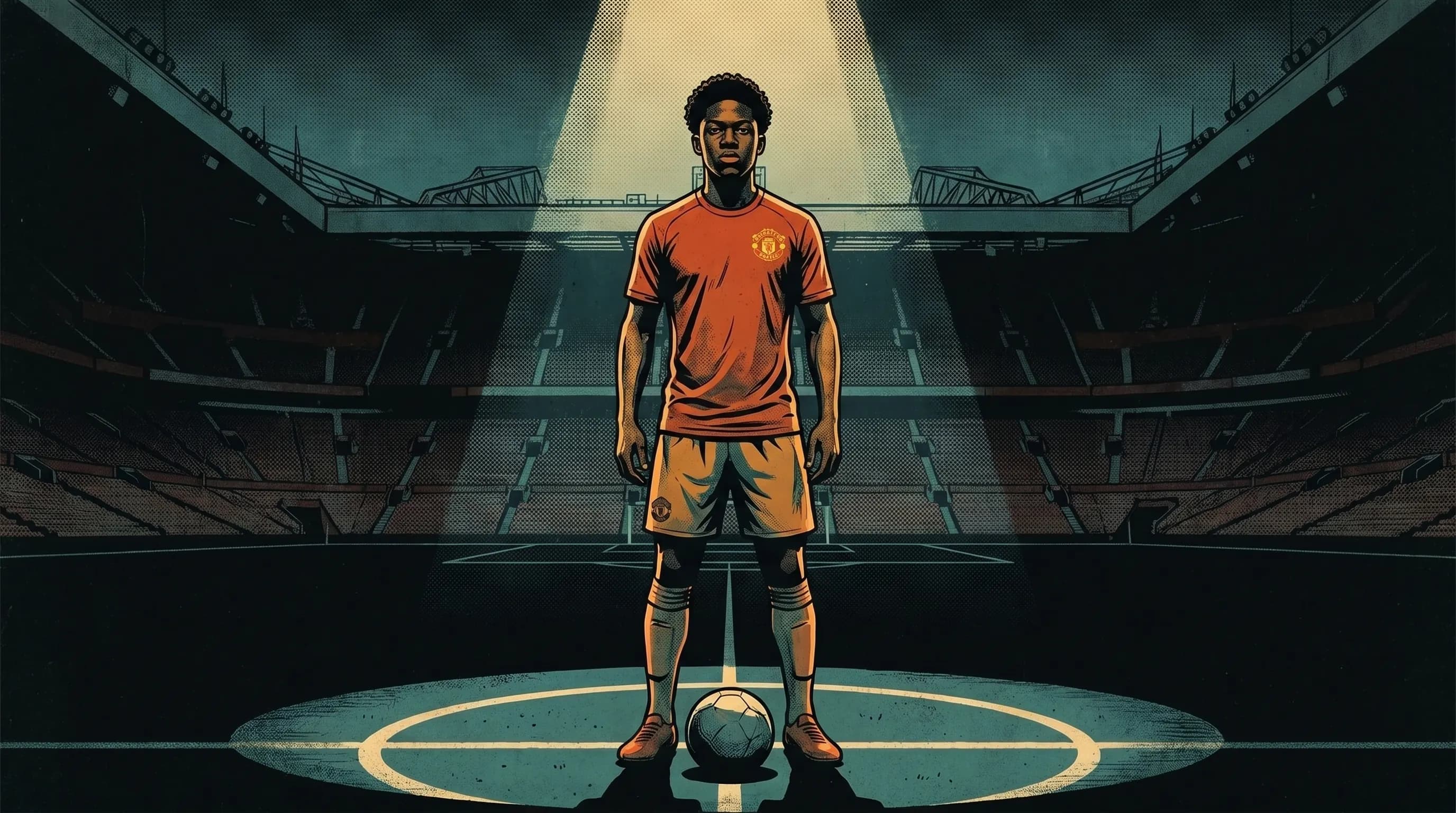
Kobbie Mainoo had every reason to leave Manchester United. He stayed anyway. That tells you more about both parties than any press conference ever could.
What Actually Happened
Mainoo has signed a new contract at United until 2031. Five years. The length matters less than the context.
Under Ruben Amorim, Mainoo was frozen out badly enough that he pushed for a January loan to Napoli. Think about that for a second. A homegrown midfielder, one of the most naturally gifted young players in English football, wanted out — not because he'd fallen in love with Serie A, but because his own manager couldn't find a use for him. United blocked the move. They told him he was valued. Then Amorim left, Michael Carrick came in, and Mainoo walked straight back into the centre of the team.
So the contract is not really a contract. It's the end of a small crisis that should never have happened.
The Mirror
Here's the part most coverage will skip past: this decision is a character X-ray of both the player and the club, and the images are fascinatingly different.
Start with Mainoo. A young player who got benched, humiliated by omission, and watched his club stumble through yet another managerial upheaval — and his response was to sign for five more years. That is not the behaviour of someone chasing the path of least resistance. In an era where young players treat clubs like Airbnbs — nice for a season, but you keep your options open — Mainoo chose to nail himself to the floorboards.
Now look at what the same decision reveals about United. They nearly lost him. Not to a rival outbidding them or a player chasing Champions League football, but to their own internal confusion. The fact that a player of Mainoo's quality was ever in a position where leaving felt necessary is an indictment of how the club was being run. That they managed to correct course and keep him is not a triumph. It's a narrowly avoided disaster dressed up as good news.
Both readings are true at once, which is what makes this interesting. Mainoo's commitment is genuine and admirable. United's relief should be enormous and slightly embarrassing.
What Makes Him Worth the Fuss
If you don't watch United regularly, you might wonder why one midfielder's contract generates this much noise. Fair question.
Mainoo's defining quality is something coaches call press resistance — the ability to receive the ball when opponents are swarming and not panic. Most midfielders in that situation do one of two things: they boot it long, or they get dispossessed. Mainoo does a third thing. He keeps it, turns, and plays forward. It sounds simple. It is extraordinarily rare.
Imagine you're in a crowded bar trying to carry three pints back to your table. Most people stop, wait for gaps, shuffle sideways. Mainoo is the person who glides through the crowd without spilling a drop, and somehow arrives at the table having also picked up a bag of crisps. He processes space and pressure one beat faster than the people around him.
That press resistance feeds into everything else he does well. He gives defenders a safe passing option when the team is under siege. He carries the ball through midfield when the alternative is aimless hoofing. He connects defence to attack without requiring the ball to take a detour through the stratosphere. United, a team that has spent recent years looking like they'd never been introduced to each other in midfield, desperately need that.
He is not the finished product. His final-third output needs work. His physical durability is unproven over sustained seasons. But the bones of the player — the spatial intelligence, the composure, the technical security — those are elite. What United are really paying for is not the midfielder he is today. It's the midfielder he could be by 2029.
Why Staying Was the Smart Bet
There's a logic to Mainoo's choice that goes beyond sentiment, even if sentiment clearly played a role.
At a settled superclub — your Madrids, your Man Citys — Mainoo would be one talented midfielder in a squad full of them. He'd get minutes, sure. But he wouldn't get ownership. At United, right now, the midfield is his to define. The club is still figuring out what its team should look like, and Mainoo is positioned to become the player around whom those decisions get made. That's not just playing time. That's architectural influence.
There's also something to be said for growing up under pressure rather than in comfort. United is a furnace. Every performance is scrutinised. Every bad game makes back pages. For a young player with the right mentality — and Mainoo's decision suggests he has exactly that — this kind of environment doesn't stunt growth. It accelerates it.
And then there's the obvious thing, the thing that's hard to quantify but impossible to ignore: he's from there. He came through the academy. He understands what the badge is supposed to mean. In a squad full of expensive imports still working out where the good coffee shop near Carrington is, that identity carries real weight.
The Catch
None of this matters if United waste him again.
Keeping Mainoo is step one. Step two — giving him the right role, the right midfield partners, the right tactical stability — is where this club has historically fallen apart. They have a pattern: identify a talented young player, celebrate the contract extension, then proceed to surround him with chaos until his potential quietly curdles.
Mainoo can become one of the best midfielders in England. That is not flattery; the technical profile supports it. But a player who thrives on calm, structure, and progressive possession cannot develop properly inside a club that changes its entire football philosophy every eighteen months.
The contract is a promise. The next five years will determine whether United can keep it.
The Definitive Read
Kobbie Mainoo chose difficulty over comfort, belonging over optionality, and long-term ownership over short-term safety. That is the decision of a player who believes he is good enough to matter at the biggest club in England — and who wants to prove it on the hardest possible stage.
Manchester United, for their part, got lucky. They created the problem, nearly lost the player, and stumbled into the right outcome. The contract is a correction, not a masterstroke.
But corrections matter. Especially at a club that has spent the better part of a decade refusing to make them.