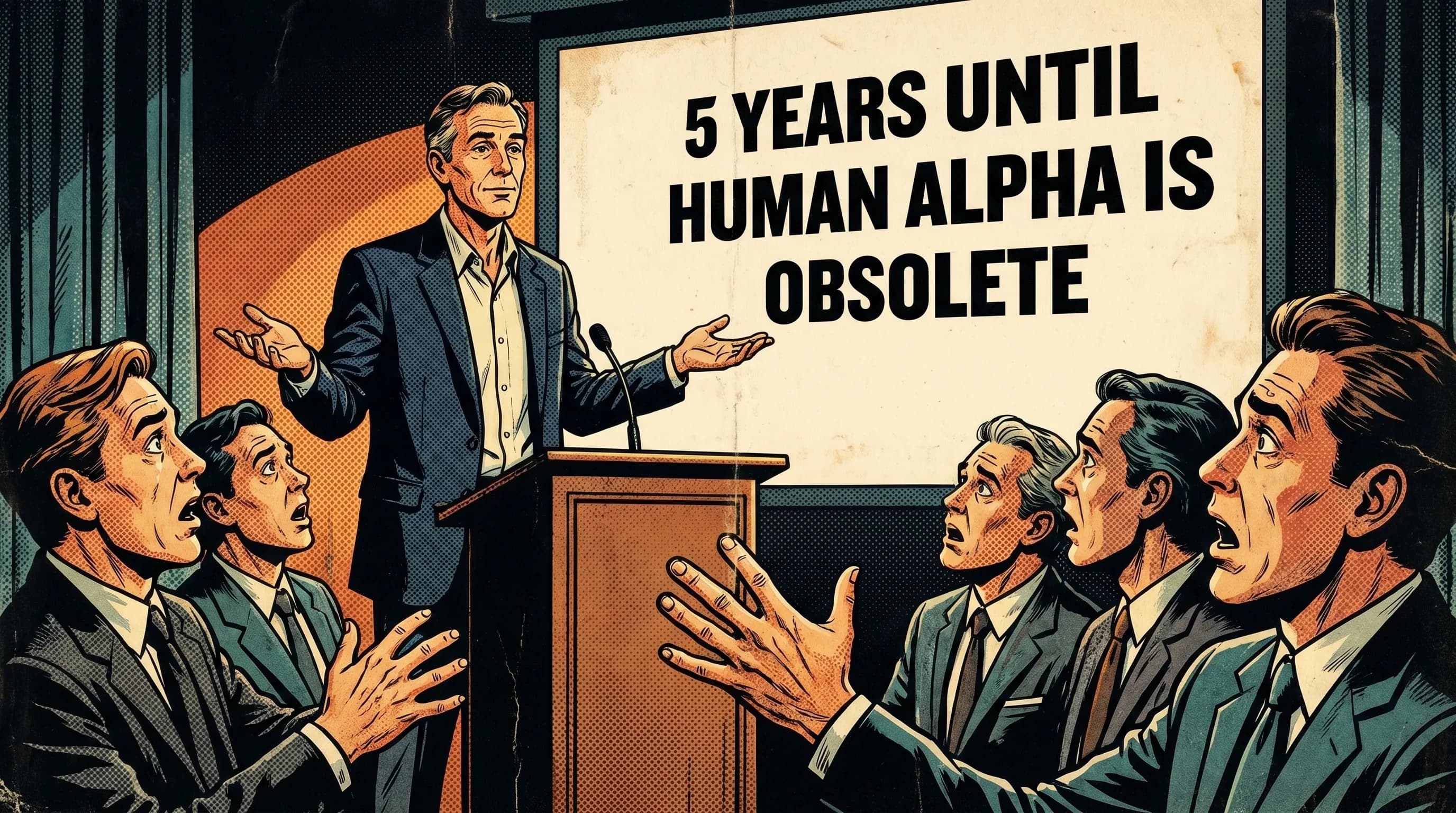
The most remarkable thing about Raoul Pal telling an audience of investors they have five years before machine efficiency makes human alpha obsolete is that he said it calmly, in passing, as though announcing train delays.
This Is Not a Hype Piece
Arpan, the CEO of a company called Beep, sat down with macro investor Raoul Pal in April 2026 for what the outside world would probably read as a standard crypto-infrastructure interview: two men enthusiastic about agents, blockchain, and the future of finance. And yes, there is a product being discussed. Beep has launched payment infrastructure for AI agents, is building yield and trading tools, and has a roadmap stretching to end of 2026 with prediction markets, tokenized agents, and custom financial models.
All of that is fine. What is not fine — or rather, what is extraordinary and keeps getting buried under product announcements — is a single quote from Pal delivered without drama: "You've got 5 years to make as much money as possible because after that the alpha might compress."
800 Trillion Economic Actors
Here is the thing about the current moment that most commentary gets wrong: people treat AI agents as a productivity story. More output, same humans, great stuff, everyone wins.
That is not what is happening.
There are roughly 8 billion humans using the internet today. Within two to three years, the projection is that each of those humans could be running 100,000 or more agents. That is not 8 billion economic actors anymore. That is 800 trillion economic actors — a number so large it barely fits in a sentence without sounding made up.
The current human GDP runs at around $105 trillion trailing twelve months. Machine GDP — what agents produce and transact — is currently near zero. The entire premise of Beep's existence, and of Pal's five-year warning, is that those two lines are about to cross, and the crossing will not be gradual.
The Cost Curve Is the Story
To understand why this is not science fiction, you need to understand the cost curve, because this is where it gets genuinely strange.
Think of it like this. Imagine hiring a financial analyst. In 2024, an AI agent that could do that job cost around $10 a day. Expensive enough that only hedge funds and early adopters were deploying them seriously — the same way only large companies could afford mainframes in 1970.
Now watch what happens as the price drops.
At $1 a day, the projection is that every DeFi protocol has agents running on it. That's not ten companies or a hundred. That's every protocol — which is like saying every corner shop suddenly has a full-time Bloomberg terminal.
At $0.01 a day — one cent — every crypto wallet has built-in agents. At micro-cents per day, we are talking about deployment at a scale that makes "every wallet" sound conservative.
This is Jevons Paradox in its most aggressive form. William Jevons observed in the 19th century that making steam engines more efficient did not reduce coal consumption — it exploded it, because efficiency made steam economically viable for a thousand new applications that previously couldn't justify the cost. The same logic applies here with terrifying precision. Every time agent costs drop by an order of magnitude, a new category of user that couldn't previously justify deployment suddenly can. And then does. And then ten times more than you expected.
The industry calls this trajectory toward something they're labeling the "economic singularity" — a point where machine economic capability surpasses human economic capability. It is a vague term, and nobody has a precise definition for it. But the direction of travel is not vague at all.
The Only Argument That Actually Matters
While most people are arguing about whether AI can write code better than a junior developer (it can, move on), a quieter and more consequential build is happening at the plumbing level.
The HTTP 402 standard — called Agent 402 or A42 — is being developed as zero-fee payment rails specifically for machine-to-machine transactions. This matters because AI labs currently pay for the data they train on via wire transfers. Wire transfers. As though we are buying a horse. The A42 standard is an attempt to build native financial infrastructure for agents the way HTTP built native infrastructure for web pages.
There is also ERC-8004, a proposed standard for agent identity, and Walrus, a decentralized storage system designed to hold agent context and memory. Beep chose to build on SUI specifically because of its object-oriented architecture — on SUI, agents are objects that natively hold wallets, rather than wallets bolted awkwardly onto agents after the fact.
None of this is sexy. It is the equivalent of arguing about TCP/IP in 1993.
The Part About You, Specifically
There is a concept floating around these conversations called "zero-human corporations" — organizations that run without any human employees in the operational loop. Nobody has a clean example yet, and the definition remains frustratingly thin. But the logic is straightforward and, if you sit with it, fairly uncomfortable.
Two-thirds of current human GDP comes from outside the US — emerging markets, where human labor is often the primary competitive advantage in knowledge work. If agent costs hit $0.01 a day, the labor cost argument evaporates. Not for factory workers. Not for surgeons. But for analysts, traders, researchers, and anyone whose job is primarily moving and interpreting information? The math does not work in their favor.
The tokenized information angle is its own strange corner of this. The thesis, associated with a group called Revit Capital, is that corporations will eventually tokenize and sell information the way they currently sell products. Real Vision's own trading strategies — currently sitting on a hard drive somewhere, generating value for internal use only — could theoretically be packaged and sold to AI labs who would otherwise be sending wire transfers to buy it. The "token factory" model, they're calling it.
It sounds slightly absurd. So did selling banner ads in 1996.
What Raoul Pal Actually Said
Strip away the infrastructure roadmaps, the blockchain choices, and the product roadmap, and what Pal is describing is a compression event. Human financial edge — the ability to read markets, identify mispricings, act faster than the consensus — has always depended on other humans being slower, more emotional, or less informed. Remove the humans, replace them with 800 trillion agents running on micro-cent economics, and the information asymmetries that generate alpha collapse.
Pal has been right about enough macro calls to be taken seriously when he's pessimistic. This is the pessimistic reading of his own industry, offered cheerfully, as a motivational framing for doing more of it faster before the window shuts.
Which is, when you think about it, a fairly surreal way to spend a Tuesday afternoon.
The Honest Conclusion
The agentic economy is not an opportunity story. It is a transition story, and transitions have losers. The five-year window Pal describes is not an invitation to get rich slowly — it is a warning that the current rules of the game have an expiry date stamped on the bottom, and most people haven't checked.
The infrastructure is being built. The cost curve is moving the way cost curves always move. The only real question is whether you treat the next five years as a runway or a countdown.


