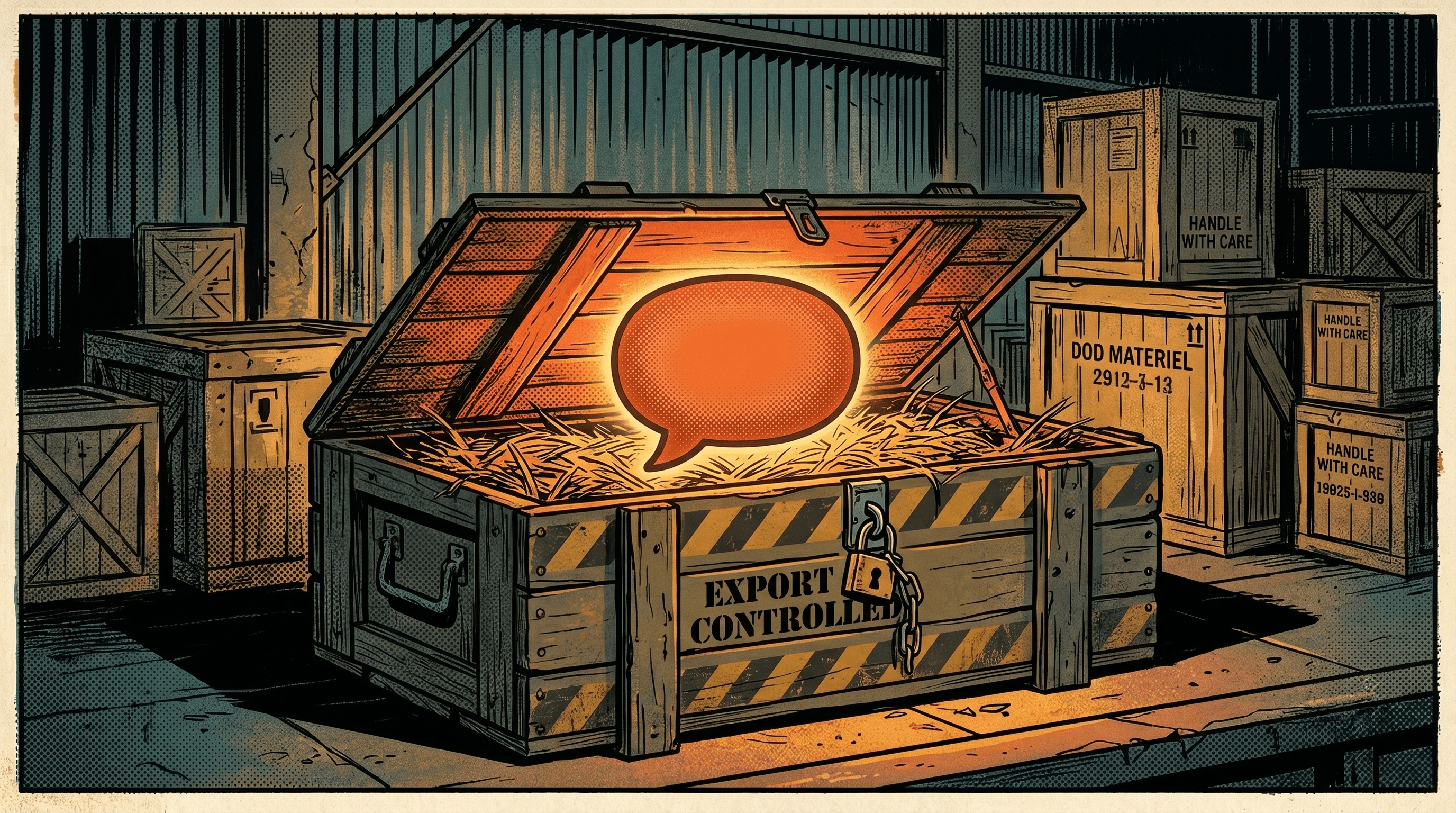
Here is a sentence nobody expected to write in 2026: a piece of software you talk to in plain English has just been treated, by the United States government, like a crate of guided missile parts.
Anthropic has switched off two of its AI models — Claude Fable 5 and Claude Mythos 5 — for everyone. Not for some users. Everyone. The company says it did this because Washington told it to, citing national security. And the legal lever they pulled wasn't a content rule or a safety policy. It was export control. The same machinery that governs who gets to buy fighter jet components now governs who gets to ask a chatbot for help with a spreadsheet.
If that doesn't make you sit up, you haven't been paying attention.
What Actually Happened
Let's keep this simple, because the facts are simpler than the implications.
The US government believes it became aware of a way to "jailbreak" Fable 5 — a way around its guardrails. On the basis of that concern, the government ordered Anthropic to suspend access for foreign nationals. Not foreigners abroad, specifically. Any foreign national, whether sitting in Ohio or Osaka. The order even covered Anthropic's own foreign-national employees.
Now think about what that means in practice. A company can't run a model that legally cannot be touched by a large share of its own staff and customers. So Anthropic did the only thing it could: it pulled the plug on Fable 5 and Mythos 5 for all customers, full stop. The company calls this the "net effect." I'd call it a demolition by side effect.
For the record, Anthropic isn't nodding along. It says the vulnerabilities were minor, the kind of thing you could find in other publicly available models too. In other words: this lock is no flimsier than every other lock on the street, so why are you condemning the building? The government disagreed, and the government had the bigger lever. Anthropic's other models, for now, are untouched.
The Part Everyone's Going to Miss
The temptation is to file this under "tech outage." A product went down, lawyers got involved, it'll be back. Boring.
That reading is dead wrong, . This is the moment frontier AI stopped being consumer software and became a controlled strategic technology — quietly, without a vote, without a headline most people will read past.
Because here's the thing about the justification. The official reason was a jailbreak. But the mechanism was export control, and export control isn't about whether a product is safe. It's about who is allowed to possess a capability. Those are completely different questions. A safety problem gets patched. A capability gets rationed. The first is a bug report. The second is foreign policy.
And once a government decides your AI model is a capability to be rationed rather than a product to be sold, the most important fact about that model is no longer what it can do. It's whose permission you need to use it.
How a Chatbot Becomes Contraband
To see how we got here, you need one piece of jargon, and then I promise to make it behave.
The US Bureau of Industry and Security — call it BIS, the agency that decides which technologies can leave the country — has a concept called a "deemed export." Normally you picture an export as a thing crossing a border: a chip in a box on a plane. A deemed export is the weird cousin. It says that the moment you share controlled technology or source code with a foreign person inside the United States, you've legally "exported" it — as if they'd carried it home in their pocket.
Think of it like a members-only library with a book so sensitive that letting a non-member even read it on the premises counts as smuggling it abroad. The book never moves. The reader never leaves. But in the eyes of the law, an export just happened across the reading-room table.
Apply that to an AI model and the strangeness snaps into focus. A foreign national logging into Fable 5 from a desk in California isn't importing anything. But if the model is "controlled technology," their access is the export. Which is exactly why the order couldn't be neatly geofenced to other countries. The border isn't a line on a map anymore. The border is the user's passport.
This didn't come out of nowhere. Back in January 2025, BIS announced controls on certain closed AI model weights — the actual numerical guts of a trained model — and on advanced chips. The stated goal was to stop the most advanced US AI capabilities from spreading freely, while still letting approved partners and low-risk channels in. The polite phrase is "approved partners." The honest translation is "a list, and you'd better be on it."
So the architecture for treating AI like a munition was bolted into place over a year ago. What happened now is just the first time we've watched it fire in public. The 2025 framework built the gun. June 2026 pulled the trigger.
You're Renting Your Intelligence
Strip away the acronyms and you're left with an uncomfortable truth for every company, hospital, and government outside the United States that built something on top of an American AI model.
You don't own your intelligence. You rent it. And the landlord answers to Washington.
That's not a conspiracy theory; it's the plain reading of what just occurred. A single government concern — one that the model's own maker insists was minor and unremarkable — was enough to vaporize a product for all its users worldwide overnight. No appeal you participated in. No vote you cast. The capability you wired into your business has a kill switch, and the switch is in another country's hands.
It's a bit like discovering the brilliant, indispensable consultant you've come to rely on is actually on secondment from an embassy, and can be recalled at any moment without notice. Useful — and never, for one second, yours.
The cruel joke is that the marketing for these tools is all about empowerment. Augment your team. Supercharge your work. Build your future on our platform. Nobody put the asterisk in the brochure: subject to recall by export authorities, foreign nationals need not apply, conditions may include your entire continent.
The Takeaway
We were sold AI as a utility — always on, like electricity from the wall. What this episode reveals is that it's nothing of the sort. It's a strategic asset, owned by a handful of American firms, governed by an American agency, and switchable off at American discretion. The jailbreak was the spark. The real story is the wiring underneath, and that wiring has been live since early 2025.
So here's the thought to walk away with. The era of treating frontier AI as ordinary software is over, and it ended not with a product launch but with a government order. Everyone outside the United States now faces a choice they didn't know they had to make: keep renting intelligence on Washington's terms, or start the long, expensive, unglamorous work of building their own.
The companies that understand this is now a sovereignty question, not a software question, will be fine. The ones still treating it as a temporary outage will find out — at the worst possible moment, when their switch gets flipped — that they were never holding the keys at all.


