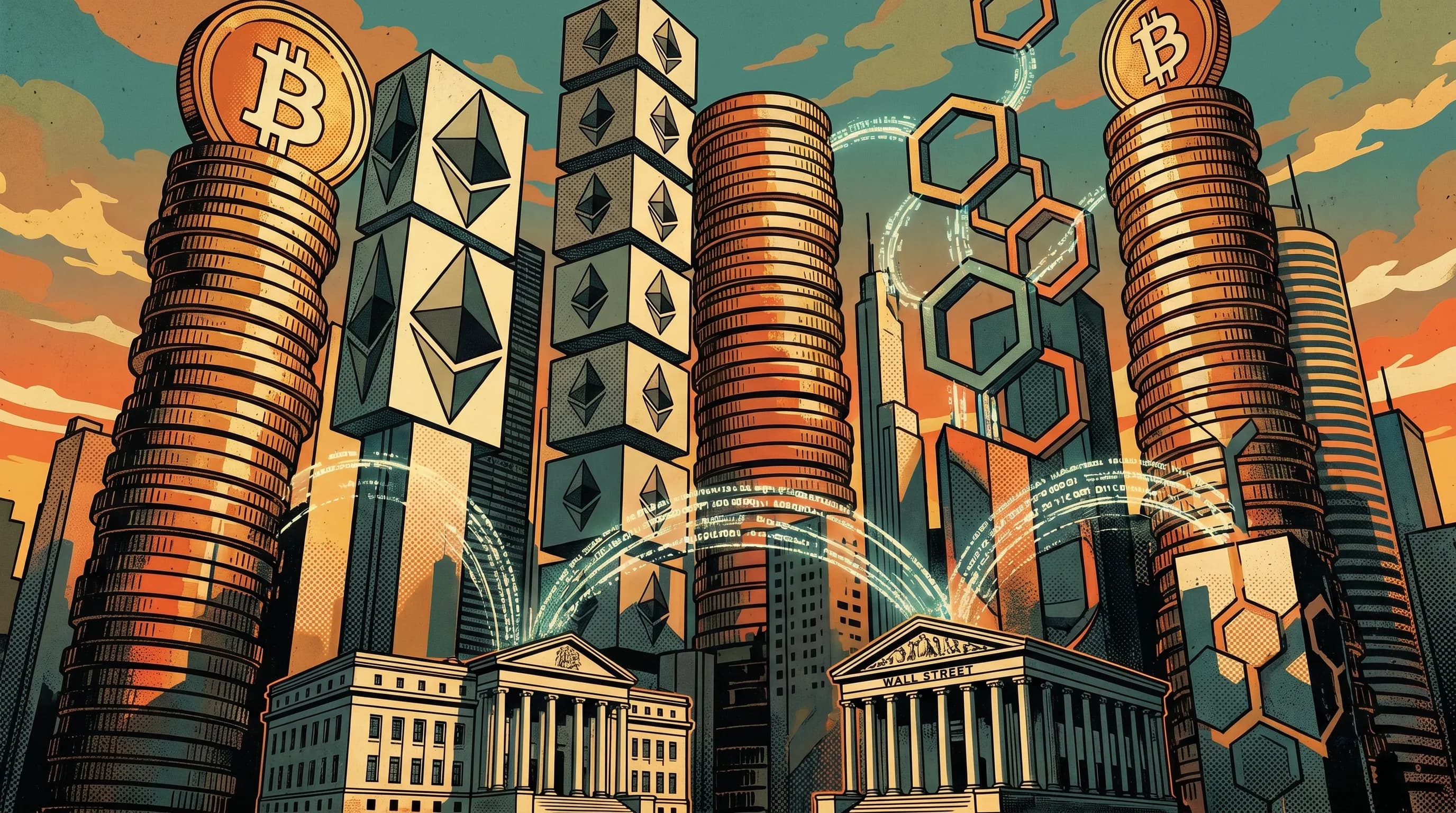
Crypto built a payment system for drug dealers and idealists. It may have accidentally built the nervous system for a $800 trillion economy that hasn't happened yet.
The true believers always said blockchain would replace banks. They were right about the destination and spectacularly wrong about the passengers. The revolution they imagined — ordinary people escaping dollar hegemony, the unbanked masses of the Global South finally plugged into the financial grid — hasn't quite materialized at scale. What has materialized, quietly and at first glance unremarkably, is infrastructure that can process millions of micropayments per second with zero friction, assign persistent identities to non-human actors, and settle value transfer in milliseconds. The humans who needed this turned out to be far less interesting than the machines that do.
The Number That Should Terrify Your Career Counselor
There are roughly 8 billion people connected to the internet. Right now, AI agents cost about $10 a day to run. That's expensive enough that only hedge funds and the technically obsessed are deploying them at scale.
But costs are falling fast. From $10 to $1. Then to a penny. Then to micro-cents. This is not speculation — it's the same curve we saw with cloud compute, with storage, with bandwidth. Every time a technology becomes cheaper by an order of magnitude, people don't use a bit more of it. They use vastly more of it, in ways nobody predicted. This principle even has a name: Jevons Paradox, coined in 1865 when a Victorian economist noticed that more efficient steam engines didn't reduce coal consumption — they caused it to explode.
So here's the arithmetic that should make you put down your coffee and stare out the window for a while.
8 billion humans. Each potentially running 100,000+ AI agents within two to three years. That's 800 trillion economic actors. For context: total human GDP right now sits at roughly $105 trillion. Machine GDP — what the agents produce — is currently near zero.
The gap between those two numbers is not a forecast. It's a gap in which an entirely new economy is waiting to be built.
For all of human history, the number of economic participants was bounded by the number of humans. Adding a new worker to the economy required roughly nine months of biological manufacturing plus 18 years of maintenance costs before you got anything useful out of them. That constraint shaped everything — every institution, every market structure, every theory of capital and labor.
Agents don't have childhoods. And at a penny a day, you can deploy ten thousand of them before lunch.
What Blockchain Was Actually Being Built For
The infrastructure crypto spent a decade building turns out to be exactly what an 800-trillion-agent economy needs to function.
Agents need to transact with each other constantly, at machine speed, in micro-amounts. A wire transfer takes days and costs $25. That's useless if your agent needs to pay another agent 0.003 cents for a piece of data. Traditional payment rails were designed for humans who think slowly and have bank accounts. They are architecturally incapable of handling what's coming.
Zero-fee micropayment rails? Check. AI labs currently paying for data via wire transfers — an arrangement so clunky it would make a Victorian bureaucrat wince — need something better. The emerging A42 standard (HTTP 402, reframed for machine-to-machine payments) is an attempt to give agents a native payment layer.
Agents also need identities. Not usernames and passwords, but persistent, verifiable identities that can hold assets, enter contracts, and accumulate reputation. ERC-8004 is that standard. Meanwhile, blockchains like SUI have been building object-oriented architectures where an agent is a first-class citizen — an object with a wallet, with memory stored on decentralized infrastructure like Walrus, capable of acting as an autonomous economic unit.
Nobody built this for agents. They built it for ideological reasons, mostly. And yet here we are.
Reed's Law Comes for Your Portfolio Theory
Networks follow predictable laws. More connections equal more value — this is Metcalfe's Law. Reed's Law goes further: when you can form sub-groups within a network, value doesn't just grow linearly with participants. It grows as a square.
Now consider what happens when the participants aren't humans who sleep eight hours and take lunch breaks, but agents running 24/7, forming and dissolving economic relationships at microsecond speed, executing arbitrage across protocols in milliseconds, managing treasury positions autonomously through the night.
The activities being created here aren't just faster versions of things humans already do. Prediction markets running at machine speed. Millisecond-level arbitrage across decentralized protocols. Continuous autonomous yield optimization. These are genuinely new forms of economic activity.
The concept emerging from this is "Machine GDP" — MGDP — a metric that doesn't exist yet in any economist's toolkit. Currently near zero. The trajectory is difficult to look at calmly.
Two thirds of existing human GDP comes from outside the United States. The agentic economy has no particular reason to replicate that geography. It exists on rails, not in countries.
The Five-Year Window (After Which You May Be Redundant)
Raoul Pal — not someone given to understatement — put it plainly: "You've got 5 years to make as much money as possible because after that the alpha might compress."
He means it literally. Capital allocation is currently a human skill. It requires judgment, pattern recognition, synthesis of vast amounts of information. These are not areas where humans maintain a permanent advantage. The same agents that will eventually run autonomous corporations (the "zero-human corporation" concept is already being discussed seriously) will also, at some point, be better at evaluating other agents than the humans currently writing checks to fund them.
The investors who grasp this aren't just making a bet on AI. They're making a bet on infrastructure — on the rails that an 800-trillion-agent economy will run on, before that economy exists and before the machines that will inhabit it can choose their own infrastructure.
Capital, famously, can now form in minutes. The memecoin experiments, whatever you think of them aesthetically, demonstrated that collective value formation no longer requires institutions, intermediaries, or time. The same dynamic applies to funding the infrastructure layer of a machine economy. The window is not theoretical. It is genuinely closing.
Wrong Ideology, Right Plumbing
The crypto movement was born in distrust of institutions. It wanted to free humans from banks. Its deepest believers wrote white papers about financial sovereignty, about censorship resistance, about giving the individual power over their own money.
What they actually built — whether they meant to or not — was a substrate for a form of economic activity that makes individual humans look like moderately interesting footnotes. The permissionless rails, the zero-fee micropayments, the on-chain identity standards, the decentralized storage for machine memory — all of it fits the requirements of an agentic economy with an accuracy that would look designed if you didn't know the actual history.
There's a philosophical tradition — going back at least to Adam Smith — of observing that markets produce good outcomes nobody planned for, through a mechanism nobody controls. The invisible hand. What's coming looks less like a hand and more like an entirely different organism.
The ideology was wrong. The plumbing was right. And the machines waiting to use it don't particularly care about the distinction.


