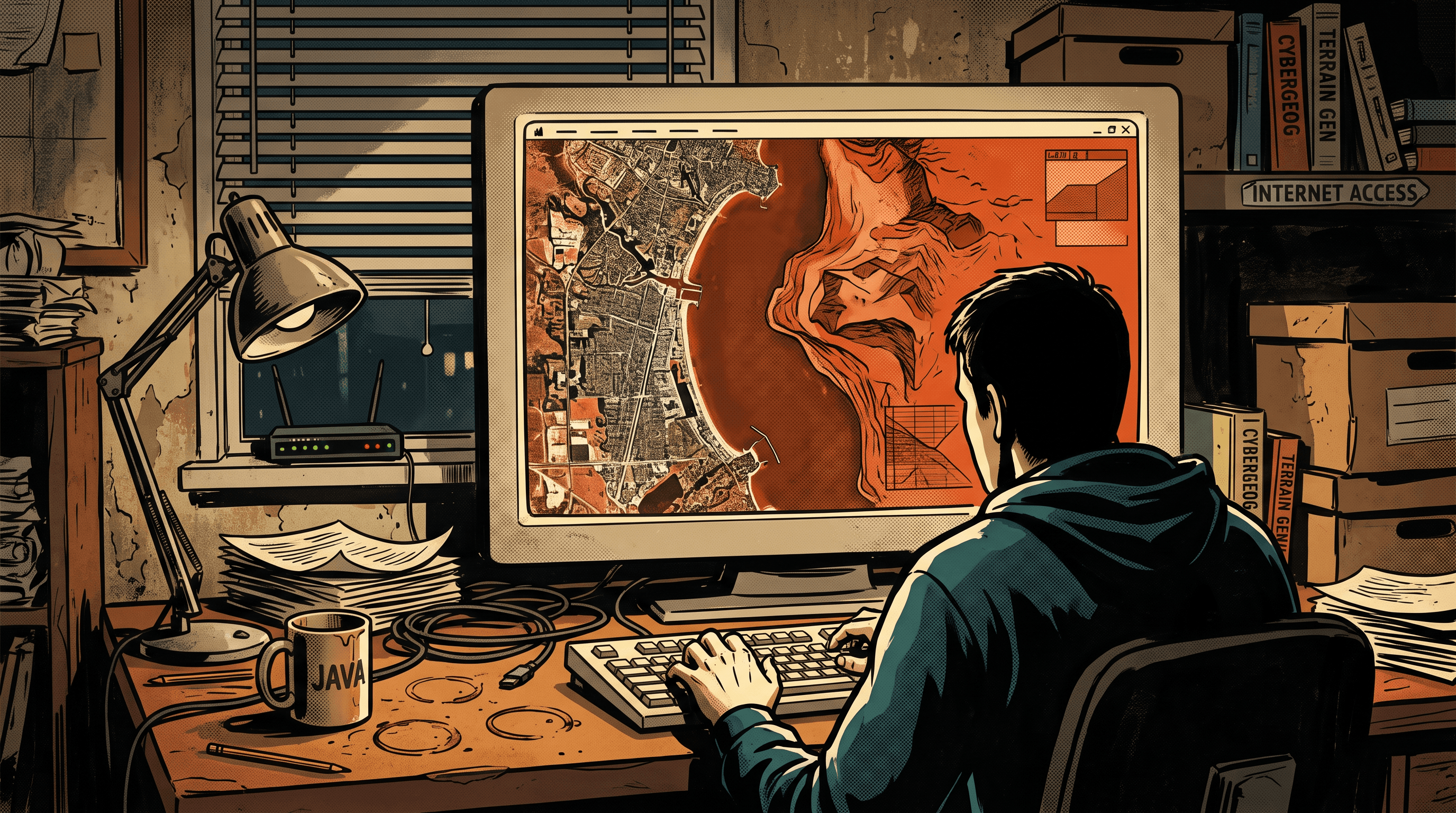
For roughly one day, the tool the world uses to check whether a photo is real could invent a photo that wasn't.
On July 30, 2026, Google shipped a feature inside Google Earth that let anyone generate AI-modified versions of the platform's satellite, aerial, and 3D imagery. It ran on Nano Banana 2, Google's image generator. Type a sentence, and Google's own view of the planet would rearrange itself to match your imagination. Bryan Horowitz, a Google Earth product manager, announced it in a company blog post and called it a breakthrough: "For the first time, you can generate custom images using Google Earth's satellite, aerial, and 3D imagery alongside Nano Banana, which creates concepts grounded in the real world."
Grounded in the real world. Keep that phrase in mind. It's about to do a lot of heavy lifting it cannot bear.
The Setup
Google showcased two friendly use cases. Real estate: drop a finished building onto the actual empty lot where it will one day stand. Education: turn the ruins of Pompeii into a "hyper-realistic view" of the town in 78 CE. Charming. Nobody is harmed by an AI reconstruction of a Roman street.
Within about 24 hours, Google announced on X that the feature was gone. Ars Technica confirmed it was inaccessible to users shortly after. Jeremy Hsu's report ran on July 31.
Here is the part worth sitting with. No regulator forced this. No lawsuit, no documented harm, no leaked memo. The reversal came from exactly two people posting on the open internet — one on Bluesky, one on a personal blog. That's the entire cavalry. Two investigators with a keyboard beat a trillion-dollar company's product team in a single news cycle.
What Google Actually Built
Investigators like Eliot Higgins, who founded Bellingcat, use Google Earth as ground truth. When a video surfaces from a conflict zone, you match the buildings, the shadows, the road layout against Google's imagery to prove where and when it was shot. Google Earth is the fixed background you measure everything else against. It's the ruler.
You do not want the ruler to be elastic. You do not want a ruler that quietly stretches to whatever length someone typed into it.
Higgins put it with the flat contempt it deserved: "Google Earth, a tool often used as a source of satellite imagery to verify photos and videos, has added a feature that allows you to alter satellite imagery with AI, for reasons." His follow-up read simply, "No way this could be abused" — attached to an AI-modified image of a giant golden Trump statue looming over the White House.
The other investigator, Henk van Ess, skipped sarcasm and went straight for the throat. In a blog post the same day, he wrote: "Tonight I typed just one sentence into Google Earth and put refugees near the Mexican border. Then I planted a nuclear plant in Iran. Then I put a fatal crash on a street in Amsterdam. Google's own satellite imagery underneath all three. What on earth is Google doing?"
Three prompts. Refugees at a border. A nuclear plant in Iran. A dead body on an Amsterdam street. Every one of them a geopolitical or human tragedy manufactured on demand, sitting on Google's authoritative map. And here's the kicker: none of the three appears to have tripped Google's "harmful topics" block. The safety net Google pointed to didn't catch a single one.
The Six Steps That Became Seconds
Picture the workflow before July 30.
Someone wanted a fake. They screenshotted the Google Earth image of the US Navy's Fifth Fleet headquarters in Manama, Bahrain. They fed it to Gemini and prompted it to transform the scene into the aftermath of an Iranian drone strike. Out came a convincing lie. That forgery went viral. It took roughly six steps.
Six steps is friction. Friction is a speed bump. Most people can't be bothered, and the ones who are leave fingerprints along the way.
The Google Earth feature collapsed those six steps into, as van Ess put it, "seconds." One sentence, one output, no detours. Google didn't invent the capability — Gemini and Nano Banana 2 could already do this, and can still do it now that the feature's gone. What Google did was remove the speed bump and pave a highway straight through the middle of its own reference map. They took the thing people trust because it's hard to fake and bolted a fake-generator to the dashboard.
That's the whole story in one image: Google put a "make it not true" button inside the tool whose only value is that it's true.
The Watermark That Guards Nothing
Google's defense, posted on X, leaned on two shields. First, SynthID — a digital watermark baked into every Nano Banana image. If you're unsure, you can ask the Gemini app or use Lens in Search to check. Second, blocks on "harmful topics," continually updated.
Let's take the watermark seriously for a second, because it's genuinely clever. Ars Technica's earlier testing found SynthID survives substantial edits and even data loss — you can hack an image around and the tag persists. When Ars tested the modified Google Earth images, Gemini dutifully confirmed it had "detected digital watermarking indicating that part or all of this image was generated or edited using Google AI tools." The technology works.
The system around it does not. Ars ran into a cap of roughly 10 SynthID checks per day. Sit with the arithmetic. Generation was unlimited. Verification was capped at about ten. You could produce a thousand fakes before lunch and check exactly ten of them. It's a fire station that answers the first ten calls and lets the rest of the city burn.
A watermark only matters if the person looking at the image bothers to check it. Almost nobody does. A lie travels through a hundred timelines before anyone thinks to right-click it, and even the conscientious ones hit the wall at check number eleven.
As for "harmful topics" — the scope is undefined, and we already know refugees, a nuclear plant, and a corpse in Amsterdam sailed right through. A filter you can't see the edges of, that missed all three published attacks, is not a safety measure. It's a press release.
What the Rollback Restored
Do not mistake the retreat for a fix. Google has not said whether the removal is permanent or just a pause while it reworks the guardrails. Nobody knows how many images got generated in that 24-hour window, or whether some are already circulating in the wild, wearing Google's imagery as a costume.
And the underlying machine is untouched. Gemini and Nano Banana 2 will still forge the Bahrain naval base for you. The rollback didn't take the capability away. It just put the six steps back.
That's the honest summary of what happened on July 31: Google restored friction, not safety. The speed bump is back. The highway underneath it never went anywhere.
The Takeaway
The reassuring reading is that the system worked — two watchdogs barked, Google listened, order restored in a day. That reading is wrong.
What actually happened is that a company built a machine to bend its own ground truth, shipped it to the entire planet, aimed a watermark checker that quits after ten swings at an unlimited supply of lies, and only backed off because two people happened to be paying attention on a slow Thursday. Ninety-three comments on the Ars report and a golden Trump statue over the White House were the entire immune response.
The next company to do this won't announce it in a blog post with a Pompeii demo. And there won't always be a Henk van Ess awake at midnight, typing refugees onto a map to prove a point. The ruler bent once. The only thing that snapped it back was luck, and luck is not a safety feature.


