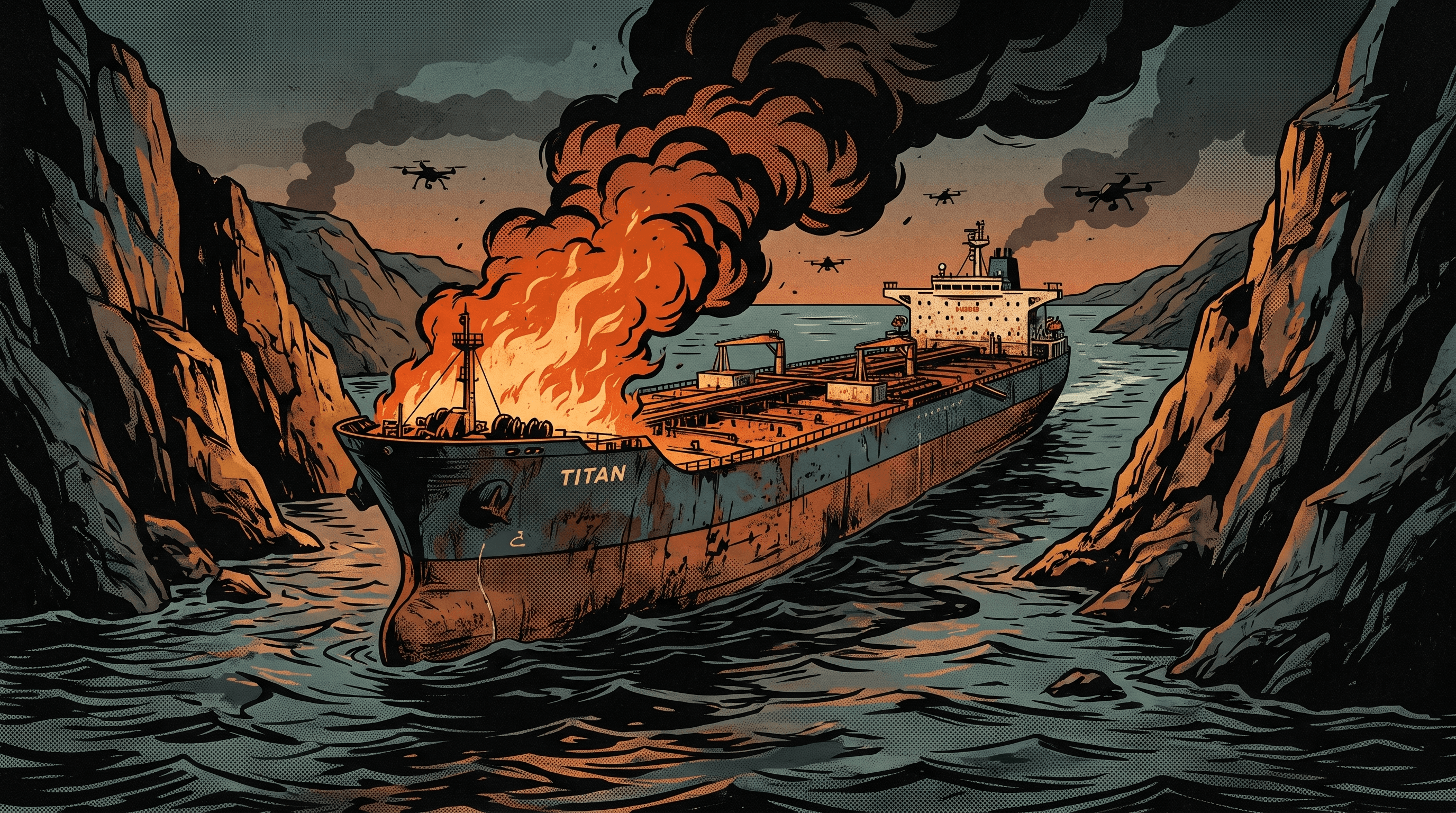
Threatening to blow up a power plant on social media is not a foreign policy. It is a mood.
And this week the mood met reality. For the twelfth night running, American forces bombed Iran. Centcom says the strikes landed at 21:30 GMT, at Trump's direction, and were meant "to further degrade Iran's ability to threaten civilian mariners and commercial vessels transiting regional waters." Read that again. Twelve nights of bombing, justified by the need to keep ships safe — and this was the week the ships stopped being safe.
The Setup
Here is what happened, stripped of spin.
On Monday, Yemen's Houthis declared a "maritime embargo" against Saudi Arabia. They say they have closed the Bab al-Mandab Strait — the Red Sea's southern gateway — to Saudi vessels. This week they claimed their first hits under that embargo: drone-and-missile attacks on two Saudi oil tankers, the Encelia and the Layla.
The Encelia is confirmed. The Saudi Press Agency says it was struck, a fire on its bow, all crew safe. UKMTO logged an "unknown projectile" hitting a Saudi tanker about 130km from Al Shuqaiq at 20:00 GMT, fire, no casualties. A UK maritime risk group, Vanguard, confirmed the hit too. The Layla is not confirmed — that one rests on the word of Houthi spokesman Yahya Saree, who also announced the group is "enforcing the 'siege for a siege' equation." Saree claims they have "forced approximately ten ships to retreat and return." Independent counts put the U-turns near Yemen at seven or more since the embargo began.
Meanwhile, at the other end of the region, Iran's Revolutionary Guard declared the Strait of Hormuz "completely closed" after an explosion. They say they stopped three oil tankers there — one caught fire on a mined route just south of the strait, two turned back. Riyadh called the Encelia strike a violation of international law, which is true and also, at this point, roughly as useful as a strongly worded Yelp review.
One Country, Both Exits
The lazy way to report this is as two separate messes: an Iran problem and a Yemen problem. That reading is comfortable and wrong.
Look at a map and the coordination is almost elegant. Saudi Arabia sells oil to the world through two doors. The eastern door is the Strait of Hormuz. The southern door is the Red Sea, reached through Bab al-Mandab. Iran is now jamming the eastern door shut with mines and explosions. The Houthis are jamming the southern door shut with drones and missiles. One country, both exits, blocked at the same moment by two actors who happen to share a patron and a grievance.
This is not weather. This is a pincer.
And the cruelest part — the part that should keep planners awake — is that the pressure was manufactured out of American firepower. Hormuz didn't close itself. It became effectively shut because of the US–Israeli war with Iran. That closure is precisely what turned the Red Sea into Saudi Arabia's critical outlet for oil in the first place. So when the Houthis slam the southern door, they aren't opening a second front. They're closing the emergency exit that the first front created. The bombing built the trap. The embargo sprang it.
The Breakdown
Picture a house with two doors and a fire alarm.
The Strait of Hormuz is the front door. It's the one everybody knows, the one on all the postcards, the narrow neck where a huge share of the world's oil squeezes out. When the US and Israel went to war with Iran, that front door effectively slammed shut. No problem, said Saudi Arabia — we'll use the back door.
Now watch the trap close. Iran holds the front door shut by dropping mines in the driveway and blowing things up until nobody wants to walk through. One tanker on that mined route caught fire; two saw the flames and reversed. The IRGC then declares the whole strait "completely closed," which in shipping terms means insurers panic, captains refuse, and the door might as well be welded.
The back door? That belongs to the Houthis. Their weapon isn't really the missile that hit the Encelia. Their weapon is the idea of the missile. You don't need to sink ten tankers. You need to sink one, film the fire, and let every other captain do the maths. Saree brags about forcing ten ships to turn around; the honest count is seven-ish. But seven ships fleeing an invisible threat is the whole point — the fear does the blockading for free.
So both doors are jammed. And here's the mental model that matters: a chokepoint is a psychological object, not a physical one. Oil doesn't stop flowing when a strait is blocked. It stops flowing when the man insuring the tanker decides he'd rather not. Two fires, one at each door, and the global oil market starts pricing in the possibility that neither door opens tomorrow. Hostilities have already whipped fuel prices around. This is why.
Then there's the third act, which is where farce arrives. Iran's military says it targeted US assets in Kuwait, Jordan and Bahrain. All three duly reported responding to airborne threats. Iranian state media says two people were killed in US strikes in southern Iran near the Iraq border. Foreign Minister Abbas Araghchi promises an "eye for an eye." So we now have an eye-for-an-eye running alongside a siege-for-a-siege, which is at least a consistent aesthetic, even if it's the aesthetic of a region deciding to lose both eyes and starve simultaneously.
Deterrence by Tweet
Trace the week and you get the funniest, grimmest little sequence in modern statecraft.
Monday: the Houthis announce the embargo. Tuesday: Trump vows to "take care of the Houthis" if they obstruct the Red Sea. Wednesday: Trump threatens to destroy an Iranian bridge or power plant if ships are hit in Hormuz. Then ships get hit — in the Red Sea and near Hormuz. The threats were specific, public, and utterly ignored, which tells you exactly how much a bridge means to men who measure success in tanker U-turns.
Remember, all of this was supposed to be over. In June the US and Iran signed a memorandum of understanding — a fancy term for a written promise — to halt military operations, reopen the Strait of Hormuz, and reach a war-ending deal within sixty days. Three weeks in, Trump declared the ceasefire "over" after Iranian attacks on ships in Hormuz and the American strikes that followed. Negotiations have stalled. The sixty-day peace lasted about twenty-one, which is a worse survival rate than most gym memberships.
The pattern is now unmistakable. America bombs to protect shipping. The bombing gives Iran and the Houthis a reason and a cover to attack shipping. The attacks provoke more bombing. Every strike Centcom launches to degrade the threat to "civilian mariners" is a strike the other side folds neatly into its own story of siege and retaliation. The world's most expensive military is being used as the opening move in someone else's chess game.
The Takeaway
Stop calling this two crises. It is one strategy, executed by two hands, on one victim, using American ordnance as the trigger.
Iran and the Houthis have grasped something Washington keeps refusing to learn: you don't beat the strongest navy on earth by fighting it. You let it fight, then charge the world for the wreckage — a fire at each of Saudi Arabia's two doors, and a fuel price that climbs while everyone argues about who started it.
A threat nobody obeys isn't deterrence. It's just typing. And you cannot bomb your way out of a trap you helped build.


