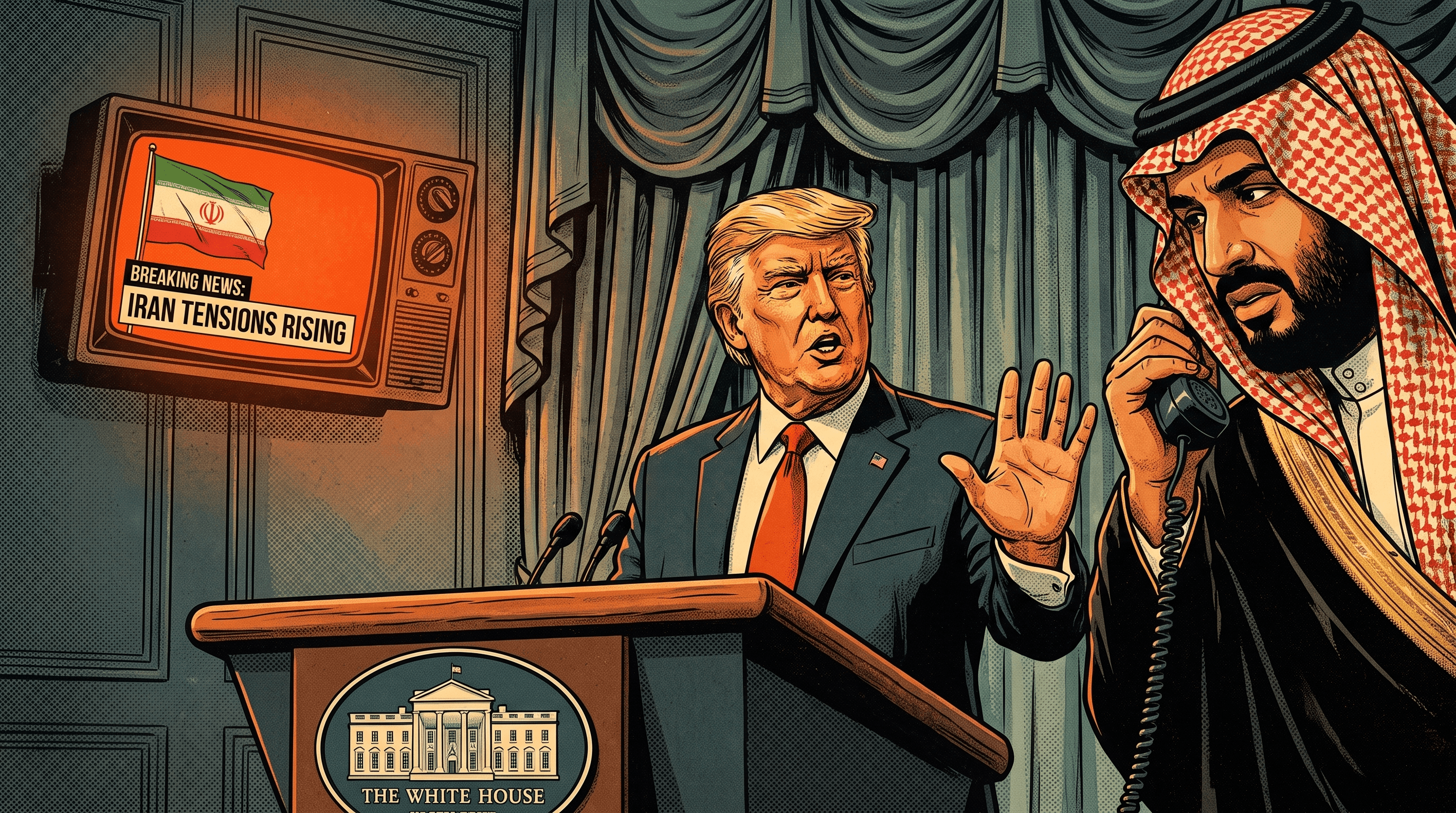
The Madman Theory has now been run twice in four months. It has produced two rounds of talks and exactly zero agreements. In any other line of work, we would call that a losing streak and stop returning the man's calls.
Yet here we are again, watching the same movie with the same ending, and a chorus of people insisting the ending was a triumph.
What Actually Happened
On Truth Social, Donald Trump announced he had cancelled planned American strikes on Iran, on condition that a deal be reached "rapidly." He said Iran and other countries in the region had asked him to "hold off," and that the "perimeters" of a deal had been agreed.
Iran's semi-official Mehr news agency answered promptly, calling Trump's claim that Tehran had asked for a pause "nothing but a new lie." So we have a peace announcement that one of the two parties says never happened.
Behind this sat something heavier. Reports carried to CBS News, unconfirmed by the US government, described the US and Israel planning one of the harshest bombing campaigns to date against Iran's energy infrastructure. The plan reportedly surfaced at Trump's cabinet meeting at Camp David on Friday. On Saturday, per the Saudi press agency SPA, Crown Prince Mohammed bin Salman called Trump and stressed "the necessity of prioritising dialogue" and a truce "that paves the way for diplomatic solutions." Which is diplomatic language for: please, everyone, put the matches down.
It's a Story, Not a Standoff
Here is the part almost everyone gets wrong. The obstacle between these two governments is not their red lines. It is their press releases.
Watch how each man needs the ending told. Trump's whole theory of leverage requires that Iran came to him beaten. On Friday, with reporters still in the room, he said: "We'll be hitting them very hard. At some point, they're going to say, 'We just can't take it anymore.'" That "we just can't take it anymore" is not a war aim. It is a screenplay. Trump does not merely want de-escalation; he wants a confession.
Iran's need is the mirror image. Its acting Defence Minister says Tehran treats every adversary threat as "real and credible" even when it is psychological warfare, and adds: "We will neither be caught off guard nor remain passive." Translation: whatever else happens, Iran will not be the party that whimpered.
So both sides can genuinely want the same thing — no strikes, no missiles, no ruined oil terminals — and still never shake hands, because a handshake requires agreeing on who reached out first. Trump needs Iran to have begged. Iran needs to have never begged. You can want peace with your whole heart and still refuse to sign a story in which you lost.
The Loop, Explained Like You're Sane
If the whole thing feels confusingly circular, that's because it is a circle. Let me draw it.
Step one: Trump issues a threat of near-cosmic proportions. Back in April, on the 7th, he warned that "a whole civilisation will die tonight" if Iran refused peace talks — a threat aimed at civilian infrastructure and power plants, which many observers pointed out would be a war crime. This time the target is energy infrastructure again, plus reported prime targets like water desalination plants, meaning the drinking-water supply of Gulf states. The threats scale up. The genre stays the same.
Step two: the world panics on cue. Oil prices swing. The US government tells Americans across the Middle East to be alert and ready to leave "should there be escalation." That warning is not decoration — the American mainland is out of range of Iran's missiles, but Bahrain, Jordan and the UAE are very much not.
Step three: the public reprieve. Trump stands down "for the future benefit of the world and, likewise, the survival of a successful and prosperous Iran" — a sentence that manages to threaten a country's survival and wish it prosperity in the same breath, like a man complimenting your garden while holding a flamethrower.
Step four: everyone declares victory and the machine resets.
In April, this exact loop produced face-to-face talks, and a ceasefire meant to pause the war. Supporters called it vindication of the Madman Theory — the idea that if your enemy thinks you're unhinged enough to do anything, they'll cave first. But the talks produced no deal. There were, in the words of the BBC, "too many competing red lines that could not be reconciled, even with the threat of civilisation erasure." When threatening to erase civilisation doesn't close the sale, your negotiating strategy may have a design flaw.
Then look what the ceasefire bought. By June it had fallen apart. Between June and August the US blockaded Iranian ports and bombed Iranian sites; Iran fired missiles and drones at American assets across the region and went after shipping in the Strait of Hormuz. So the great achievement of the last cycle — the ceasefire everyone applauded — lasted about two months before curdling into a blockade and a shooting gallery in one of the world's busiest waterways.
That is the return on the Madman Theory. Two summits, one collapsed truce, and a bombing menu that has now circled all the way back to the same energy targets Trump threatened in April. The theory generates meetings the way a broken vending machine generates noise: something is clearly happening, but nothing comes out.
The Uncomfortable Possibility
There is a quieter reading here, and it's the one that should worry people. What if a low-grade, on-again-off-again war actually suits at least one of these governments better than any settlement?
A permanent deal forces both leaders to accept a fixed story about who conceded what. The loop asks them to accept nothing. Trump gets to be "locked and loaded and ready to go... at levels of Military Terror, Strength, and Power not seen since World War II," which is a great line whether or not a single bomb falls. Iran gets to be the nation that stared down a superpower and blinked at nobody. Both men keep their preferred self-portrait intact. The only losers are the people in Bahrain and Jordan and the UAE told to pack a go-bag, and the roughly 60% of Americans who, per Pew, already disapprove of the war.
That's the grim genius of the arrangement. The narrative that keeps peace out of reach is the same narrative that keeps both leaders comfortable. The threat is the product. The deal was never the point.
The Bottom Line
Judge a strategy by what it ships, not by how loud it is. The Madman Theory is loud. It is genuinely gripping television. And after two identical cycles in four months, it has delivered a dead ceasefire, a blockade, missiles in the Strait of Hormuz, and a peace announcement that one of the two governments flatly denies took place.
De-escalation isn't stuck because the two sides want different things. It's stuck because they want the same thing and cannot agree on who to thank for it. Until one of these men decides he'd rather have a deal than a good story about a deal, expect a third run of this loop — same threat, same panic, same reprieve, same nothing. Book the theatre now. The show clearly isn't closing.


