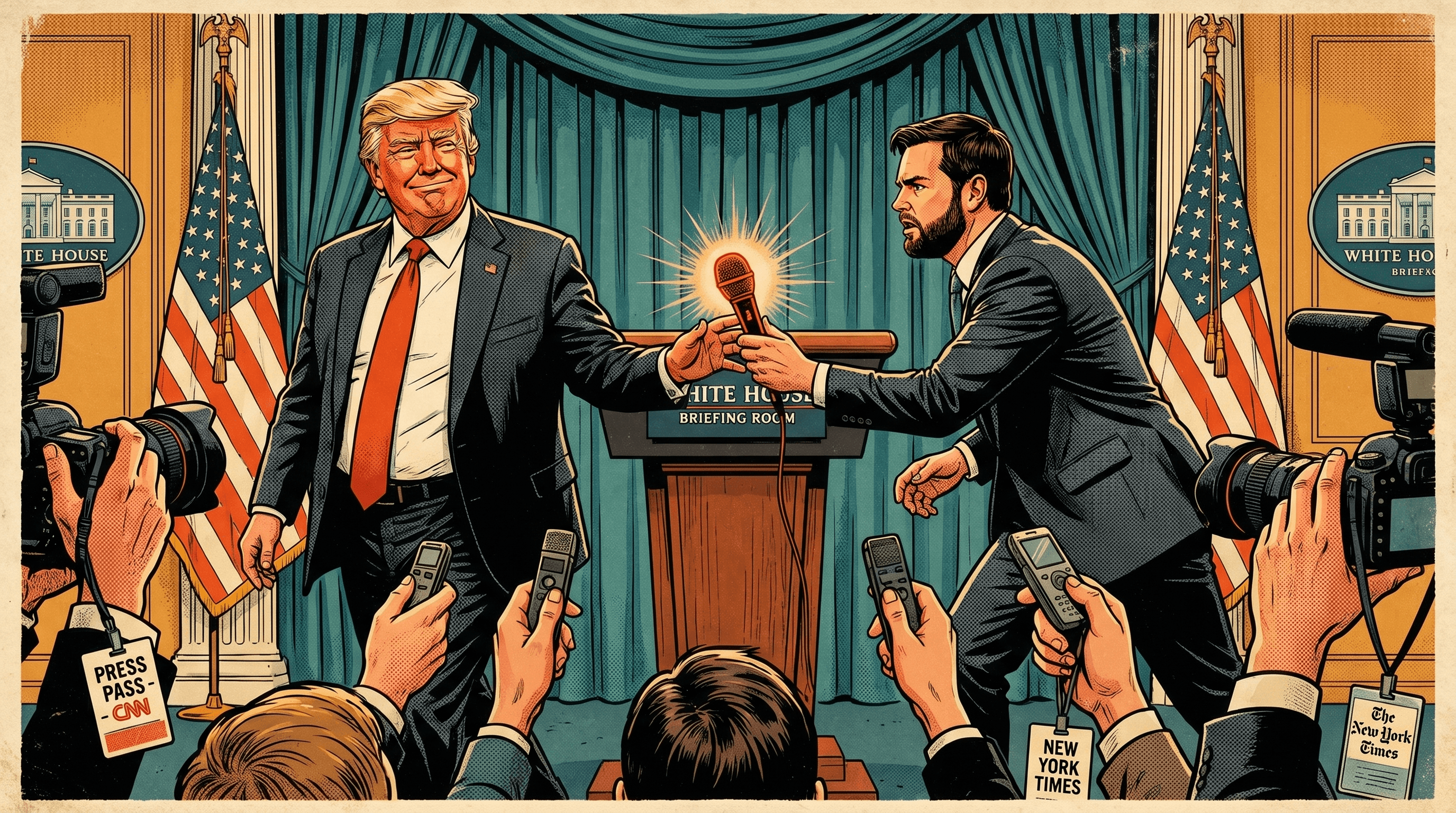
Donald Trump does not share credit. He has spent a lifetime making sure his name sits at the top of every marquee, every tower, every deal worth bragging about. So when the public face of the biggest foreign-policy gamble of his presidency turns out to be his vice-president and not himself, you should not read it as generosity. You should read it as a warning.
The Setup
Here is what is happening, stripped of spin. The United States and Iran have agreed to a memorandum of understanding — an MOU, which is a fancy way of saying "a written promise to keep talking." On Sunday the administration announced Iran had signed on, then released no details, which sparked exactly the confusion you would expect when you announce a deal and forget to mention what is in it.
JD Vance has been the man defending it all week. Not Trump. Not Secretary of State Marco Rubio, who has quietly stepped out of the spotlight on this war the way a sensible person steps out of a bar fight. Not Defense Secretary Pete Hegseth, who has cheered the military campaign loudly but is not the face of this agreement. The face is Vance, and the agreement is, in the words of plenty of people in his own party, "broadly unpopular with Republicans in Washington."
The MOU is only an interim deal. The two sides have roughly 60 days to hammer out a final agreement on the genuinely hard stuff — the "deeply technical" nuclear questions. There is no guarantee they pull it off.
The Tell
A Republican strategist named Matt Mackowiak put his finger on it: "It's not in the president's nature to cede the limelight and he's done that here... That does feel like a deliberate choice." That is the whole story in two sentences.
Trump is a president "long known for blaming his subordinates for unpopular policies." Now he has taken an unpopular policy and stapled his vice-president's name to it. This is not a coincidence. It is risk allocation, and Trump is very good at it.
Think of the Iran deal as a financial bet with a strange shape. The downside is front-loaded — it can blow up immediately, in the next 60 days, while the cameras are rolling. The upside is back-loaded — it only pays off later, if and when a final nuclear deal actually lands. Trump has handed Vance the half of the bet that can hurt you now and kept his options open on the half that might reward you later. If the talks collapse, there is a vice-president standing right there holding the receipt. If they succeed, well, success has a way of finding its way back to the top of the marquee.
The clearest sign of how this works came on Thursday, when a reporter at a White House briefing asked Vance directly whether Trump had set him up as the "fall guy." The day before, Trump had floated the idea that he might blame his vice-president if the deal fell apart. Vance's defense? Trump was "joking."
Pause on that. Your boss publicly muses about pinning a national-security failure on you, and your official position is that it was a bit of fun. That is not a man who feels secure. That is a man laughing nervously while standing on a trapdoor and insisting the lever is decorative.
The $300 Billion Comedy of Errors
To understand how exposed Vance already is, look at what happened on Monday. On CBS News, he said Iran "could have access" to a $300 billion reconstruction fund if it stuck to the terms. A reasonable thing to say, because the official agreement text commits the US to work "with regional partners to develop a definitive mutually agreed plan with at least USD $300 billion" for rebuilding Iran.
Hours later, Trump went on social media and to reporters and called reports of America paying Iran through that fund "Fake News," adding that "we're not putting up 10 cents."
So within a single day, the vice-president confirmed a $300 billion figure that is written into the actual document, and the president denied it down to the dime. The gap between their two positions is, give or take, three hundred billion dollars minus ten cents. That is not a messaging hiccup. That is two men reading from the same agreement and describing two different planets.
And notice who got left holding the awkward number. Vance is the one who said it out loud. Vance is the one now connected to a fund that the president insists does not exist. When the hawks in the party — the conservatives who already believe the White House "has ultimately capitulated to Tehran" — go looking for someone to blame for handing Iran a fortune, they will not have to look hard. He volunteered.
Then there is the signing ceremony. Vance had been planning to fly to Switzerland to put pen to paper alongside Iranian leaders. He was, by all accounts, unsure of the logistics. Late Thursday the White House announced he would not be travelling "at least for now" — a phrase that does for international diplomacy what "we should grab coffee sometime" does for friendships. The grand handshake photo is on hold. The blame is not.
Why He's Doing It Anyway
Here is the part that makes Vance more interesting than a simple patsy. He is not just absorbing this risk. He is using it.
This week Vance did not only defend the deal — he delivered a sharp rebuke of Israel's response, "going further in his criticisms than anything Trump has said in recent days." The vice-president broke from his own president, on Israel, in public, and broke harder. That is not the behavior of a loyal lieutenant minding the store. That is a man trying on a foreign-policy identity that is his own and not borrowed.
The timing fits. Vance recently published a memoir that "intensified speculation about a possible presidential run in 2028." His party is split clean down the middle — anti-interventionist MAGA supporters who opposed this war from the first shot on one side, conservative Iran hawks who think the White House caved to Tehran on the other. Whoever wants to lead this party next has to say something to both camps. Vance is, right now, the only major figure saying anything at all.
The veteran consultant Terry Holt framed the danger plainly: "Vance being connected to the Iran war is one more way [that critics will] hold him accountable for Trumpism." True. But accountability and ownership are the same currency, just spent in different moods. The man critics blame for a thing is also the man who gets to claim it. As one longtime Republican operative put it, "It's classic Trump to throw JD under the bus." Maybe. But you can only throw someone under the bus they were already driving.
The Takeaway
Trump has made a clever trade and Vance has taken the other side of it with his eyes open. The president offloaded the part of the Iran deal that can detonate in the next two months and kept a claim on the part that might pay off in 2028. On paper, Vance got the worse end.
But the worse end is the only end that comes with a microphone, and a man planning his own run needs a microphone more than he needs cover. If those 60 days produce a real deal limiting Iran's nuclear programme, Vance "will have played a central role in achieving a longtime goal" — and he will have done it while publicly outflanking the very president now setting him up to fail.
So no, this is not Trump being generous. It is Trump handing his understudy a loaded gun and betting it goes off. The twist is that Vance took it knowing exactly that — because the only thing more dangerous than holding Trump's risk is being the man Trump never trusted with it.


