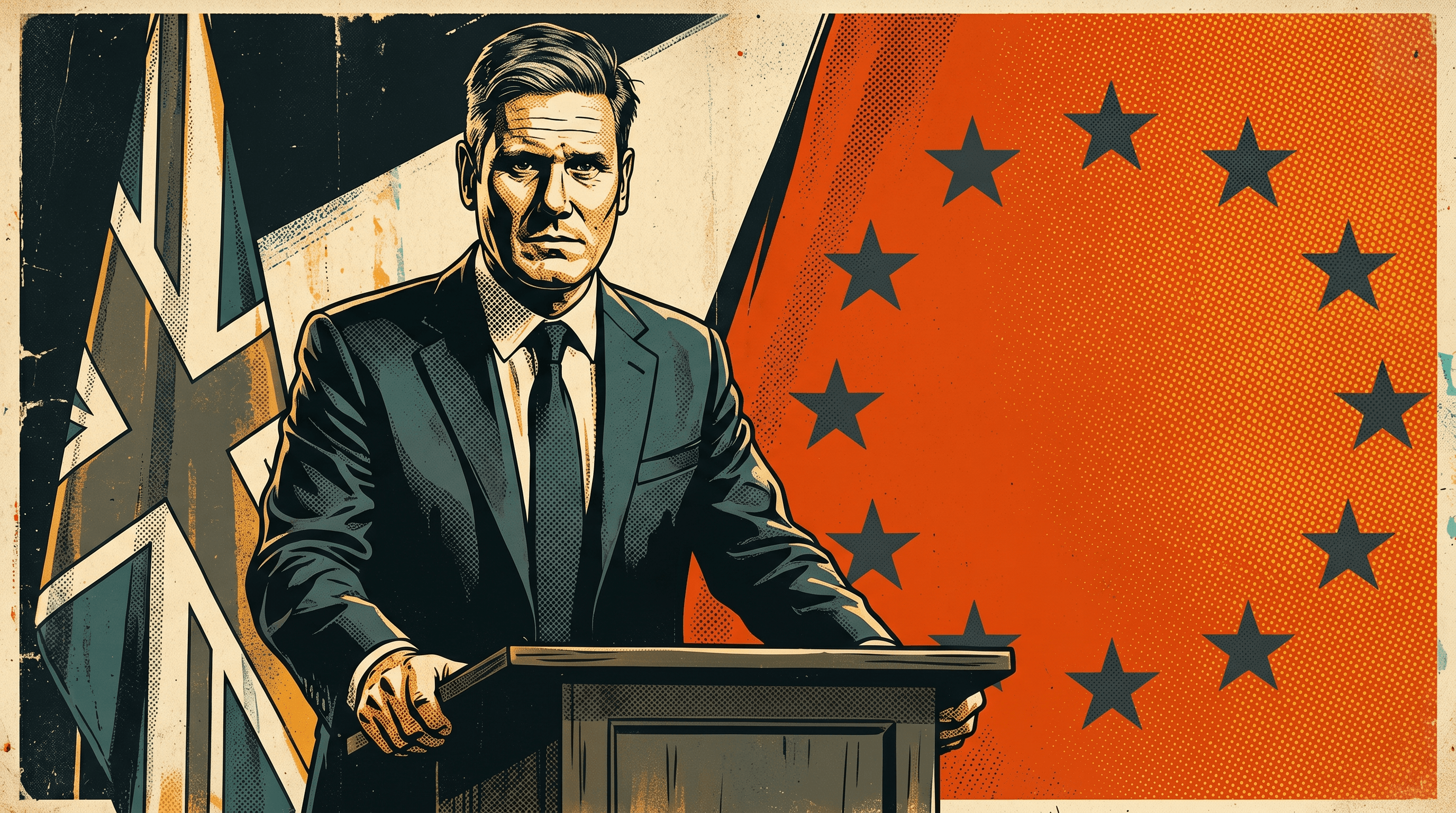
It turns out that "taking back control" has a shelf life, and that shelf life is exactly as long as it takes for a land war to erupt on your continent.
What's Actually Happening
The UK is preparing to open talks on joining the EU's €90 billion loan scheme for Ukraine — a structured financing vehicle worth approximately £78 billion, designed to funnel military equipment and support to Kyiv. The discussions are circling a European gathering in Yerevan, Armenia, where Prime Minister Keir Starmer is expected to make the case for closer cooperation.
Nobody has signed anything. No financial contribution has been settled. This is the beginning of negotiations, not the end of them. But the direction of travel is unmistakable: Britain is walking toward an EU-led strategic mechanism and asking to be let in.
The government is framing this as defence cooperation — bolstering support for Ukraine, deepening ties with European allies. And it is those things.
The Fantasy Finally Meets the Invoice
For years, the operating assumption of Brexit's foreign policy was that Britain could maintain all the influence of a major European power while operating entirely outside European structures. That it could be simultaneously indispensable and independent. That geography was optional.
This was always nonsense, but it was comfortable nonsense — the kind you can sustain as long as nothing serious happens. The problem with comfortable nonsense is that serious things do, eventually, happen.
Britain has been strongly supportive of Ukraine since the war began. Nobody disputes this. The UK remains a major defence player in Europe — arguably. But being supportive through ad hoc promises and one-off announcements is one thing. Being supportive through a structured, coordinated, continent-wide financing vehicle is another. The first lets you pretend you're going it alone. The second requires you to admit you're not.
What Starmer is doing in Yerevan isn't betraying Brexit. He's acknowledging what the war made obvious: that when the serious business of European security comes calling, Britain's choices are to sit at the EU table or to sit outside while decisions get made without it. The €90 billion scheme exists whether Britain joins or not. The question was never whether Europe would build collective security mechanisms. It was whether Britain would be inside them.
How We Got Here (A Brief History of Pretending)
Think of post-Brexit foreign policy like someone who's moved out of a shared house but still shows up to use the washing machine. For a while, everyone politely pretends this arrangement makes sense. The housemates don't want conflict. The person who moved out doesn't want to admit they need anything. It works, sort of, as long as nothing goes wrong with the plumbing.
Then the plumbing explodes — in this case, a full-scale invasion of a European country — and suddenly everyone needs to coordinate on who's paying for repairs, who's buying materials, and who's responsible for what. At which point the person who "moved out" faces a choice: either come back inside and have the awkward conversation, or stand in the garden insisting they're still independent while the house floods.
The EU's €90 billion loan scheme is the collective repair fund. It's a structured response to the obvious reality that defending a country costs money, requires coordination, and works better when the continent's biggest military power is actually participating in the plan rather than running a parallel operation from across the Channel.
What makes this moment significant isn't the money — the UK's exact exposure hasn't even been settled. It's the mechanism. Joining this scheme means working directly with an EU financial and strategic structure. Not adjacent to it. Not in parallel. With it.
The Objections (And Why They Don't Matter)
The objections are predictable. Taxpayers may end up taking on costs or liabilities linked to an EU-led scheme. Britain is being pulled into EU structures without formal acknowledgment. The "post-Brexit reset" — a phrase being used to characterise this move — is really just re-entry through the back door.
These criticisms aren't entirely wrong. They're just irrelevant to the actual question, which is: what's the alternative? Britain can either coordinate European defence through European mechanisms, or it can pretend that sending weapons individually while the rest of the continent pools resources is an equally effective strategy. One of these is a serious position. The other is cosplay.
The telling detail is how the government is framing this — not as EU integration, but as "deepening defence ties with Europe." The language is doing heavy lifting. It's as if someone described moving back in with their ex as "optimising their geographical proximity to shared assets." Technically accurate. Spiritually dishonest. But perhaps spiritually dishonest is the only way British politics can absorb the obvious.
Sovereignty Isn't Isolation
Strip away the diplomatic language and the political positioning, and what you're left with is straightforward: a war in Europe made it impossible to sustain the fiction that Britain could be a major European security power without participating in European security structures.
This isn't a betrayal of sovereignty. Sovereignty is the right to make choices, and Britain is choosing — freely, without coercion — to join a scheme because it serves British interests. That's sovereignty working exactly as designed.
The people who will scream loudest about this are the ones who always confused sovereignty with isolation. That's like confusing freedom with living alone in a cave.
The reporting across the BBC, Sky, Reuters, and the Evening Standard all landed on the same day, which tells you this was a coordinated briefing. The government wants this known. They want credit for it. They believe — probably correctly — that "strengthening Ukraine's defence" is popular enough to absorb the political cost of the words "EU scheme."
The Verdict
What happened in Yerevan isn't complicated. Britain looked at the reality of European security in 2026, looked at, and chose reality. The war in Ukraine didn't change Britain's strategic interests — those were always European, always collective, always dependent on coordination with neighbours. What the war did was make it embarrassing to pretend otherwise.
The Brexit foreign policy fantasy was never killed by a single blow. It died of exposure. Keir Starmer isn't burying it. He's just the one holding the shovel when everyone finally admits the thing stopped breathing years ago.


