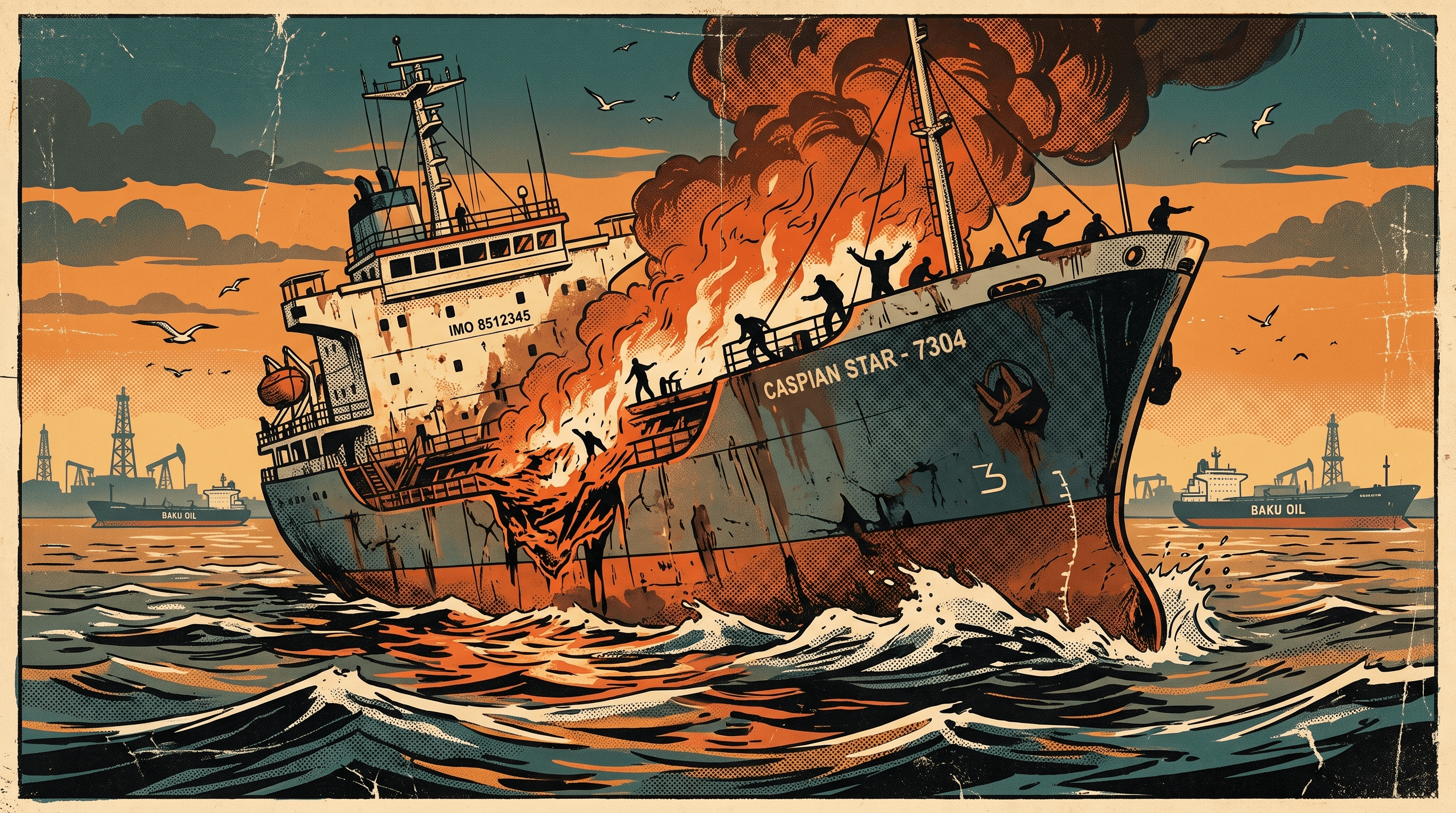
Here is a sentence I did not expect to write in 2026: Ukraine has opened a front in the Caspian Sea. Not the Black Sea, where the shooting has been going on for years. The Caspian. A body of water so far from the trenches of the actual war that you could be forgiven for wondering whether someone at a map table simply sneezed.
On July 25, Kyiv said it carried out a long-range strike there against a vessel it claims was moving military cargo linked to Iran, along with a Russian warship. Iran tells a very different story: the ship was commercial, one sailor is dead, others are hurt, and this was a hostile act that "cannot go unanswered." Tehran summoned Ukraine's chargé d'affaires to say as much in person. Both sides agree a man is dead. Almost nothing else about the incident is agreed upon, and almost nothing has been independently verified.
The Setup, In Plain English
Strip away the drama and the facts are thin. Ukraine hit at least one ship in the Caspian. Ukraine says the ship carried weapons cargo between Iran and Russia while dodging sanctions. Iran says it was an ordinary merchant vessel with an ordinary crew, one of whom is now dead.
The Caspian has long been treated as a safe road for Iranian trade. Ships move through it the way delivery vans move through a quiet suburb: nobody expects an ambush, because nobody has ever bothered to stage one. That assumption is what just broke. Whatever was actually on that vessel, the more interesting cargo is the message the strike was built to carry.
Because the Caspian is nowhere near the front. And that is precisely the point.
What This Was Actually For
This was not really a military operation. It was a pitch.
Think about the geography for a second. Ukraine is fighting a land war hundreds of miles to the west. Reaching a ship in the Caspian is a genuine feat of engineering and nerve, and it changes the tactical situation of that land war by roughly zero. You do not spend that kind of effort and range to sink one boat you claim is dodging sanctions. You spend it to say something. And the audience for what Kyiv is saying does not sit in Moscow or Tehran. It sits in Washington.
Zelensky didn't just announce a sunk ship. He announced that the targets were "vessels used in military cargo shipments involving Iran," and then, in the same breath, accused Russia of feeding Iran satellite intelligence on Gulf and US military facilities. Read that again. Ukraine wants you to picture a Moscow–Tehran axis with American bases in the crosshairs. That is not a battlefield report. That is a screenplay, and it has been cast with a specific viewer in mind.
The strike is already being read as "a message for Trump." I'd go further. The whole thing is engineered as one.
The Breakdown: How To Reverse-Engineer a Superpower
Let me make this concrete.
Imagine you're trying to convince a very rich, very busy, easily bored neighbour to keep paying for your home security system. He doesn't care much about your feud with the guy across the street. He finds it tedious. But you know one thing about him: he hates the family three doors down. Absolutely can't stand them.
So you stop talking about your feud. Instead, you casually mention that the guy across the street has been seen sneaking around with the family your neighbour hates, passing them notes, maybe even helping them case his house.
Suddenly your neighbour is interested. Suddenly your problem is his problem. You haven't changed a single fact about your own situation. You've just re-pointed the story at the thing he already cared about.
That is what's happening here, and it works in layers.
Layer one: find the obsession. Washington under Trump has a well-known appetite for taking a hard line on Tehran. That's the pre-existing fixation, the family three doors down.
Layer two: attach yourself to it. Instead of pleading "help us fight Russia," which is an old and tiring ask, Kyiv reframes the entire war. The claim becomes: we aren't just fighting Russia, we're intercepting the weapons pipeline between Russia and Iran. Same war, new label. It's rebranding, except the product is a two-year-old conflict and the new packaging says "Anti-Tehran."
Layer three: make it visual and impossible to ignore. A memo about sanctions-busting gets skimmed and binned. A burning ship in a sea everyone assumed was untouchable does not. The Caspian was chosen because it was considered secure. Hitting the one place nobody thought could be hit is how you make a headline instead of a footnote. It's the difference between telling someone your car is fast and doing a handbrake turn in their driveway.
Layer four: hand the enemy the pen. Here's the elegant part. By striking Iran directly, Kyiv more or less guarantees an Iranian reaction, and Tehran obliged instantly with "cannot go unanswered" and dark hints of retaliation. Every angry Iranian threat now reinforces Ukraine's story that Iran is a live, aggressive player worth confronting. Iran has been cast in a movie it never auditioned for, and its outrage is the trailer.
The beauty of it, from a purely tactical standpoint, is that Ukraine barely has to prove anything. Remember: the claims about what that ship was carrying come entirely from the two governments shouting past each other, and none of it is independently verified. Kyiv says weapons. Tehran says groceries. You, the outside observer, cannot check. But the narrative doesn't need a customs manifest. It only needs to be plausible enough to lodge in the right imagination in Washington. Certainty is optional. Suggestion does the heavy lifting.
The Takeaway
The dead sailor is real, and that is not a small thing. But the operation that killed him was aimed less at a hull than at a headline. Ukraine has looked at a war the world is quietly getting bored of and made a shrewd, cold-blooded marketing decision: if the West won't stay invested in your enemy, borrow its enemy and staple the two together. The Caspian strike is the staple.
Whether it's true that the ship carried weapons almost doesn't matter to the strategy, and that should make you deeply uneasy. We have reached the point where a state can conduct a real strike, in a real sea, killing a real person, primarily to shape the mood of one man's foreign policy. The battlefield and the pitch deck have merged.
So don't file this under "the Iran war reaching the Caspian." File it under advertising. Ukraine isn't fighting Iran. It's using Iran to keep America watching. And the grim genius of it is that it might just work.


