Elon Musk became the world's first trillionaire on Friday — and the people protesting it helped pay for the milestone.
The Bell Rings
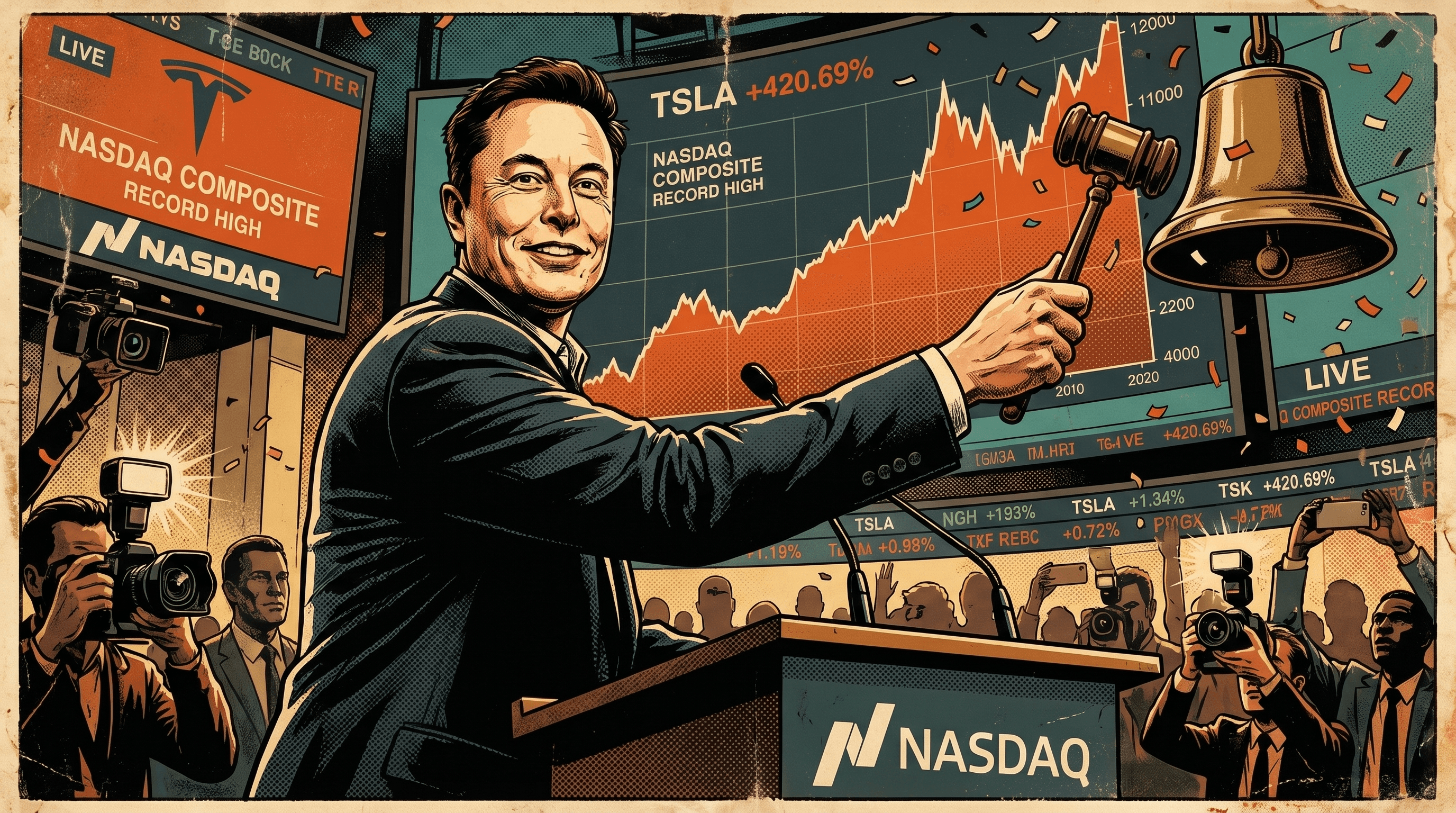
Here is what happened, plainly. On 12 June 2026, SpaceX completed its stock market debut on the Nasdaq, raising $75bn in the biggest IPO the world has ever seen. The shares jumped 11% to $150 at the open, climbed roughly 20% in early trading, and pushed the company's valuation past $2 trillion before settling somewhere around $2.2 trillion.
Musk, who owns 38% of the company, rang the opening bell himself. "We want to take the fiction out of science fiction," he said — which is either an inspiring mission statement or a quietly menacing one, depending on which science fiction you've read.
Meanwhile, in Manhattan, protesters held a "Stop Musk" rally outside JPMorgan Chase headquarters, complete with a giant inflatable Elon Musk warning of the dangers of Grok. The only version of Musk it is currently possible to deflate is the balloon. The real one finished the day worth more than a trillion dollars. Oxfam called it "a dark day for democracy." Prominent Democrats lined up to agree.
The Inconvenient Arithmetic of Outrage
Here is the part the placards miss, and it's not a small part.
Musk was already worth roughly $980bn before the float, by Forbes' count — the magazine reported hours beforehand that he was "on the verge of becoming a trillionaire." His wealth, in other words, was assembled almost entirely in private: a 38% SpaceX stake, just over 10% of Tesla, options on nearly 8% more, plus Neuralink, the Boring Company, and the proceeds of past Tesla sales. For years, ordinary people couldn't touch any of the SpaceX portion. Exposure was limited to private markets — a velvet rope with institutions on one side and everyone else on the other.
Then Friday happened, and the rope came down. And the moment it came down — the moment the public could finally buy in — is the precise moment Musk crossed the trillion line. The crowd didn't just witness the coronation. The crowd was the coronation.
And it gets better, or worse. UK pension funds are now invested in SpaceX following the IPO. Which means the comfortable moral position — his obscene wealth over there, our honest savings over here — collapsed on contact with an index. The pensioner appalled by the trillionaire is now, structurally, a part-owner of the trillion. You cannot meaningfully boo a man whose share price funds your retirement. You can try, but the boo comes out sounding suspiciously like "hold."
The "dark day for democracy" was also, awkwardly, the day SpaceX ownership was democratized. Both things are true at once, and almost nobody wants to hold both at the same time.
How You Mint a Trillionaire Without Anyone Writing a Cheque
If "he made $20bn-odd in a morning" sounds impossible, that's because you're imagining wealth as a pile of money. It isn't. It's a price tag, and Friday was the day the price tag got rewritten in public.
Start simple. Musk owns 38% of SpaceX. Before Friday, that stake had a value, but a fuzzy, private, take-our-word-for-it value. An IPO replaces the fuzzy number with a public one: whatever the last buyer paid, multiplied across every share in existence.
Think of it like house prices. You don't get richer when you sell your house. You get richer when your neighbor sells theirs for a fortune, because suddenly everyone agrees your identical house is worth the same. Musk sold his metaphorical neighbor's house to the entire planet on Friday morning, and the planet bid it up 20% before lunch. His own house — all 38% of it, which he retains in full — got repriced to around $800bn without him lifting a finger beyond bell-ringing.
That's why his pre-float wealth of roughly $980bn mattered so much: he was standing so close to the line that even a modest first-day pop would have carried him over. The market didn't deliver a modest pop. It delivered a stampede. Shares were already rising in shadow trading before the official float — the financial equivalent of hearing the applause before the curtain goes up.
Stack the rest of the portfolio on top — $165bn of Tesla, another $114bn in Tesla options by Forbes' math, Neuralink's brain interfaces, the Boring Company's tunnels — and the trillion stops looking like a freak event and starts looking like a rounding outcome. The man's net worth has more load-bearing columns than the Parthenon.
There is a catch, and an analyst flagged it: a float this enormous can "cannibalise capital" — plain English, the $75bn flowing into SpaceX is $75bn not flowing into everything else. One live-blog put the stakes even more bluntly: "After SpaceX's huge IPO, Americans' financial future will be bound to AI." However you read that, the binding part is hard to argue with. Tens of millions of people just got tied — through pensions, funds, and Friday's buying frenzy — to one man's companies, whether they cheered the bell or inflated the balloon.
The Ratification
An economist duly warned that wealth on this scale could have profound effects on society and democracy. Fine. Probably true. But the sharper truth of 12 June 2026 is less comfortable than any warning, because it implicates the audience.
The first trillion wasn't extracted from the public. It was ratified by the public — priced, bid, and certified in an open market, with pension money helping set the number. Musk didn't cross the trillion line by hoarding something away from us. He crossed it the instant he let us in.
Inequality used to be something done to the many by the few. As of Friday, it's something the many hold in their portfolios, with quarterly statements to prove it. The inflatable Musk will be packed away by Monday. The real position — yours, very possibly — stays open.


