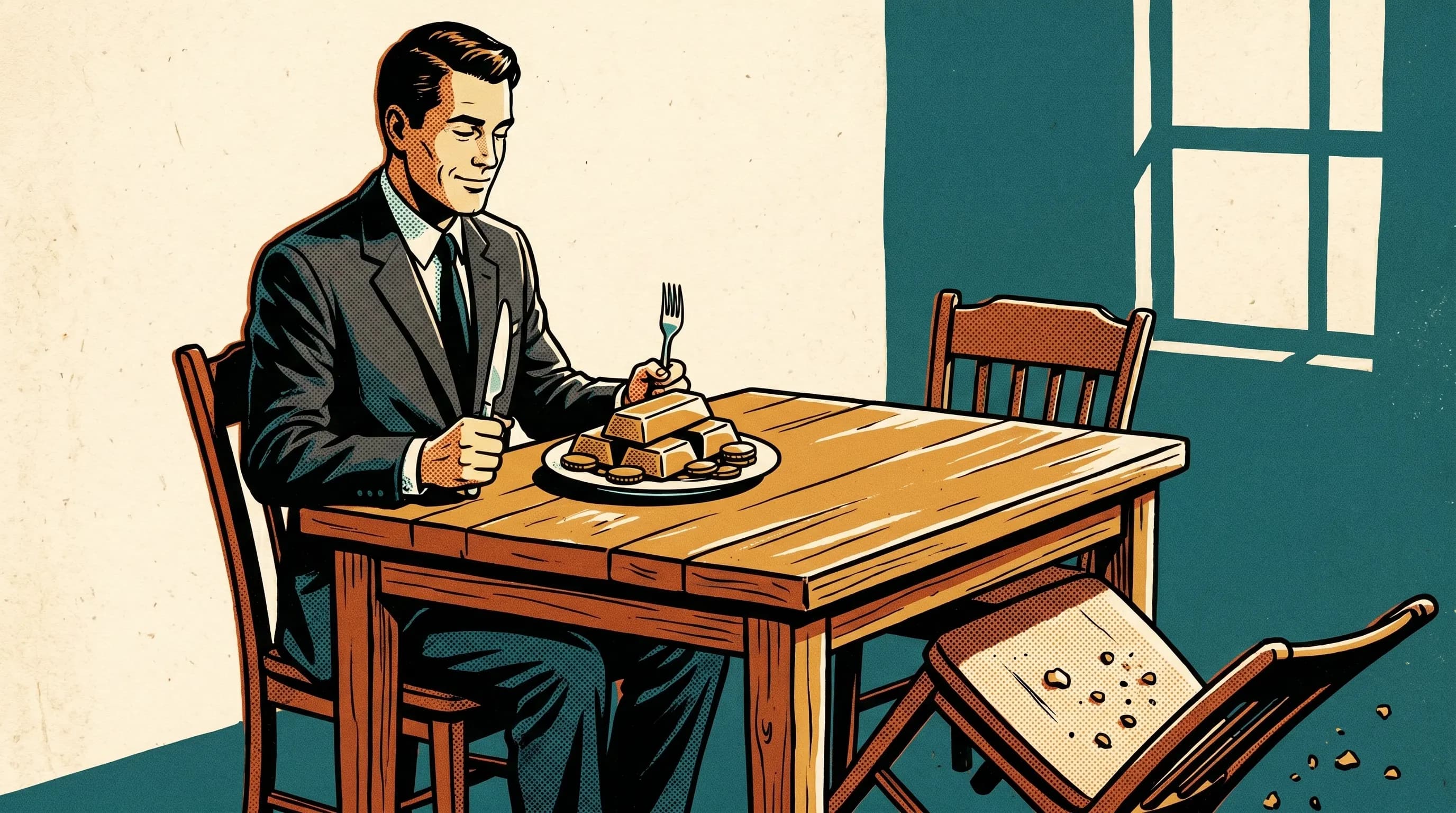
Gold just had its worst month in roughly 13 years — a drop of about 12% that sent retail investors scrambling for the exits. US gold ETFs hemorrhaged $14 billion in outflows. Managed money dumped approximately 22 tons of exposure. And somewhere, in quiet offices in Zurich and Beijing and at trading desks on Wall Street, the people who actually set the price of gold over the long term picked up their forks.
The Mechanics of a Crash
The sell-off wasn't mysterious. It was mechanical.
Hedge funds had been running leveraged gold positions — not modest ones, but positions amplified anywhere from 5x to 40x. When you're leveraged 40-to-1, a 2.5% move against you wipes out your entire position. A 12% decline doesn't just hurt. It triggers a cascade.
Here's the sequence: gold dips, margin calls arrive, funds liquidate gold to meet those calls, the liquidation pushes gold lower, which triggers more margin calls, which forces more liquidation. It's a financial centrifuge. The selling feeds the selling until the leveraged players are flushed out entirely.
There's a line that traders use to describe this kind of event: "In a crisis, you sell what you can, not what you want." Gold is liquid. Gold is easy to sell. So when the margin calls come knocking, gold gets sold — not because anyone decided gold was worth less, but because it was the fastest way to raise cash.
The Divorce Between Price and Conviction
Here's what should keep you up at night if you sold your gold ETF last month: the crash was caused by a leverage structure, not by a change in anyone's fundamental view of gold. The people who panicked were the ones who had to. The people with a choice? They stayed. Or they bought more.
Goldman Sachs described itself as "constructive on gold" even after the sell-off — which, in Goldman's famously hedged vocabulary, is about as close to pounding the table as you'll get from a bank that UBS went further, calling itself outright bullish, citing stagflation risk, a weaker dollar, and lower interest rates as tailwinds.
Meanwhile, the World Gold Council reported that central banks had been buying gold for 15 straight months. Fifteen. Not a quarter. Not a burst of enthusiasm. Fifteen consecutive months of accumulation, part of what's been described as a multi-year trend of reducing US debt holdings and replacing them with gold.
So the scoreboard reads: retail investors sold, hedge funds were forced to sell, and central banks kept buying. One of these groups tends to be right over time horizons longer than a news cycle.
How a Leverage Squeeze Actually Works (For Normal Humans)
Think of it like a crowded movie theater. Everyone's enjoying the film — gold is going up, leveraged bets are printing money, life is good. Then someone smells smoke. Maybe it's real, maybe it's burnt popcorn. Doesn't matter. One person stands up and heads for the door. Then two more. Then the whole row.
Now here's the leverage part: imagine that for every real person in the theater, there are five to forty imaginary people also trying to leave — because that's what 5x to 40x leverage effectively creates. You haven't just sold your seat. You've sold five to forty seats, all at once, all pushing through the same door.
The exits jam. People start trampling each other. The price of "getting out of this theater" skyrockets. And the people standing outside, watching the chaos? They're picking up the tickets that flew out of everyone's pockets. At a discount.
That's what happened to gold.
The key insight is that the smoke was never real — a plumbing problem dressed up as a crisis.
What the Big Players Are Actually Doing
While retail investors were having their fire sale, several things were quietly happening on the other side of the trade.
China allowed its insurance companies to allocate 1% of their portfolios to gold — a number that sounds tiny until you remember the size of China's insurance industry, and that UBS says insurers haven't even fully allocated that permitted 1% yet. The door opened a crack, and nobody's walked all the way through it. This is the financial equivalent of China opening a very large door by a very small crack, and even that crack hasn't been fully walked through.
Turkey, which showed up in the sell-off data, used approximately 50 tons of gold for swap financing — meaning it posted gold as collateral rather than selling it outright. This is the difference between pawning your wedding ring to make rent and actually selling it because you've decided you hate marriage. Turkey still owns the gold. It's still on the balance sheet. But the headline "Turkey dumps 50 tons of gold!" reads much better for people trying to justify their panic selling.
Central banks, meanwhile, have been methodically doing what central banks do when they've made a strategic decision: executing slowly, consistently, and with complete indifference to what retail investors think about it. The 15-month buying streak is part of a broader pattern of de-dollarization — central banks trimming US debt holdings and reallocating toward gold. They're not doing this because of last month's price action. They're doing it because of a structural view about the next decade.
The Irony No One Wants to Hear
There's a beautiful, almost literary irony at work here. The very mechanism that caused gold to crash — leveraged liquidation creating forced selling — is the same mechanism that's creating the opportunity for well-capitalized, patient buyers to accumulate at lower prices. The hedge funds running 40x leverage didn't just lose money. They effectively transferred wealth from the leveraged and reactive to the patient and strategic.
This is not a new pattern. It's arguably the oldest pattern in markets. Leverage amplifies gains on the way up, destroys its users on the way down, and creates bargains for anyone disciplined enough to buy what panicked sellers are throwing overboard.
The Takeaway
Gold didn't have a crisis of identity. It had a crisis of leverage. The 12% decline was real, the $14 billion in ETF outflows was real, the 22 tons of dumped exposure was real — but none of it reflected a change in what gold actually is or what it's for. It reflected the structural fragility of positions built on 5x to 40x borrowed money.
The people who move gold prices over years, not weeks — central banks accumulating for 15 straight months, Chinese insurers just beginning to fill a new allocation, major banks publicly calling themselves bullish and constructive — none of them flinched. They didn't flinch. The reason you're selling is the reason they're buying.
Every leveraged liquidation ends. The leverage gets cleared out, the forced sellers finish selling, the price stabilizes, and the people who bought the fear own the recovery. The only real question is which side of that trade you want to be on — and if you sold last month, you've already answered it.


