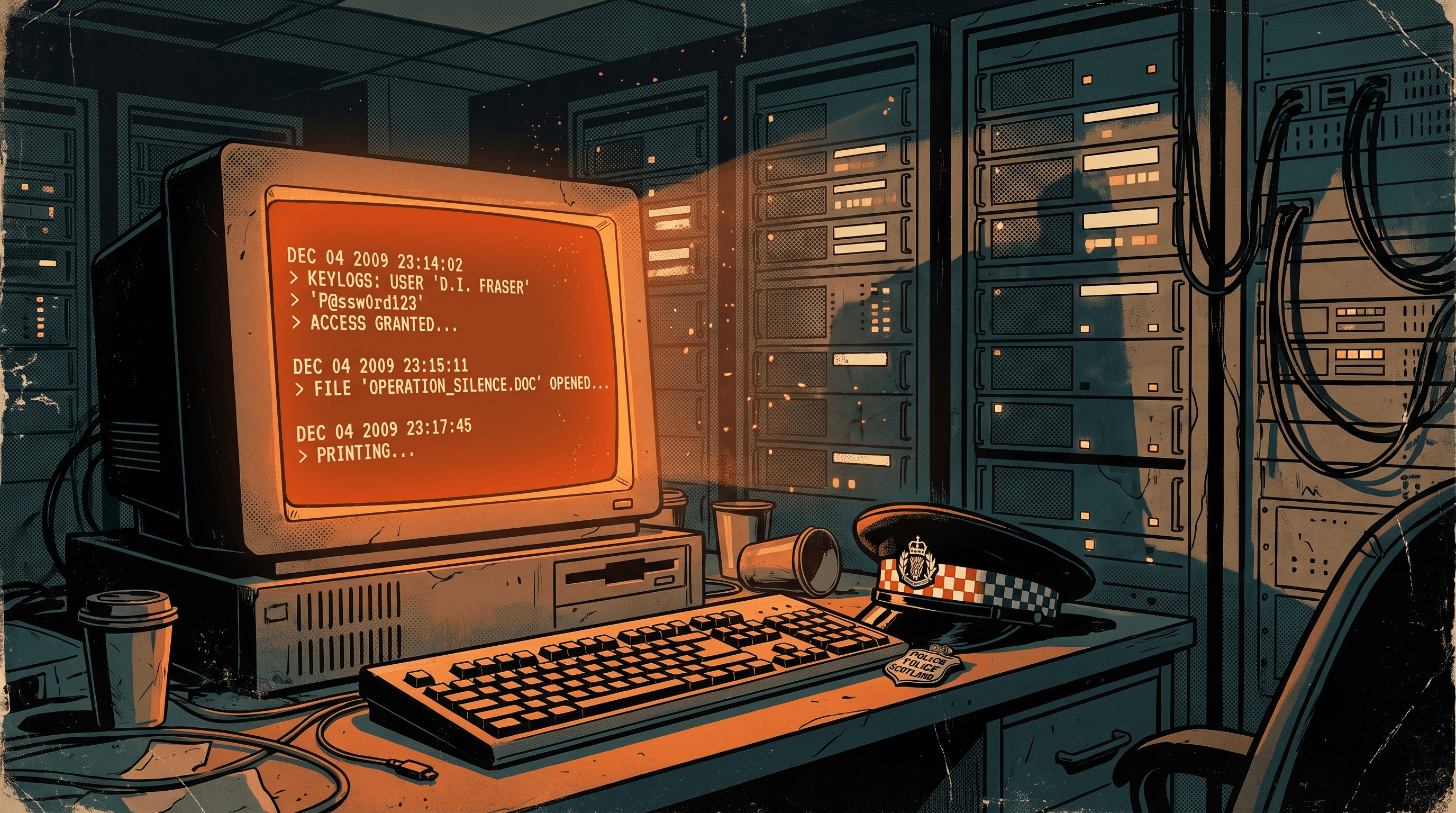
For 17 years, PC Alan Greer fooled everyone who mattered. His wife. His child. His colleagues. The vetting officers whose entire job was to smell a rat in a uniform.
The thing that finally caught him couldn't smell anything at all. It was a computer log, sitting quietly in a Police Scotland server, remembering keystrokes he'd made 14 years earlier.
A tidy record
Here are the plain facts. Greer was born in Australia in 1978 and moved to Britain aged six. He joined Strathclyde Police in 2009, which folded into Police Scotland in 2013. Around 2016 he moved into officer safety training in Coatbridge, where he taught probationers and refreshed the skills of experienced officers. On paper, an unblemished career.
Off paper, he was a violent rapist who attacked women over at least 14 years. Detectives have now identified nine victims and expect to find more. In May 2026, aged 47, he took his own life, leaving a wife and a child who are understood to have been completely oblivious to any of it.
That last detail deserves a pause. He committed these crimes for over a decade while living, apparently, as an ordinary family man and a trusted trainer. His record was clean the way a crime scene looks clean before anyone thinks to dust it for prints.
He chose people the system was built to doubt
Look at who Greer went after, because it was not random.
His first known victim was a woman he raped in her own Glasgow home in 2012. He'd attended earlier that day as a uniformed response officer, after she called the police to report a crime. She trusted the man in the uniform. Then he came back alone and raped her. As Assistant Chief Constable Lynn Ratcliff put it, he "clearly abused his power and has revisited someone that he's encountered in the course of his duties."
Five of the eight further victims were sex workers, attacked while Greer was off duty. He used hundreds of prostitutes throughout his police career.
This is the cold logic at the heart of the case. Greer didn't hunt at random; he hunted where the odds were stacked in his favour. A woman assaulted by the officer who took her statement, or a sex worker warning police about a violent client — these are exactly the people whose word institutions have always been slowest to believe. He understood the machine's blind spots better than the machine did. And that is what should unsettle you. Not that a monster wore the uniform, but that he read the system's prejudices like a map and used them as cover.
How a log file does the job a person wouldn't
Here's the bit worth slowing down for, because it tells you where accountability in policing actually lives now.
Every time an officer opens a file on the police computer, the system writes down three things: who looked, what they looked at, and when. Think of it like the stamp on your hand at a nightclub, except it never washes off and nobody can pretend they weren't inside.
In the weeks after the 2012 rape, Greer repeatedly opened his victim's crime file. There was no legitimate police reason. He did it once while on annual leave. That is not a holiday anyone wants a postcard from.
Those entries then did absolutely nothing for 14 years. They just sat there, because no human being had a reason to go looking.
The reason arrived in late 2025. The original victim, by then in her late thirties, walked into a Glasgow police station and reported the rape — and then largely disengaged. She said her piece and stepped back. In April 2026 the anti-corruption unit secured her full statement, traced her original 2012 call, and pulled the names of the officers who'd attended. Then they checked the audit trail. And there was one officer who had obsessively opened her file for no reason at all, including on a day he wasn't even working.
The victim disengaged. The database never did. Fourteen-year-old keystrokes handed detectives their suspect.
The warning that couldn't find its man
Now for the fixable failure, the one that should keep someone at Police Scotland awake.
Wanting a second strand of evidence, investigators took Greer's mobile number and ran it through intelligence databases. Up popped a single report from 2018: a Glasgow sex worker had told police that this number belonged to a violent customer. No name was attached. Nothing suggested the owner was a serving officer. But the number was Greer's.
That warning sat unmatched for seven years for one stupid, mundane reason. Greer's mobile number was never held on his personnel file. The force only kept his home number. So in 2018 there was simply no way to connect a tip about a dangerous man to the dangerous man himself.
Picture a police station with a wanted poster in one filing cabinet and the matching mugshot in another, and a rule that says the two cabinets may never be in the same room. The information existed. The link didn't. A phone number in the wrong field let a red flag lie face down for the better part of a decade.
Ratcliff is adamant on this point: "I am entirely satisfied that everything that could have been reasonably done at that time was done, and that there were no missed opportunities." She may be right that no officer in 2018 could have joined those dots. But that's precisely the indictment. The dots couldn't be joined not because anyone was careless, but because the system was built so they'd never touch.
What actually caught him
A source close to the investigation told reporters this "could be Police Scotland's Wayne Couzens moment" — a reference to the Metropolitan Police officer jailed five years ago for the rape and murder of Sarah Everard. The comparison writes itself, and it should sting.
But notice how this ended. Greer's death means there will be no trial. No jury, no verdict, no sentencing. Accountability now runs entirely through an anti-corruption inquiry and public disclosure, because the courtroom door is closed forever. And even the process that exposed him owed almost nothing to human vigilance. Colleagues didn't spot him. Vetting didn't stop him. His family never suspected. What got him was a brave woman finally speaking, and then a machine that had been quietly taking notes since 2012.
That is the uncomfortable lesson. In modern policing, the most reliable witness against a bad officer is no longer another officer. It's the data exhaust — the digital crumbs he drops without meaning to, the log that watches when everyone else looks away.
The uniform gave Greer 17 years of camouflage. The database gave him 14 years of a paper trail. One of those two things did its job. And a violent man went undetected for years not because the warning didn't exist, but because someone forgot to write his phone number in the right box.


