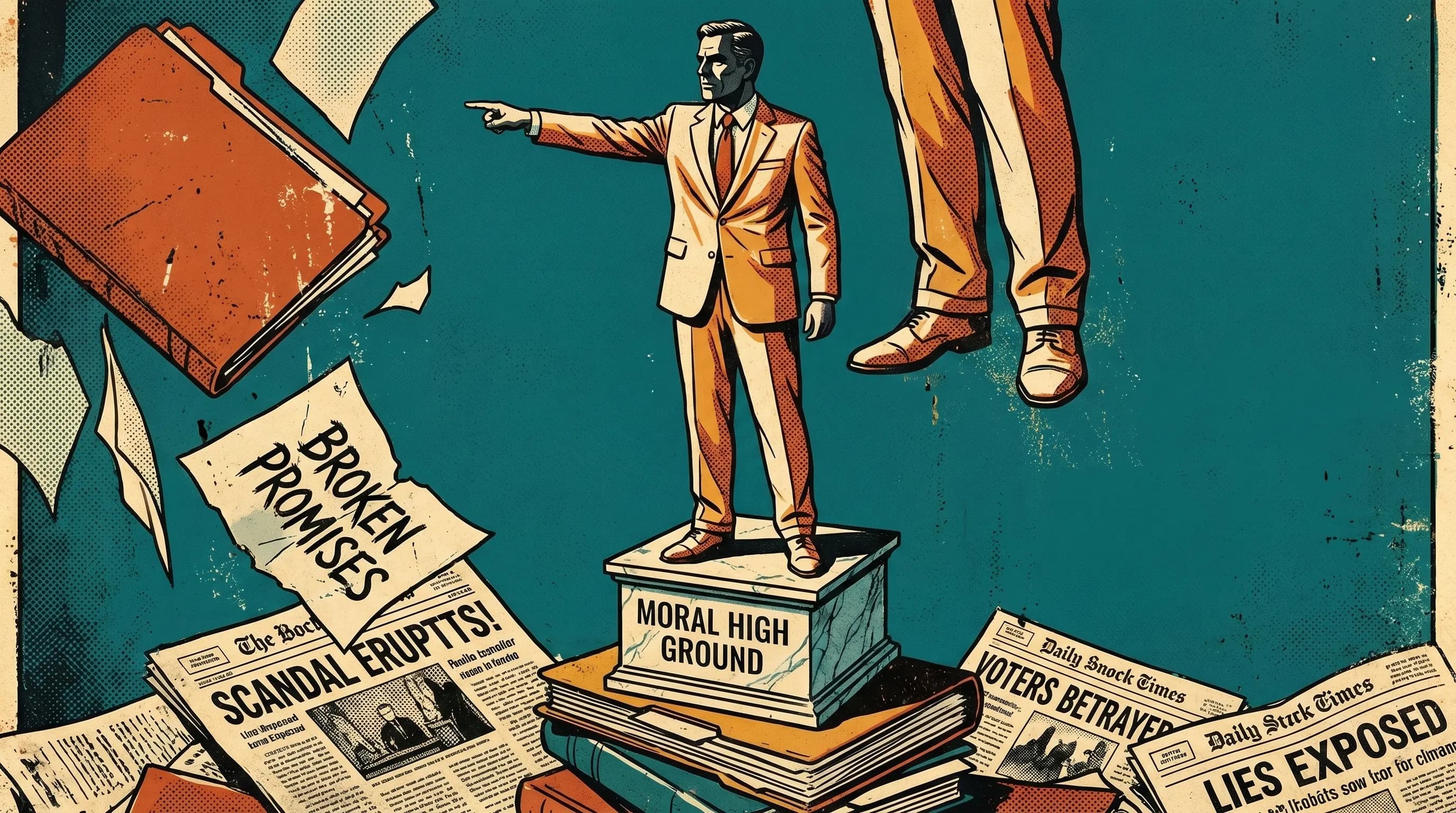
The cleanest political move is always the one that lets you demand accountability from everyone except yourself.
On April 9, 2026, Melania Trump walked into the White House and delivered a six-minute, unannounced statement about Jeffrey Epstein. Six minutes. Unannounced. In the context of a scandal that has consumed American public life for years, that is either an act of extraordinary confidence or an act of extraordinary calculation. Possibly both.
The statement was, on its surface, a denial. She had never had a relationship with Epstein or Ghislaine Maxwell. She had never been involved in his abuse in any capacity. She crossed paths with Epstein once — at an event in 2000, with Donald Trump present. Epstein did not, she was at pains to clarify, introduce her to Donald Trump; that introduction happened at a party in 1998. An email exchange with Maxwell found in DOJ files? "Casual correspondence." The false smears, she added, "must stop."
Then came the twist. After clearing her name with the precision of someone who has clearly thought about little else for several years, Melania turned to face Congress and called on it to hold a public hearing. Survivors should testify under oath. That testimony should be permanently entered into the Congressional Record. "Then, and only then," she said, "we will have the truth."
It was, in the truest sense, a mic drop. The problem is that the mic landed on someone else's foot.
Six Minutes to Solve Everything
Let's be precise about what actually happened here, because the sequence matters.
The Department of Justice had just released Epstein-related records — records that, among other things, contained an email exchange involving Melania and Maxwell. This is the context into which she walked. Not unprompted virtue, but a specific document drop that required a response. Her office's explanation — that she spoke because "enough is enough" — is technically consistent with this. It's also consistent with the interpretation that "enough is enough" arrived at approximately the same moment the DOJ files did.
She has, it should be noted, been fighting this battle for a while. Legal actions over Epstein-linked claims. A dispute with Michael Wolff over related allegations. Retractions secured from media outlets in 2025. This was not her first rodeo. By the time she took that podium, she had already spent considerable energy establishing, through legal channels, what she now stated plainly from the White House.
So the denials made sense. They were clean, specific, and supported by prior legal groundwork. What was surprising — genuinely surprising — was the Congressional hearing proposal.
Political Geometry
Here is the political geometry of what Melania Trump did, rendered as simply as possible.
Imagine you're in a room where someone accuses you of knowing where the treasure is buried. You say: "I don't know. But I think we should ask the people who were actually there." The call for public hearings with survivor testimony under oath is, on its face, a pro-transparency position. It puts Melania on the side of the victims. It lets her say, with complete sincerity, that she wants the full truth to emerge. It costs her nothing, because the mechanism she's proposing — Congressional hearings — sits entirely outside her control. She can't schedule them. She can't run them. She can't be blamed if they don't happen. She has simply made the call.
The burden now sits with Congress. If hearings happen, the spotlight moves to survivors and whatever emerges from their testimony. If hearings don't happen, the obstruction belongs to whoever blocked them — currently, that would land at the feet of House Oversight Chairman James Comer, a Republican, in a Congress her husband's party controls. Either way, Melania Trump is not holding the bag.
Democrats, interestingly, walked straight into this. Rep. Robert Garcia urged Chairman Comer to schedule the hearing, saying they "certainly welcome and agree with her call." This is a politically sensible response that also, whether Garcia noticed or not, completes the mechanism Melania designed. She has now created a situation in which both parties are nominally aligned on transparency, which is precisely the kind of political judo move that looks obvious only in hindsight.
The People Who Weren't Asked
Here is where the story gets genuinely uncomfortable, and where the survivors' representatives — including relatives of Virginia Giuffre — made a point that deserves more attention than it has received.
Their statement was unambiguous: "Survivors of Jeffrey Epstein have already shown extraordinary courage… Asking more of them now is a deflection of responsibility, not justice."
This cuts to the bone. Melania Trump's proposal positions survivors as the vehicle through which truth will arrive. Under oath. In front of Congress. Permanently on the record. But the survivors did not ask for this role. They were not consulted about whether they wanted to be the mechanism by which a former First Lady rehabilitates her reputation. The people who were trafficked and abused by Epstein are now, in this framing, the ones who need to come forward — again — so that we can have "the truth."
The survivors' representatives are pointing at something real: the accountability burden has been elegantly outsourced. First from the White House to Congress, and then from Congress to the women and girls who suffered most.
There is nothing in Melania's statement that offers accountability from above. No demand for testimony from those who knew Epstein in positions of power. No call for those who enabled or ignored his behaviour to face sworn questioning. The hearing she envisions is one where survivors speak. Not one where everyone speaks.
What Reports Couldn't Quite Confirm
One detail deserves a pause: whether President Trump knew the content of Melania's remarks before she delivered them remains unclear.
This is either extremely significant or completely irrelevant, and the gap between those two options is wide enough to drive a truck through. If he didn't know, that's an unusual degree of operational independence for a White House statement. If he did know, the unannounced, apparently spontaneous quality of the statement requires some reframing.
The honest answer is: we don't know. Nobody has confirmed it either way.
What we do know is that she said it. That it was six minutes. That it was unannounced. And that it was delivered from the White House — which is not a neutral backdrop. It is, deliberately or otherwise, the most powerful stage on Earth.
The Statement That Solves Nothing
Her supporters will see a woman defending herself against years of smears with composure and legal precision. Her critics will see a political operation dressed in the language of victims' rights. Both readings are, to be honest, partially correct.
But the survivors' representatives have identified the sharpest truth in all of this, and it deserves to be the thing you walk away with.
The people who were actually abused by Epstein have already given more than anyone should have to give. They testified. They sued. They suffered the public exposure that comes with naming powerful men. Several have done this multiple times over multiple years. To now place them at the centre of a process whose primary visible beneficiary is the reputation of a former First Lady is not a demand for justice. It is a demand for service.
Survivors are not instruments. The powerful calling for survivor testimony — without first calling for their own — are not champions of transparency. They are very skilled users of it.


