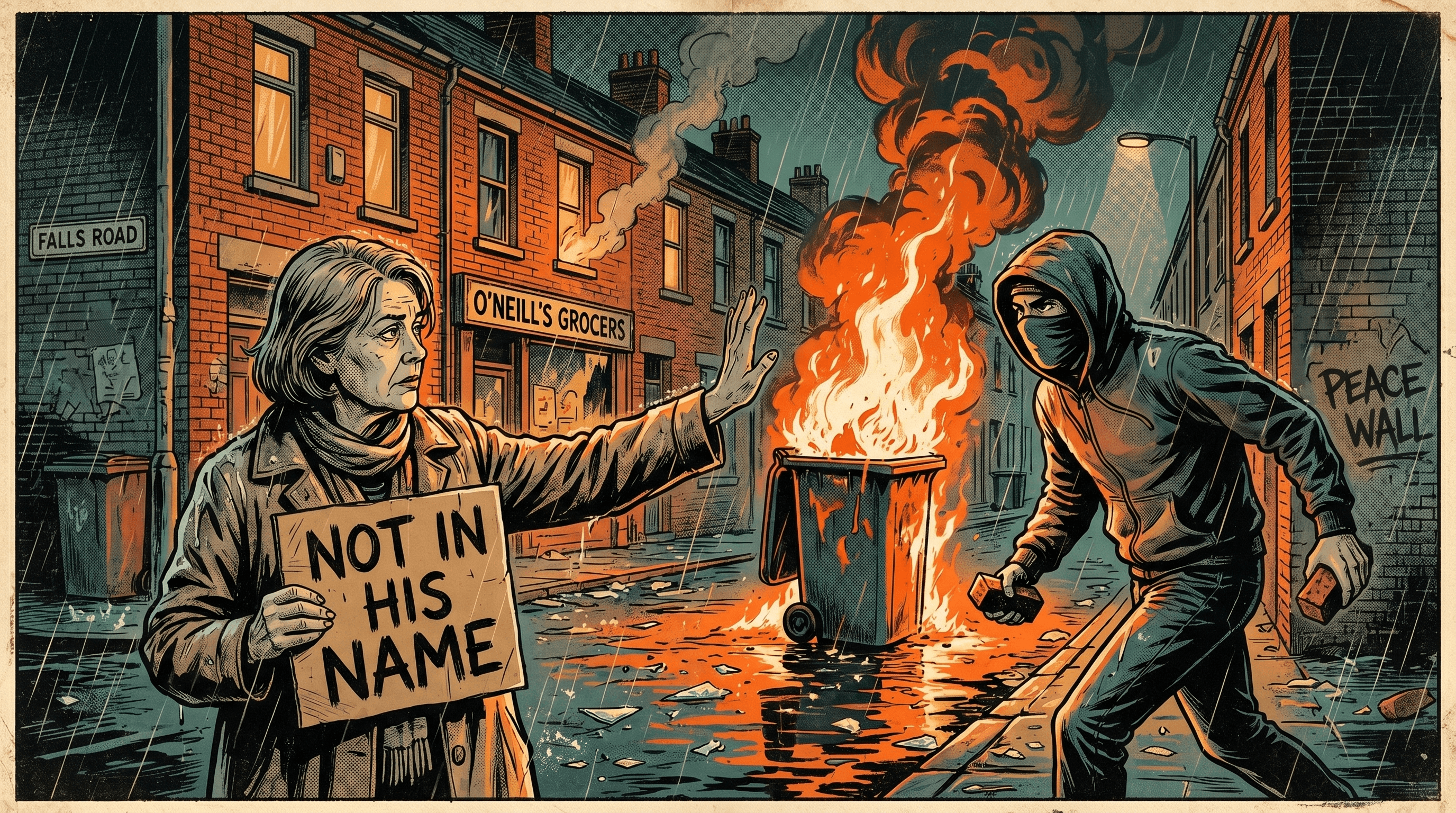
If you want proof that a riot has nothing to do with the grievance it claims, watch what happens when the grievance itself tells the rioters to go home — and they don't.
That's exactly what happened in Belfast this week. Stephen Ogilvie, a man in his 40s, was stabbed on a Belfast street on Monday. He was blinded in his left eye and suffered deep cuts to his head, face, and back. Video of the attack went viral. By Tuesday night, masked men were burning houses in his name. By Wednesday, his family had publicly begged them to stop, saying migrants "make a deeply valuable contribution to our country" and asking that the tragedy not "be used to divide people or fuel hostility."
The mob kept rioting anyway. Which tells you everything: the violence was never for Stephen Ogilvie. He was just the excuse that happened to be available.
What Actually Happened
The facts of the crime are ugly and uncomplicated. Police found Hadi Alodid, a 30-year-old man from Sudan, on top of the victim, armed with a kitchen knife. He's now charged with attempted murder, possessing a knife, and threatening to kill a radiographer during hospital treatment — where he reportedly told staff, "I've killed someone, I don't know if they are dead" and "I will kill you." He appeared in Belfast Magistrates' Court by video, refused legal representation via an Arabic interpreter, entered no plea, and was held in jail. Alodid entered Northern Ireland from the Republic of Ireland in 2023 — the island has an open land border — applied for asylum, and was granted a five-year permit to remain. The PSNI says nothing suggests the attack was terrorism-related.
So: one man, one knife, one horrific crime, one suspect in custody within hours. The justice system was doing precisely what it exists to do.
Then the second crime began. On Tuesday night, masked men set fire to several homes believed to house immigrants, torched a bus, burned bins, and pelted police with whatever came to hand. Firefighters pulled people out of burning houses. More than two dozen people were left homeless. Evacuated families — including one with a baby — sheltered in police stations.
Wednesday brought round two: water cannons, small fires, bricks and bottles, 200 extra police officers deployed, support called in from other forces, bus and train services cut short. In Newtownabbey, demonstrators dismantled a picket fence and used it as a shield against the water cannon — a level of tactical preparation you don't improvise out of raw grief.
The Machine Was Already Built
Here is the part everyone politely tiptoes around: nobody burns down a street because they're sad about a stranger.
Grief doesn't issue balaclavas. Grief doesn't bring sledgehammers to smash sidewalks into ammunition — demonstrators tore bricks from walls and broke up pavement to manufacture projectiles. That is not an emotion. That is logistics.
What the viral video did was not create anger; it activated infrastructure. The protests were encouraged online by far-right activists. The footage was seized on by anti-immigration activists before a single fire was lit. Politicians saw it coming and called for calm in advance — calls for calm being the political equivalent of yelling "please slow down" at a train that has already left the station and is, in fact, on fire.
And this is a rerun, not a premiere. Prior riots in the UK were sparked by viral misinformation around stabbings. The script exists. The cast is on retainer. All it needs is footage.
How the Outrage Machine Works (A Field Guide)
Think of it like dry forest and lightning. The lightning — the viral video — gets all the attention, because lightning is dramatic and you can point at it. But lightning strikes forests all the time without burning them down. The fire needs years of accumulated dry tinder: networks, grievance, organizers, and people who've spent a long time waiting for permission.
The video isn't the cause. The video is the permission slip.
Notice what the machine doesn't care about. It doesn't care that the suspect was caught immediately. It doesn't care that he's in jail. It doesn't care that the victim's own family — the only people on earth with genuine standing to demand vengeance — explicitly refused it. The machine takes one input (viral footage of a crime, suspect ideally foreign) and produces one output (burning houses of people who had nothing to do with it). It's a vending machine that dispenses arson no matter which button you press.
And like all genuinely stupid machines, it can't aim. PSNI Chief Constable Jon Boutcher pointed out that the arson victims included "families from across communities" — not only ethnic minorities. A movement supposedly defending the local community managed to burn out the local community. The mob set out to protect Belfast from outsiders and ended up making twenty-five-plus Belfast residents homeless. As mission statements go, this is like a neighborhood watch that steals your car to keep it safe.
Meanwhile, the human cost lands exactly where you'd expect. Anselme Shima, a Belfast man of Congolese origin who has lived there nearly ten years, put it plainly: "I'm scared. Seeing this, I'm wondering if I'm next." A decade of life in a city, reduced overnight to wondering whether your house is on someone's list.
The Rare Sound of Agreement
Northern Ireland's power-sharing government is not famous for harmony. It is a structure that yokes together Sinn Féin and the DUP, two parties who could plausibly disagree about the weather. And yet: First Minister Michelle O'Neill called the violence "thuggery" and "disgusting cowardice." Deputy First Minister Emma Little-Pengelly said that "taking frustration at the evil actions of a person out on those who had no part in it is utterly wrong." Boutcher added, "There is absolutely no excuse for it."
When Sinn Féin, the DUP, the police, and the victim's own family are all saying the same thing, the people on the other side of that consensus should probably sit with the fact that they've achieved something genuinely difficult: uniting Northern Irish politics.
The Stolen Grievance
A man was nearly killed on a Belfast street, and within twenty-four hours his suffering had been stolen from him — converted into fuel by people who never asked his family's permission and ignored them when they spoke. The Ogilvies asked for the one thing the mob couldn't give: for the tragedy not to be used as a weapon. The mob used it as a weapon anyway, because the weapon was the point and the tragedy was just the trigger.
So let's retire the polite fiction that this was an "outpouring of anger" at a crime. The crime had a suspect, in custody, facing court. The anger had an itinerary. When the next viral video drops — and it will — remember the lesson of Belfast: the people who claim to avenge a victim while ignoring his family aren't avenging anyone. They're shopping for a pretext.
And a movement that burns down the homes it claims to defend isn't a protest. It's arson with a press release.


