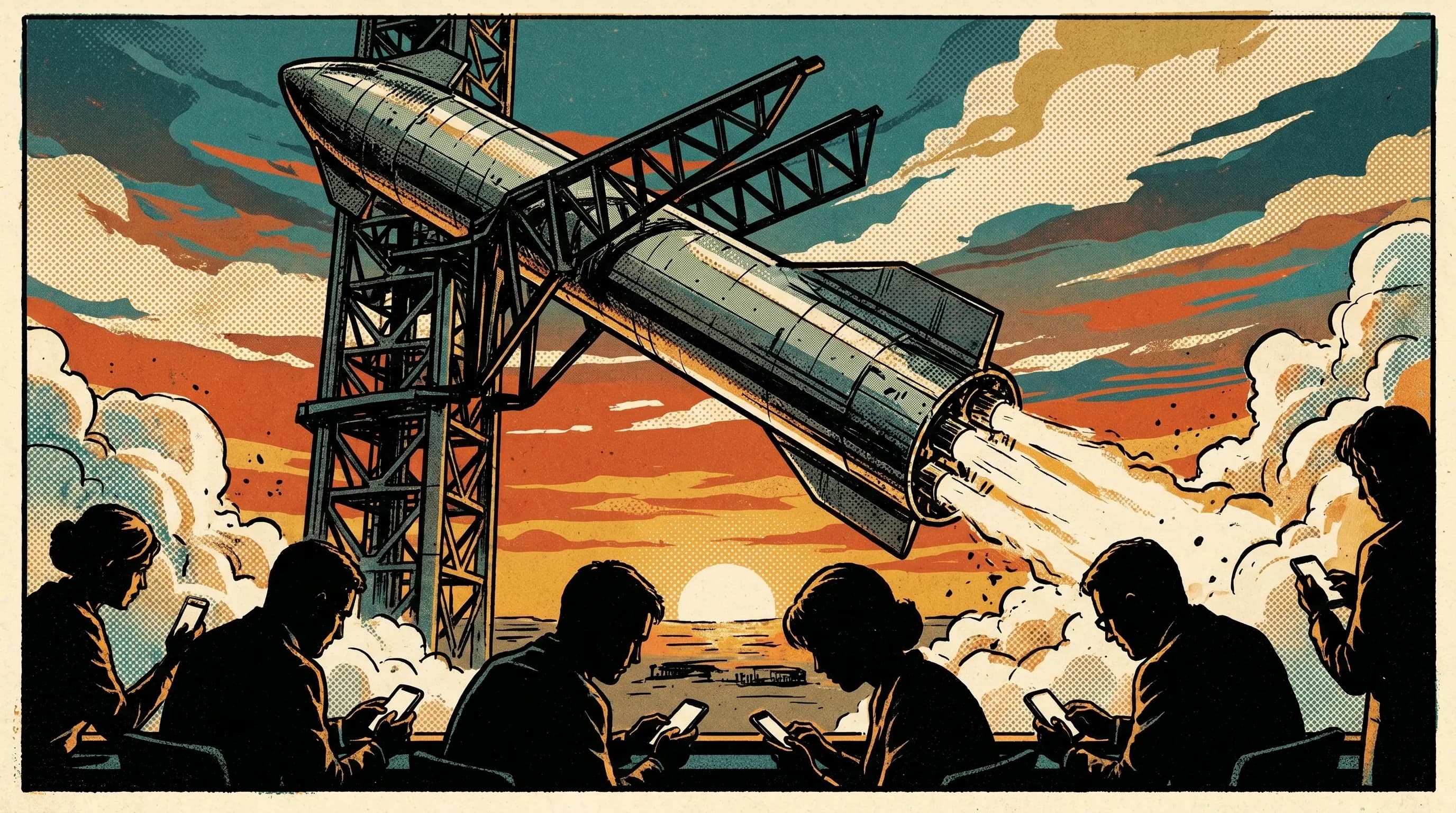
The most technically demanding thing humans have done in half a century happened last week, and most of the coverage treated it like a very expensive fireworks display.
On April 1, 2026, four astronauts climbed into a capsule called Integrity, strapped themselves to the most powerful rocket currently flying, and spent ten days surviving conditions that would have killed them in a hundred different ways if any single system had blinked. They didn't land on the Moon. They didn't plant a flag. They went out there, proved that humans can make the round trip without dying, and came home at 25,000 miles per hour — roughly 32 times the speed of sound — into a fireball of ionized plasma that briefly cut them off from all contact with Earth.
The headline, almost everywhere, was: Historic milestone.
The actual story is considerably more interesting than that.
What Artemis II Actually Was
Reid Wiseman, Victor Glover, Christina Koch, and Canadian Space Agency astronaut Jeremy Hansen didn't go to the Moon. They went to the edge of the Moon's gravitational grip — swinging within 4,000 to 6,000 miles of the lunar surface at closest approach — and then used the combined gravity of the Earth and Moon to slingshot themselves back without firing a single additional propulsion burn. In total, they covered 694,392 miles. That's about 1.1 million kilometres, for those keeping score in metric.
The mission was, in NASA's own framing, a systems validation flight. Not exploration. Not science. Validation. Every headline that called it a "giant leap" was technically correct and substantively misleading in the same breath, which is a skill the press has honed to near-perfection.
What NASA actually needed to know was simple: can the life support keep four people alive? Can the heat shield survive re-entry from deep space? Can the navigation hold? Can the radiation protection do its job when you push humans through the Van Allen belts and into the Moon's sphere of influence? These questions sound boring. They are, in fact, the questions that determine whether any human being ever sets foot on the lunar surface again. Artemis III — the actual landing — rides entirely on the answer being yes.
The Part That Should Have Been the Lede
Here's what the "historic milestone" frame buries: this mission was a gauntlet, and the engineering had to run it perfectly.
Let's talk about the Van Allen radiation belts, because nobody in mainstream coverage seemed to want to. They are two doughnut-shaped regions of magnetically trapped, highly energetic particles that encircle Earth at various altitudes. If you're heading to the Moon, you go through them. During the outbound journey, Integrity crossed them, and the crew was conducting active radiation-protection tests while it happened. This isn't a footnote. This is one of the central reasons Artemis II existed — to see what the radiation environment actually does to humans and hardware on a crewed deep-space transit.
Then there's the communications blackout behind the Moon. For approximately 30 to 50 minutes, while Integrity was on the far side, the crew had no contact with Earth. Victor Glover put it plainly before the mission: "For the 45 minutes that we're closest to the lunar surface, we are also going to be out of contact." Closest approach and communications blackout coincide. NASA's Deep Space Network, which handles communications for missions of this range, simply cannot reach a spacecraft hiding behind 2,000 miles of rock. You're on your own. Whatever happens, happens.
And then they came home.
Re-entry Is Not What the Movies Made You Think
Imagine you're sitting in a capsule travelling at 25,000 miles per hour. You need to stop. The way you stop is to use the atmosphere as a brake pad.
When a spacecraft enters the atmosphere at those speeds, the air in front of it compresses faster than it can get out of the way. That compression generates heat. Not "leave the oven on too long" heat. Not "industrial furnace" heat. Five thousand degrees Fahrenheit. For context, iron melts at around 2,800°F. Integrity was hitting temperatures nearly twice that.
The heat shield is what stands between the crew and this fact. It ablates — meaning it burns away deliberately, layer by controlled layer, carrying the heat with it. It is, essentially, a very sophisticated sacrificial object. The entire re-entry sequence is an exercise in controlled destruction performed in exactly the right way.
The plasma that forms around the capsule during this process is so electrically charged that it blocks radio signals entirely. The crew went dark. Nobody on the ground could reach them. This blackout is distinct from the one behind the Moon — same silence, completely different cause. Behind the Moon, it's geometry. During re-entry, it's physics.
Christina Koch, during the mission, gave a description of the free-return trajectory that's worth sitting with: "The burn that gets us going to the moon is also our deorbit burn." The same engine fire that launched them toward the Moon ultimately sealed their path home. There's something almost poetic in that — except that it's not poetry, it's orbital mechanics, and if it had gone wrong there was no rescue mission available.
They splashed down in the Pacific Ocean. The U.S. Navy had the crew out of the water within approximately two hours. Someone at NASA described it as a "perfect bull's-eye splashdown." Which is the kind of thing you say when the alternative was genuinely unthinkable.
The Record That Went Unreported
Artemis II broke the Apollo 13 record for the farthest humans have ever been from Earth.
Apollo 13, for those who need the reminder, is famous because almost everything went wrong. It is remembered as NASA's finest hour precisely because survival was not guaranteed. The crew of Integrity quietly surpassed the distance those three men reached in extremis — and they did it in a capsule that performed, by all accounts, as designed.
That's the record. Farthest humans from Earth. Broken on a mission most people think of as a dry run.
Rick Henfling, NASA's entry flight director, made the point with appropriate plainness: "None of us were born during Apollo… this is our opportunity to inspire a generation of kids to get involved in future space exploration." Which is true, and fine, and slightly misses the point that the mission's real job wasn't inspiration. It was proof. Inspiration is the byproduct. The product is data about whether humans survive.
The Proof of Concept the Press Missed
Artemis I, the uncrewed test flight in 2022, ran for 25 days. Nobody was aboard. Every system that needed testing in a crewed configuration — life support, radiation protection, suit integrity, manual piloting, the human body's response to deep space — remained untested with actual humans inside. Artemis II fixed that. All of it, in ten days.
Glover, Koch, Wiseman, and Hansen were not explorers in the romantic sense. They were, more precisely, test subjects and test pilots simultaneously — running checklists, conducting suit checks, performing manual piloting exercises, and monitoring radiation exposure while also being the data points. That is a particular kind of courage that the "historic milestone" frame doesn't quite capture, because it's unglamorous in a very specific way. It's the courage of someone who has agreed to be the experiment.
The mission also carried three genuine firsts: first crewed mission to include a woman in the lunar vicinity, first to include a Black astronaut, and first to include a non-American. These facts were reported dutifully and then immediately subordinated to the "milestone" narrative. They're worth noting not for the optics but because the talent pool NASA is drawing from for Artemis is demonstrably wider than it was in 1969, and wider talent pools produce better outcomes. This isn't idealism. It's engineering logic.
The Only Conclusion Worth Drawing
The Moon landing that everyone is actually waiting for — Artemis III, boots on the surface — cannot happen without what Integrity just proved. Every system that needs to work for a lunar landing was stress-tested during those ten days: the heat shield that has to survive re-entry, the radiation protection that has to survive the Van Allen belts, the life support that has to keep four people alive in deep space, the communications architecture that has to function at lunar distances except for the windows when it fundamentally cannot.
The coverage called it a milestone. It was a proof of concept. And the difference between those two things is the difference between watching someone cut a ribbon and watching someone pour the foundation.
We tend to celebrate the ribbon cutting. The people who poured the concrete rarely make the front page.


