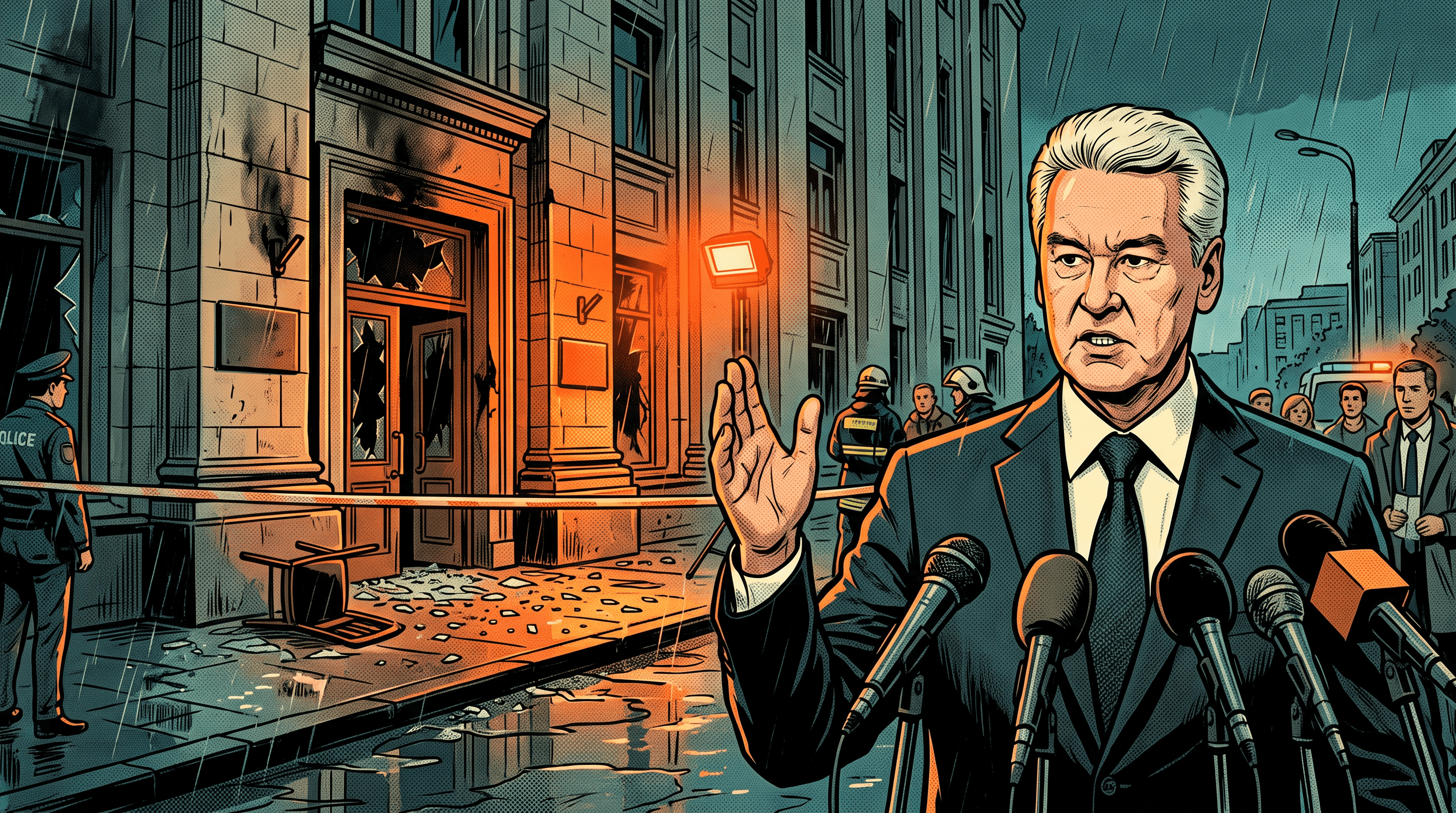
Within an hour of the explosion, everyone with a keyboard had already cracked the case. It was Ukraine. Obviously Ukraine. Another chapter in the long, bloody feud playing out on Moscow's doorstep. Case closed, pundits fed, geopolitics served hot.
And in that stampede toward the big story, almost everyone stepped straight over the only person who actually did something that night: a security guard whose name we don't have, standing at a restaurant door, working the dullest job in the building.
What actually happened
At around 20:00 on Saturday 1 August 2026, a homemade bomb went off outside the Balzi Rossi restaurant on Kudrinskaya Square, near the centre of Moscow. Balzi Rossi is Italian, and it sits inside one of the city's landmark Stalin-era skyscrapers — the kind of vast, heavy building designed to make a person feel small. That evening it was hosting a private function.
According to Russia's National Anti-Terrorist Committee, a woman carrying the explosives tried to get in. A guard stopped her at the door. The device went off at that exact spot. It killed three people: the woman, the guard, and one restaurant visitor. Another 21 were hurt. The figures were preliminary and still moving as reports came in.
Moscow's mayor, Sergei Sobyanin, called it "a cruel act of terror which took human lives" and said law enforcement was working to establish what happened. No one has been named as the target. No group has claimed it. Russia has made no official attribution. Roads around the square were briefly shut, armed police sealed the area, and a group of cyclists who had gathered nearby for an evening ride were sent home.
The story isn't the bomb. It's the threshold.
The tale everyone will tell is about geopolitics. The one that matters is about a doorway.
Picture the two versions of that night. In one, a woman with a bomb walks unchallenged into a room full of people at a private party and detonates it. In the other, she gets stopped at the door. The distance between those two nights is measured in bodies — and the reason it went the second way is one guard who did his job.
We're told, understandably, to look at the war, the assassinations, the missing generals. Maybe that's where this leads. But the commentators sprinting toward Kyiv are skipping the single layer that changed the outcome: a man standing between a crowd and a stranger, deciding she did not get to walk through.
Why the boring layer is the important one
Physical security is boring on purpose. It works in layers, like an onion — except this onion can save your life and mostly just annoys you on a Tuesday.
The outermost layer is the door. It's the cheapest, dullest, most human part of the whole system: a person who looks at you and decides whether you come in. And it turns out the outermost layer is also, almost always, the most important, thanks to a rule that has nothing to do with politics and everything to do with physics. Where a bomb goes off decides how many people it kills.
A device that detonates in the open air at an entrance is a catastrophe for the handful of people right beside it. The same device in the middle of a packed private function is a catastrophe for the whole room. Same bomb. Wildly different arithmetic. The single variable that changed here was distance — and distance is exactly what a guard at a door buys you.
That's the unglamorous point nobody wants. There's no thriller where the hero stops the villain in the lobby and everyone goes home for an early night. The successful version of security is invisible, and the invisible version of heroism is a man who didn't like the look of something, blocked the threshold, and paid for that judgement with his life.
Hold the certainty loosely
There is real uncertainty here that the rush to blame tends to flatten. We don't actually know whether the woman knew what she was carrying. She may have been the bomber. She may have been a courier with no idea what was in the bag. We don't know who the target was — the party, the building, someone specific inside, or nobody in particular. And the official account of the guard stopping her at the door hasn't been independently checked. Hold all of it loosely.
But hold this next detail as tightly as you like, because it's the most human thing in the whole affair. The restaurant's very first public act, after a bomb killed three people outside its door, was to post that everything on the premises was safe. Then, presumably after someone in the room started quietly hyperventilating, they deleted it and apologised, calling the post "highly inappropriate given the circumstances." Early reports had even described a kitchen blast, before the restaurant clarified that "there was a problem outside."
A problem outside. Three dead is certainly one way to phrase a problem outside.
And yes, the war
Now, the war. Muscovites will suspect a link, and that isn't a mad thing to suspect. Russia has seen a run of assassinations of senior military figures in and around Moscow in recent years, and the Kremlin has blamed those on Kyiv.
But notice the shape of those earlier killings. They were surgical. They went after named, specific military men. A homemade device carried into a private dinner by a woman who may not have known what she held is a different animal entirely — messier, more indiscriminate, and so far claimed by nobody. Filing it under "Ukraine" is comforting precisely because it spares you from admitting you don't yet know.
The result nobody will report
So by all means chase the geopolitics. It's the bigger story, the one with maps and armies and grand consequences, and it will fill a thousand columns.
But the next time somebody sneers that security is just theatre — the guy at the door, the bag check, the tedious human friction that makes you late for dinner — remember Kudrinskaya Square. Someone will eventually win the argument about who planted that bomb. The guard already won the only argument that saved lives, and he won it in the width of a doorway, with no room to run.
The geopoliticians will get the headlines. He got the result.


