There is a certain kind of joke that isn't a joke at all. It's a policy statement delivered with just enough laughter that nobody can object.
At an Easter lunch at the White House, Donald Trump announced the terms of JD Vance's diplomatic mission to Islamabad with characteristic precision: "If it doesn't happen, I'm blaming JD Vance… if it does, I'm taking full credit." The room, one assumes, laughed. The Vice-President of the United States, one assumes, did not.
The Room, the Stakes, the Tap
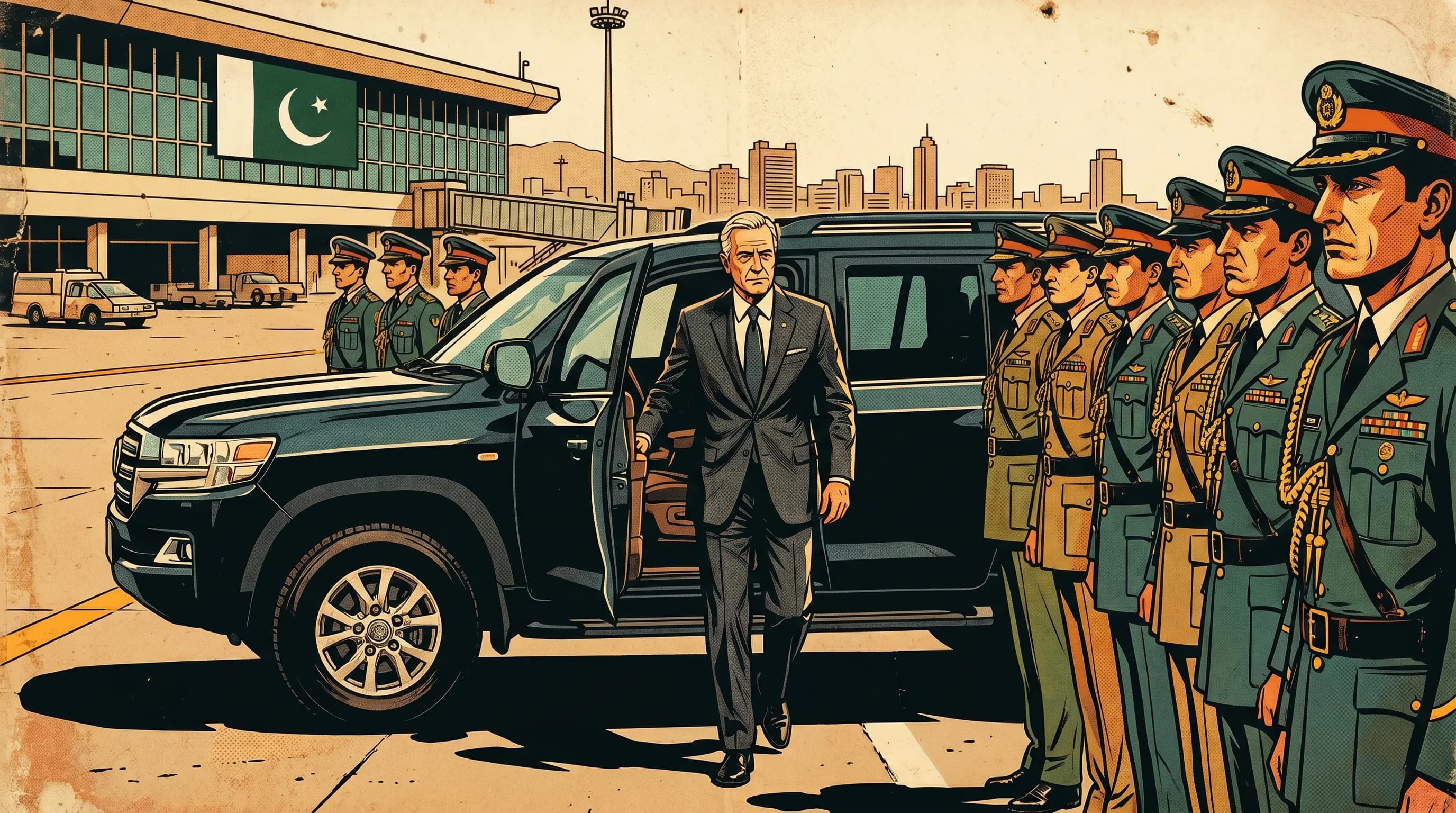
Vance flew to Pakistan to negotiate with Iran over a long-term deal following a six-week US military campaign that left Iran's regime weakened but, crucially, still standing. He didn't travel alone. The delegation included special envoy Steve Witkoff and Jared Kushner — which is either a sign of how seriously the administration takes this, or a sign that someone wanted several bodies in the room to absorb potential blame.
Iran, despite the campaign, retains meaningful leverage. It still controls the Strait of Hormuz, the chokepoint through which a substantial portion of the world's oil passes. That's not nothing. That's, in fact, everything in a negotiation. You don't get to call yourself the losing side when you still have your hand on the tap.
European allies are reluctant to support any US effort to reopen the Strait. Israel is wary of a region-wide ceasefire framework. The MAGA base is broadly hostile to the kind of foreign entanglement this mission represents. And an unnamed European official has summed up the situation with the blunt compassion of someone watching a colleague walk into a meeting they know won't go well: Vance "needs to step into the room and deliver something."
Not a lot to work with, then.
Not a Joke
What Trump said at Easter deserves more examination than it will get, because it is not a throwaway gag. It is, in miniature, a complete theory of executive power and political liability.
When a president dispatches a vice-president to negotiate in a volatile situation, the public framing matters enormously. It sets expectations. It signals how seriously the administration views the mission. It tells the other side something about how much weight the envoy actually carries.
What Trump's framing told everyone — the Iranians, the Europeans, the Israelis, and Vance himself — is that the Vice-President is operating without a net. If the deal collapses, it's Vance's failure. If the deal holds, Trump takes the bow. This is not an unusual political arrangement in the general sense; leaders have always harvested the successes of their subordinates. But announcing it publicly, before the negotiations have concluded, while the man is literally in the room trying to negotiate, is something else entirely.
It's the diplomatic equivalent of your manager sending a company-wide email saying "if this project tanks, it's Dave's fault" while Dave is presenting to the client.
The Contradiction Sitting at the Table
Here is where it gets genuinely strange. JD Vance is a former Marine and Iraq war veteran. He has been, for years, one of the more consistent anti-intervention voices in American politics. He previously stated that Trump would not drag the US into "forever wars." By multiple accounts, he was privately sceptical of the Iran strikes that produced the very conflict he is now tasked with resolving.
The man sent to negotiate the end of a war he privately opposed is being held publicly responsible for the outcome of a war the president publicly owns.
That's not a foreign policy assignment. That's a trap with a travel itinerary.
Imagine you work at a firm, and your boss launches a product you quietly think is a bad idea. The product launches, causes chaos, and now your boss sends you to clean it up — telling everyone in the office that if the cleanup fails, it's your fault. Oh, and the client you're meeting is sitting across a table with their hand on your firm's main power switch.
That is Vance's Tuesday.
The intellectual tension here runs deep. His instincts — and the instincts he built his political brand on — pull against everything this mission requires. Vance's restraint instincts clash directly with the war he is now tasked with ending. Which raises an uncomfortable question: is Vance the right person for this job? Or is he simply the most politically convenient person to send?
The Thirty-Six Hour Masterclass in Chaos
Whatever strategic framework Vance is working from, it was generated in interesting conditions. Within a single thirty-six-hour period, Trump threatened Iran by suggesting "a whole civilisation will die," issued a one-day ultimatum, then declared a ceasefire — with less than two hours remaining on that ultimatum.
That is not diplomacy. That is a man refreshing his feelings every few hours and calling it foreign policy.
Vance now has to translate this into something Iran will actually sign. The Iranians, who have been negotiating with great powers since most great powers were fields, are not going to miss the subtext. They watched the thirty-six-hour performance. They know who is running this show and how the show is being run. The question is whether they want a deal badly enough to work around it.
The Vance Résumé Problem
There's one more layer worth examining, and it is the layer that nobody in Washington will say out loud: everything Vance does between now and 2028 will be read as a 2028 audition.
His recent record is a set of deliberate ideological statements. He delivered a speech at the Munich Security Conference criticising Europe. He clashed publicly with Ukrainian President Zelensky during an Oval Office meeting that was, depending on your sensibility, either a display of MAGA realpolitik or a diplomatic ambush conducted in a room with very good cameras. He campaigned for Viktor Orbán in Hungary. Each of these moves was legible as a signal to a particular constituency.
Now he is in Islamabad, trying to broker peace with an adversary his own country just bombed, in a mission that his boss has already disclaimed responsibility for, with European allies who won't fully back him and an Israeli government that doesn't want the deal he's there to make.
If Vance pulls this off, Trump takes the credit. If Vance fails, the MAGA base — already allergic to foreign entanglements — will have been handed a narrative about a Vice-President who dragged America deeper into exactly the kind of conflict the movement was built to oppose. And the man who sent him there will be standing well clear of the wreckage.
The Mission's Real Purpose
The generous reading of all this is that Trump trusts Vance enough to put him in the room on something consequential. The realistic reading is that Vance was chosen because he is expendable in a way that Witkoff and Kushner, as private operators without electoral futures, simply are not.
What this mission is really testing is not Vance's diplomatic skill — though that matters — but his political durability. Can he absorb a public pre-assignment of blame, walk into a high-stakes negotiation, and emerge with something that looks like a win, even if the credit goes elsewhere? Can he manage the contradiction of being an anti-interventionist who just became the face of an intervention — while holding together reluctant Europeans, wary Israelis, and a MAGA base that wanted none of this, all while his boss auditions for the Nobel Peace Prize from the comfort of a White House Easter lunch?
That's not a diplomatic test. That is a character test, conducted under live fire, with someone else's finger on the scoring button.
The Punchline
The Trump quote will be remembered as a joke. It shouldn't be. It is the clearest possible articulation of how power actually works inside this administration: success is Trump's by definition, failure is always someone else's by design, and the Vice-President of the United States is not a governing partner but a deployable asset — useful precisely because he can be blamed.
Vance knows this. He went to Islamabad anyway. Whether that is loyalty, ambition, or the simple professional calculation that there is no good alternative, only he can say. But it is worth noting that the man who once warned against forever wars is now the public face of ending one — under terms set by a president who has already, cheerfully, washed his hands of it.


