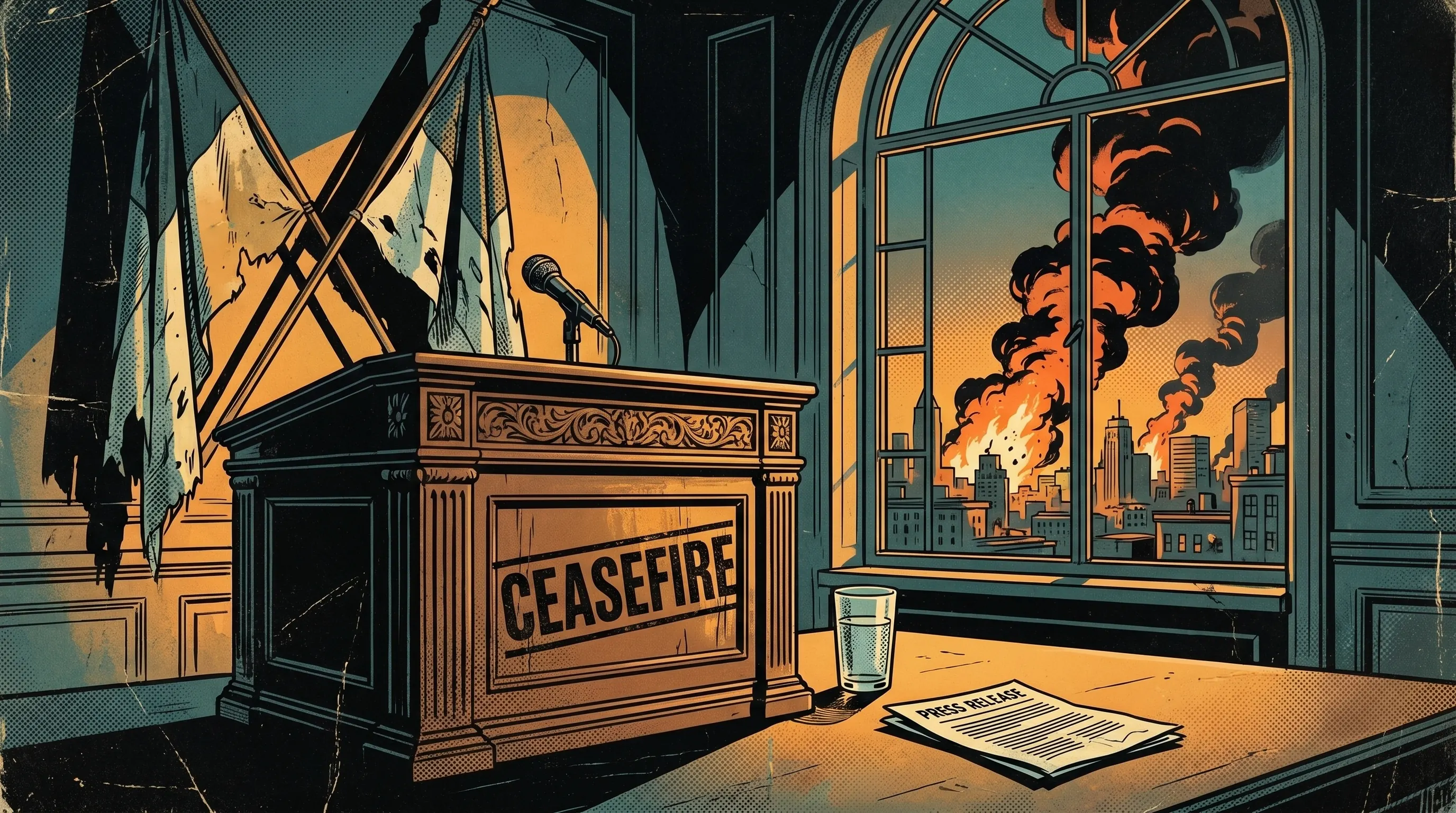
If you want to understand why this war has no end in sight, don't study the battlefield maps. Study the press release.
Russia and Ukraine have agreed to a 32-hour ceasefire over Orthodox Easter weekend. It begins at 4pm Moscow time on Saturday and runs until midnight Sunday. Vladimir Putin announced it. Volodymyr Zelenskyy confirmed Ukraine would honour it. The Kremlin issued orders for Russian forces to stop shooting in all directions — while simultaneously ordering those same forces to remain ready to "counter any possible provocations by the enemy."
So: stop shooting. But stay ready to shoot back. Because the other side will shoot.
This is what diplomacy looks like in the fifth year of this war, and you should find it as revealing as it is depressing.
The Annual Production
Last year, there was also an Easter ceasefire. It lasted 30 hours. It collapsed under mutual accusations of violations by both sides. The year before that, presumably, something similar. And here we are again, same ritual, different date — Orthodox Easter falls on April 12, 2026 — with both governments doing the thing where they agree to stop killing each other for approximately one news cycle, then go back to killing each other.
There's a word for repeating the same action while expecting different results, but since this is an Easter piece we'll be charitable about it.
The more instructive detail is in the Kremlin's own statement, which is worth reading slowly: "We proceed on the basis that the Ukrainian side will follow the example of the Russian Federation." That is not the language of a side that trusts its counterpart. It is the language of a side that has already written the press release for when things go wrong. It is, in diplomatic terms, a pre-loaded excuse — a sentence that functions equally well as a call for peace and as the first paragraph of a blame document.
Zelenskyy, for his part, noted that Ukraine had previously proposed a similar Easter pause. Which is to say: the Ukrainians wanted this too, Russia announced it, and now both sides are claiming credit for a ceasefire that neither expects to hold.
This is not diplomacy. This is a performance of diplomacy, staged for an audience that is increasingly watching something else.
Why Short Is the Point
Here's what makes the 32-hour ceasefire strange.
Imagine you are trying to end a war. What would a useful ceasefire look like? It would be long enough to establish trust, open corridors, begin serious talks, and give both sides something to lose by going back to fighting. It would be, at minimum, the kind of breathing room where a diplomat could actually do something — book flights, hold meetings, draft frameworks.
Thirty-two hours is not that. Thirty-two hours is long enough to sleep, go to church, eat Easter lunch, and then get back to it. You cannot negotiate a lasting peace in the time it takes to finish a long weekend.
Now contrast this with what Russia rejected: a US-backed proposal for a 30-day unconditional truce. Thirty days versus thirty-two hours. One of those is a serious attempt to create the conditions for peace. The other is a symbolic pause with a built-in expiry date, tied to a religious holiday, after which everyone goes right back to their positions — literally and figuratively.
Russia has consistently preferred exactly this kind of arrangement: short, unilateral, linked to symbolic events. Not long enough to build anything. Long enough to look reasonable to anyone who isn't paying close attention.
The asymmetry tells you everything. A side genuinely interested in ending a war says yes to thirty days. A side interested in managing the perception of being open to peace says yes to thirty-two hours and rejects the rest.
The Grammar of a Managed War
Think of this war, in its current phase, less as a military conflict and more as a long-running institutional arrangement that both states have adapted to.
But there is a difference between a war that both sides are trying to end and a war that both sides have learned to sustain. The evidence for the second reading keeps accumulating.
What are the active channels between Russia and Ukraine right now? Not peace talks. Humanitarian exchanges: prisoner swaps, the return of remains. These are real, and they matter to the individuals involved. But they are also, structurally, the kind of cooperation that keeps a conflict manageable rather than the kind that ends it. You can run prisoner swaps indefinitely without ever resolving the underlying conflict. In fact, you need the conflict to keep running to have prisoners to swap.
Meanwhile, the bigger diplomatic questions sit unanswered. Zelenskyy proposed a pause on attacks against energy infrastructure — a practical, harm-reducing measure that didn't require agreeing on anything fundamental. That went nowhere. The 30-day unconditional truce proposal was rejected. What remains is the Easter ceasefire, the Christmas ceasefire before it, the humanitarian corridor here and there — a careful grammar of managed hostility designed to demonstrate that neither side is totally intractable, while ensuring that nothing structurally changes.
This war is in its fifth year. That is not a statistic you arrive at by accident.
The Audience Has Left
One thing working quietly in the background of all this: international attention is a finite resource, and it has been drifting. The kind of concentrated global focus that can make a ceasefire into something more — that can turn a 32-hour pause into a negotiating framework, because the cost of going back to war becomes too high under the scrutiny — is not at full strength here. The world is looking elsewhere.
When nobody is watching particularly closely, a managed ceasefire is easy to stage and easy to break. The mutual accusations that ended last year's Easter truce cost neither side much. They blamed each other, the news moved on, the war continued. This year's ceasefire will follow a similar script, and next Easter there will probably be another 30-or-so-hour pause, and both sides will confirm they will honour it, and the Kremlin will note that it "proceeds on the basis" that Ukraine follows Russia's example.
You could set your calendar by it. They practically have.
What the Ritual Is For
There is a version of this story in which the Easter ceasefire is better than nothing — and that version is not entirely wrong. A few hours of quiet is a few hours where people don't die. That is a real thing. Humanitarian exchanges happening at all, in the middle of active war, indicates that some baseline of pragmatic communication remains open. These are not nothing.
But to mistake the ritual for progress is to miss what the ritual is actually communicating. Both sides agreed to this ceasefire. Both sides expected the other to break it. Both sides issued statements pre-positioning themselves as the aggrieved party when that happens. They have done this before. They will do it again.
A ceasefire that everyone knows won't hold isn't an attempt to stop a war. It's a way of conducting a war while maintaining plausible deniability about not wanting peace.
The 32 hours will pass. Orthodox Easter will come and go. The accusations will fly, as they flew last year. And then, somewhere around midnight Sunday, the war that has been running since before most current news cycles were born will resume exactly where it left off — because neither side has agreed to anything that would make resuming it difficult, inconvenient, or politically costly.
That is not a peace process. That is a war with better PR.


