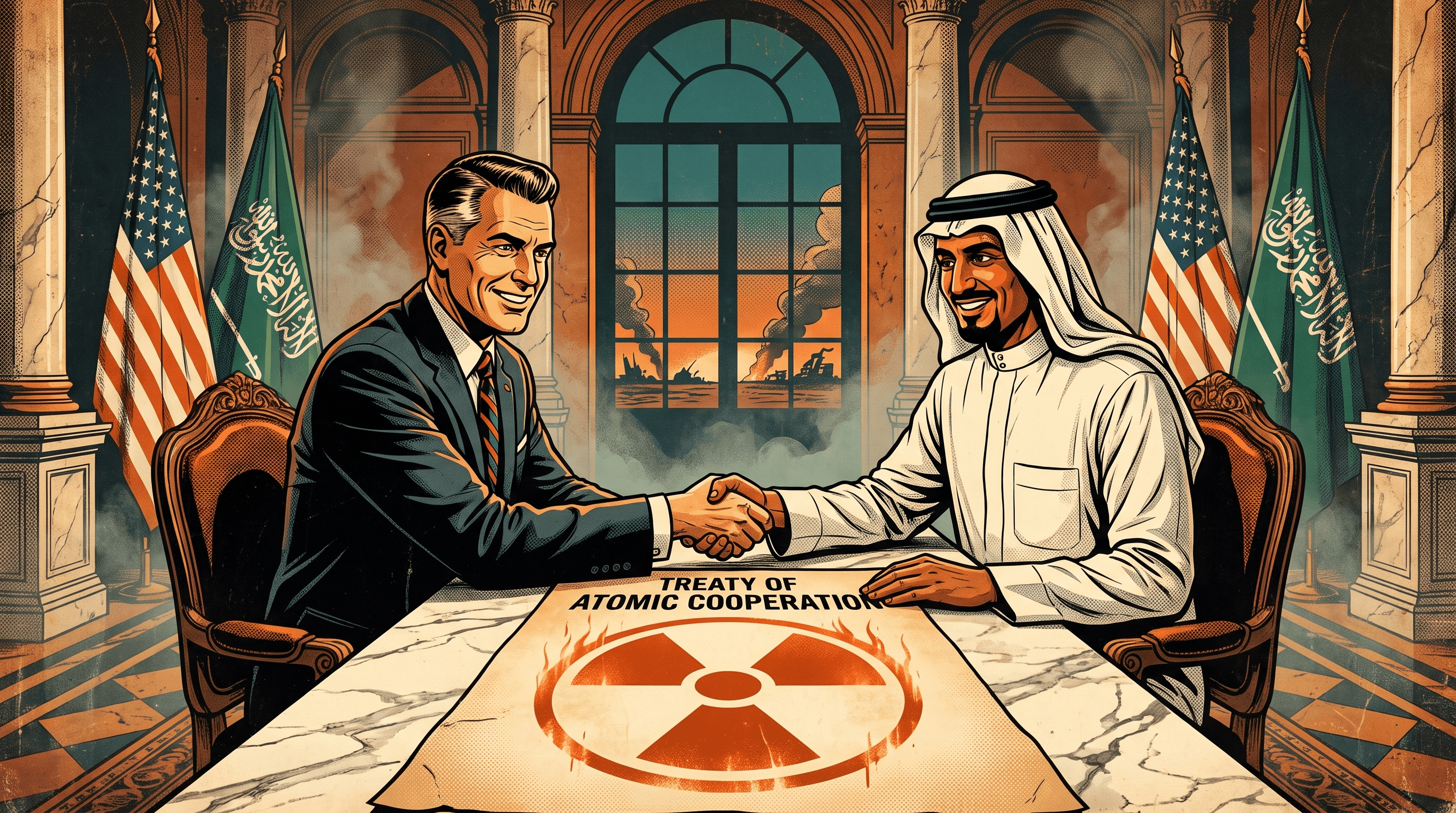
There is a special kind of nerve required to drop bombs on one country for enriching uranium while quietly handing another country the keys to do exactly that. On 22 July 2026, the United States found that nerve.
What Actually Happened
On that day, Washington and Riyadh signed a "peaceful nuclear co-operation agreement," along with a separate "bilateral safeguards agreement." The US Department of Energy called the pair "the legal foundation for a decades-long, multi-billion-dollar partnership." The deal lets Saudi Arabia build a civilian nuclear programme, and — the DOE was keen to stress — promises "great access for American companies in the Saudi nuclear energy program."
The text was not made public. That is a detail worth holding onto, because everything interesting about this deal lives in the part nobody can read.
US media reports suggest the agreement could permit Saudi Arabia to enrich uranium on its own soil, at a facility the US would build after a joint study. The alternative — the boring, safe, grown-up option — would be for the Saudis to simply import their nuclear fuel like sensible people who don't want the world watching them nervously. The deal now goes to Congress for review, where bipartisan opposition is expected, even though Republicans control both chambers.
Meanwhile, the US and Iran are shooting at each other. Saudi Arabia hosts several US bases that Iran has already hit. Two days before this cosy nuclear announcement, the Houthis — Iran's allies in Yemen — declared a "maritime blockade" against Saudi Arabia. So the timing is, let us say, textured.
The Rule America Just Broke For Free
Here is the thing that should stop you cold. Rosemary Kelanic of Defense Priorities put it plainly: "The US has never done that before, we have never helped another country enrich on their own soil." Never. Not once. And her reasoning is the whole ballgame: "if you can produce your own nuclear fuel, you become a much bigger risk" for building weapons.
This is not a minor policy tweak. This is America potentially abandoning its single most consistent nonproliferation principle — don't let your friends make their own fuel — and doing so for a country that hosts bases currently under Iranian fire.
And the price? There wasn't one. Saudi nuclear cooperation was, for years, understood to be the grand prize Riyadh would receive in exchange for recognising Israel. That was the deal everyone assumed: normalisation for reactors. Trump reportedly dropped the Israel condition entirely. The Saudis got the prize and skipped the queue. Imagine haggling for a car for a decade, then watching the dealer hand over the keys and say, "Actually, forget the money."
The hypocrisy writes itself, and Senator Edward Markey of Massachusetts obligingly read it aloud. Trump and Rubio's "hypocrisy is matched only by their recklessness," he said, accusing them of "allowing Saudi Arabia, a belligerent and authoritarian nation, to develop nuclear weapons technologies while starting a war with Iran under the guise of preventing an Iranian nuclear bomb."
You can dislike Markey's politics and still admit the man has a point sitting right there in the open.
Why "Enrichment On Your Own Soil" Is The Whole Argument
The entire fight hinges on one concept, and the officials involved are counting on you not understanding it.
Uranium is dual-use. The same enriched uranium that powers a nuclear plant is also the pathway to a bomb. The difference between "keeping the lights on" and "vaporising a city" is mostly a matter of how much you enrich — spin the uranium a little, you get fuel; spin it a lot, you get a warhead. It's the same machine, the same process, the same building. You just don't turn it off when you're supposed to.
So think of it like this. A power plant that runs on imported fuel is like a restaurant that buys its bread from a bakery. Convenient, traceable, and if the restaurant suddenly starts stockpiling ten thousand loaves, the bakery notices.
A power plant with its own enrichment facility is a restaurant that owns the flour mill, the oven, and the recipe. Now nobody outside the building knows how much bread is being made, or what shape it's taking, or whether "bread" is still the goal at all.
Every nonproliferation official on earth has spent decades trying to keep as many countries as possible in the "buy your bread" category. Owning the mill is the whole problem. And this deal may hand Saudi Arabia the mill — technically an American-built mill, which is the reassurance equivalent of installing the burglar's ladder yourself and pointing out that it's a very high-quality ladder.
To be fair to the sceptics-of-the-sceptics: many experts think an actual Saudi bomb would take decades and draw fierce international pushback. Even nuclear experts and former officials in Israel — not a group prone to shrugging about regional bombs — have voiced concern the plan could ultimately enable a Saudi weapon. "Ultimately" and "decades" are doing heavy lifting. But nonproliferation has never been about the sprint. It's about not building the starting blocks.
The Officials Reassure Us, Sort Of
The reassurances arrived precisely on schedule and with all the credibility of a man insisting the parachute definitely works while declining to jump.
Energy Secretary Chris Wright said the agreements "uphold the highest standards of nuclear safety and nonproliferation, while relying on the world's best nuclear technology and scientists, designed right here in the United States." Note the pivot from "we're keeping you safe" to "and it's great business for us," which the DOE couldn't help repeating. Nonproliferation as a sales brochure.
Secretary of State Marco Rubio, speaking from the Philippines, offered the categorical denial: "The US is not going to reach any agreement with any country in the world that leads to the risk of proliferation." Firm. Clean. Reassuring.
There is one small problem. As a senator, Rubio endorsed the "No Nuclear Weapons for Saudi Arabia Act" — legislation that required congressional sign-off on exactly this kind of Saudi nuclear deal. Democrats are now waving his own past position at him like a receipt he hoped you'd lost.
The Saudi framing, for its part, is a masterpiece of understatement: the deal is merely "an extension of existing co-operation" in energy. Yes, and a flamethrower is an extension of a match.
The Takeaway
Strip away the diplomatic language and the multi-billion-dollar brochure copy, and one fact remains standing. The United States is fighting a war it justifies as stopping Iran from enriching uranium, and in the same week it signed a secret document that may let Saudi Arabia enrich uranium — the first time in its history it has ever offered that to anyone.
The lesson the entire region will absorb is not "nuclear weapons are forbidden." It is "nuclear weapons are forbidden to America's enemies and available to America's friends, subject to change without notice." That is not a nonproliferation policy. It is a loyalty programme with warheads, and the terms are printed on paper no one is allowed to read.


