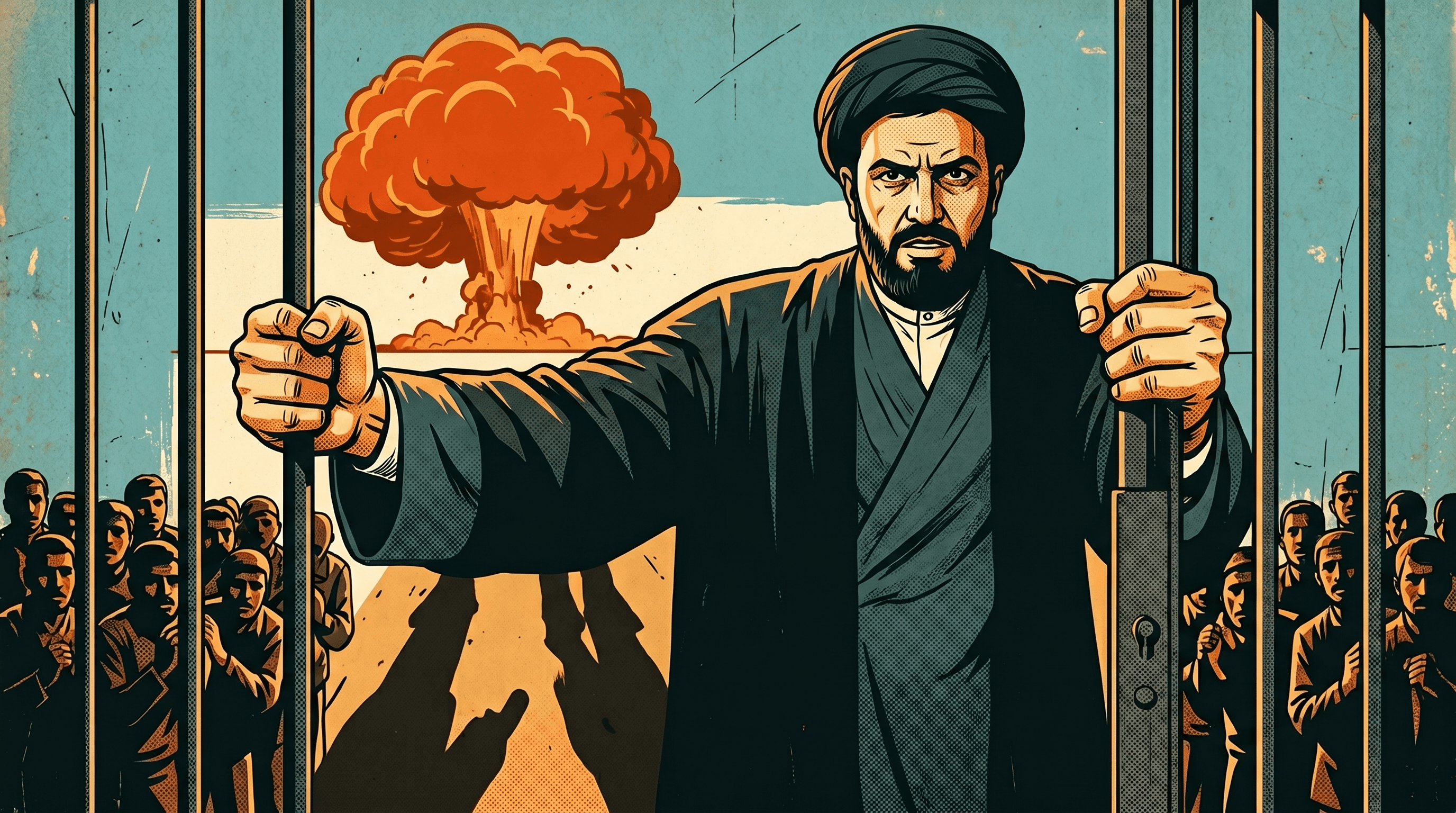
There is a special kind of stupidity reserved for people who believe you can bomb a dictatorship into becoming a democracy. It ranks somewhere between "the market will regulate itself" and "this email from a Nigerian prince seems legitimate" on the scale of ideas that sound plausible only if you've never once consulted the historical record.
What Actually Happened
Before the war, Iran's streets were alive with defiance. According to HRANA, the Washington-based Human Rights Activists News Agency, more than 53,000 people were arrested during anti-regime protests in January alone. Fifty-three thousand. That is not a protest movement — that is a population in revolt.
Then the war came. And everything got worse.
Many thousands more have been detained since the fighting began. Twenty-one political detainees were hanged during the war in a very short period — reportedly the highest number of political detainee executions in over thirty years. Among those executed were people linked to the January protests, members of opposition groups, and individuals accused of spying. The regime did not pause its internal repression to focus on the external threat. It used the external threat as fuel.
A lawyer working with detainees told the BBC that prison conditions became even harsher during wartime. Opposition presence has effectively vanished from the streets. The regime has been described as "master of life and death." Independent journalists inside Iran now fear that simply reporting facts about the war could be treated not as a political offence but as espionage — a charge that carries the death penalty.
Read that again. Writing down what is happening can now get you killed.
The Fantasy That War Creates Freedom
Some anti-regime Iranians initially hoped that external military pressure might create space for political change. This is understandable. When you have lived under a boot for decades, any force that seems capable of lifting it — even briefly — looks like salvation. But that expectation has collapsed entirely.
Here is the non-obvious thing most Western commentators refuse to absorb: war does not weaken authoritarian control. It perfects it.
The vocabulary of national security is the most powerful solvent ever invented for dissolving civil liberties. And it works identically whether the government speaks English, Farsi, or Mandarin.
The Iranian regime has shown no sign of compromise during the war. None. Not a flicker. Not a gesture. The comfortable Western assumption — that sufficient military pressure will crack open a closed system and let the light in — is not just wrong but precisely backwards, and the pressure sealed the system shut.
How Dictatorships Actually Use Wars (A Brief, Depressing Primer)
Think of it this way. Imagine you run a household where the kids are getting increasingly rebellious. They're questioning your rules. They're organising. They've started a group chat you're not in, which is always a bad sign. You're losing control.
Now imagine someone throws a brick through your front window.
Suddenly, you don't have rebellious kids. You have a family under siege. And anyone who keeps complaining about curfew while the house is under attack isn't a free thinker anymore — they're a traitor to the family. You didn't have to change the rules. The brick changed the context.
That is what war did for the Iranian regime. The 53,000 arrests before the war were a sign of weakness — a government flailing against a population that had lost its fear. The executions and detentions during the war are a sign of something far darker: a government that has regained the narrative.
Independent journalists used to worry about political charges. Now they worry about espionage charges. The war didn't create this escalation, but it handed the regime the rhetorical framework to justify it. Every crackdown is now a matter of national survival. Every hanging is wartime justice.
One woman quoted by the BBC captured the psychological whiplash perfectly. She described feeling joy during the war when key regime figures were killed — a moment of hope, a crack in the edifice. Then she realised the regime itself was still intact and conditions had actually worsened. It is the cruellest kind of disappointment: watching the building shake and believing it's about to fall, only to discover the shaking was just the landlord reinforcing the walls.
The Generation That Gets Crushed
There is a family split running through Iranian society that makes this story even grimmer. A pro-regime older generation and an anti-regime younger generation, divided by rhetoric around martyrdom and collapse. The older generation hears "war" and thinks sacrifice for the nation. The younger generation hears "war" and thinks: this is our chance. Both are wrong, but only one group pays the price for being wrong.
The young people who protested in January — who risked everything because they believed the regime was fragile — are now the most exposed people in the country. Their names are on arrest lists. Their faces are in files. And the wartime atmosphere has given the state a blank cheque to process those files however it likes.
A mood of foreboding has settled over opposition activists, lawyers, and independent journalists inside Iran. Not foreboding about the war itself, but about what comes after. There is a recurring fear among these groups that when the war ends, the state will intensify its internal crackdown. The logic is straightforward: during the war, the regime handles dissidents under cover of national emergency. After the war, it handles the backlog.
This is worth pausing on. The people inside Iran who most want freedom are not hoping for the war to continue. They are dreading its end. That single fact should demolish any remaining illusion that military pressure is working in their favour.
What Nobody Wants to Admit
Nobody knows the true scale of support for the regime across Iranian society. The arrest and execution numbers have not been independently verified. These caveats matter. We are looking at the situation through a keyhole, not a window.
But here is what we can see through that keyhole: twenty-one political hangings in a span that represents the worst such toll in three decades. Tens of thousands detained. Journalists terrified that factual reporting will be reclassified as a capital offence. Lawyers describing escalating brutality behind prison walls. And a complete absence of any regime concession — not one — in response to the war.
The West's theory of the case was simple and satisfying: apply enough external pressure and the regime cracks, the people rise, freedom blooms. It is the geopolitical equivalent of believing that if you just shake the vending machine hard enough, everything falls out for free — when all you've done is weld it shut.
The people who protested in January did something genuinely brave. They stood up in a country where standing up can get you killed. Military escalation did not reward their bravery. It punished it. The regime did not liberalise under pressure. It consolidated. And the 53,000 names on those arrest lists are not abstractions. They are individuals who bet on change and are now living — or dying — with the consequences of a war that was supposed to help them.
War gave the Iranian regime exactly what no amount of domestic repression could achieve on its own: a reason.


