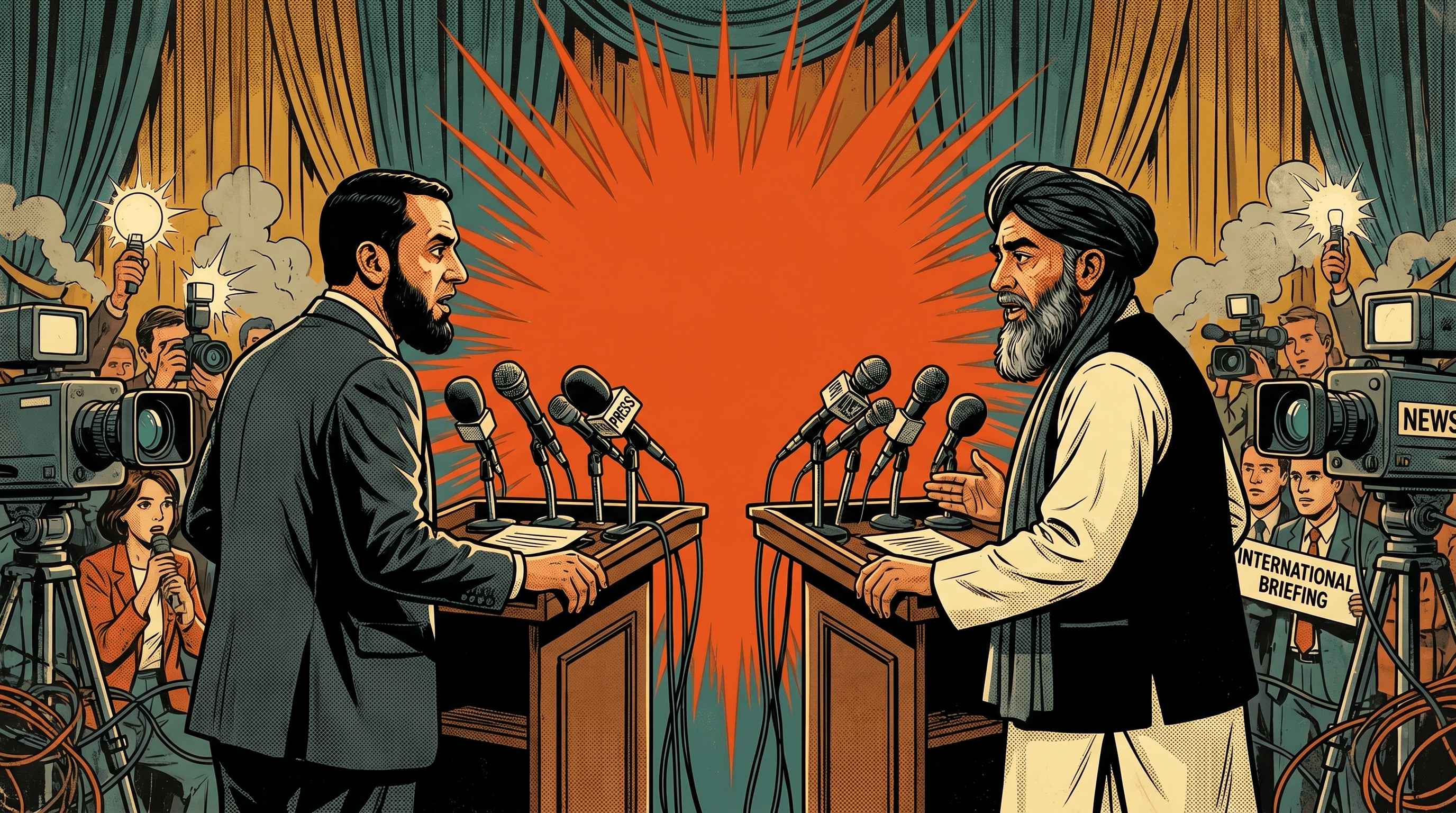
When two governments describe the same air strike, you can usually learn more from the gap between their stories than from either story itself.
On or around 11 June 2026, Pakistan launched air strikes along its border with Afghanistan, ending months of relative calm. Pakistan's Information Minister, Attaullah Tarar, called them "calibrated strikes" on four targets — "hideouts and safe havens" near the border, including a training centre and an ammunition cache. The result, per Islamabad: 26 militants killed.
Then Zabihullah Mujahid, spokesman for Afghanistan's Taliban government, gave his version. Thirteen dead: 11 children, one woman, one elderly man. Fourteen more women and children injured. The strikes, he said, hit the provinces of Kunar, Khost and Paktika.
Read those two paragraphs again. Not a single human being appears in both accounts.
Twenty-Six Militants or Eleven Children
This is not a rounding error. This is not the fog of war producing a 26 versus, say, 31. One side says it killed two dozen armed men at a training facility. The other says the dead were almost entirely children. These are not competing estimates of one reality; they are two entirely separate realities, marketed to two entirely separate audiences.
And here is the uncomfortable part: neither figure can currently be independently verified. Which means that for now, the casualty count is not a fact. It is a product. Both governments manufactured one, shipped it on the same day, and are now competing for market share in your head.
The trigger, at least, is not disputed. The strikes came one day after an attack on security forces near Peshawar, in which the Pakistani government says at least six officers were killed. Tarar framed the air strikes as a response to "recent terrorist incidents in Pakistan." Pakistan accuses Afghanistan of harbouring terrorists who attack Pakistani soil. The Taliban government rejects this and insists its territory is not used to threaten other countries — a claim and counter-claim that have settled into the diplomatic equivalent of a couple arguing about whose turn it was to do the dishes in 2019.
There is also the small historical detail that Pakistan once backed the Taliban movement. The relationship has the specific bitterness of a falling-out between former partners, which is always worse than a quarrel between strangers, because each side knows exactly where the other keeps its excuses.
How to Read a War Press Release
Think of each government as a lawyer, not a witness.
A witness tells you what happened. A lawyer tells you the version of what happened that helps their client. Nobody is surprised when a defence lawyer and a prosecutor describe the same night in irreconcilable terms — we wait for the evidence. War communiqués work exactly the same way, except the lawyers have air forces.
So Pakistan's account does what a state's account must do. "Calibrated strikes" — calibrated is doing heroic work in that sentence, suggesting a surgeon's precision rather than ordnance falling on a borderland. "Hideouts and safe havens" — language that pre-classifies everyone inside as a legitimate target. "26 militants" — a number with no children in it, because children are very bad for the brief.
The Taliban's account does the mirror-image job. Eleven children, one woman, one elderly man. Not one fighter admitted among the dead. Their version of the strike hit a target of pure innocence; Pakistan's version hit a target of pure guilt. Reality, whenever it is finally measured, has an irritating habit of being messier than either brief.
The terrain helps both lawyers enormously. The shared border runs 2,600 kilometres — 1,615 miles of mountainous frontier where journalists are scarce, access is controlled, and the first draft of history is whoever gets to a microphone fastest. When verification is impossible, the press release becomes the battlefield. It is cheaper than artillery and, in the court of international opinion, often more effective.
The Hospital That Settled an Earlier Argument
But here is why you should not throw up your hands and declare the truth unknowable. We have run this exact experiment before, recently, on this exact border — and we know how it ended.
The two countries agreed a ceasefire in October of the previous year, after weeks of deadly clashes. It held about as well as you'd expect. In late February, fighting flared again, leaving dozens dead, after a Taliban offensive on Pakistani military bases near the border. Pakistan responded by bombing targets in Kabul, Kandahar and Paktika.
Then, on 16 March, a Pakistani air strike hit the Omid Drug Rehabilitation Hospital in Kabul.
A UN report later put the death toll at at least 269 people. That made it the deadliest single attack in Afghanistan's recent history — deadlier than anything from the 20-year war between the Taliban and NATO-backed Afghan republic forces. Sit with that. Two decades of one of the most heavily bombed conflicts on earth, and the single worst day came from a neighbour's air force hitting a hospital for recovering addicts.
The number 269 did not come from a ministry podium in Islamabad, and it did not come from a Taliban spokesman's feed. It came from UN investigators doing the slow, unglamorous work of counting actual bodies. The press releases got the first word. The investigators got the last one. They usually do.
That is the pattern worth carrying into the June strikes. The day-one numbers — 26 militants, or 13 civilians — are opening bids, not findings. The real count arrives later, delivered by people with clipboards instead of microphones, and it tends to embarrass at least one of the original storytellers. Sometimes both.
Believe the Clipboards
None of this means the two accounts are equally suspect in some lazy, both-sides way. It means the burden of proof sits where it always sits: on whoever did the bombing and whoever counted the dead — and history shows that governments are reliably bad at counting their own collateral damage and reliably excellent at counting their enemies.
So when the next round of strikes comes — and on a 2,600-kilometre border between a state that once sponsored its neighbour's rulers and now bombs them, it will come — remember the order of operations. First the strike. Then the duelling numbers. Then, months later, the verified figure that one or both capitals would rather you never saw.
The strikes of 11 June killed somebody. Children, militants, or — most likely — some combination no press office will ever volunteer. Until investigators do for Kunar, Khost and Paktika what the UN did for the Omid hospital, treat every casualty figure from this border as what it is: not a measurement, but a weapon.
The first casualty of this war isn't truth. Truth is merely wounded, and waiting for the UN to find it.


