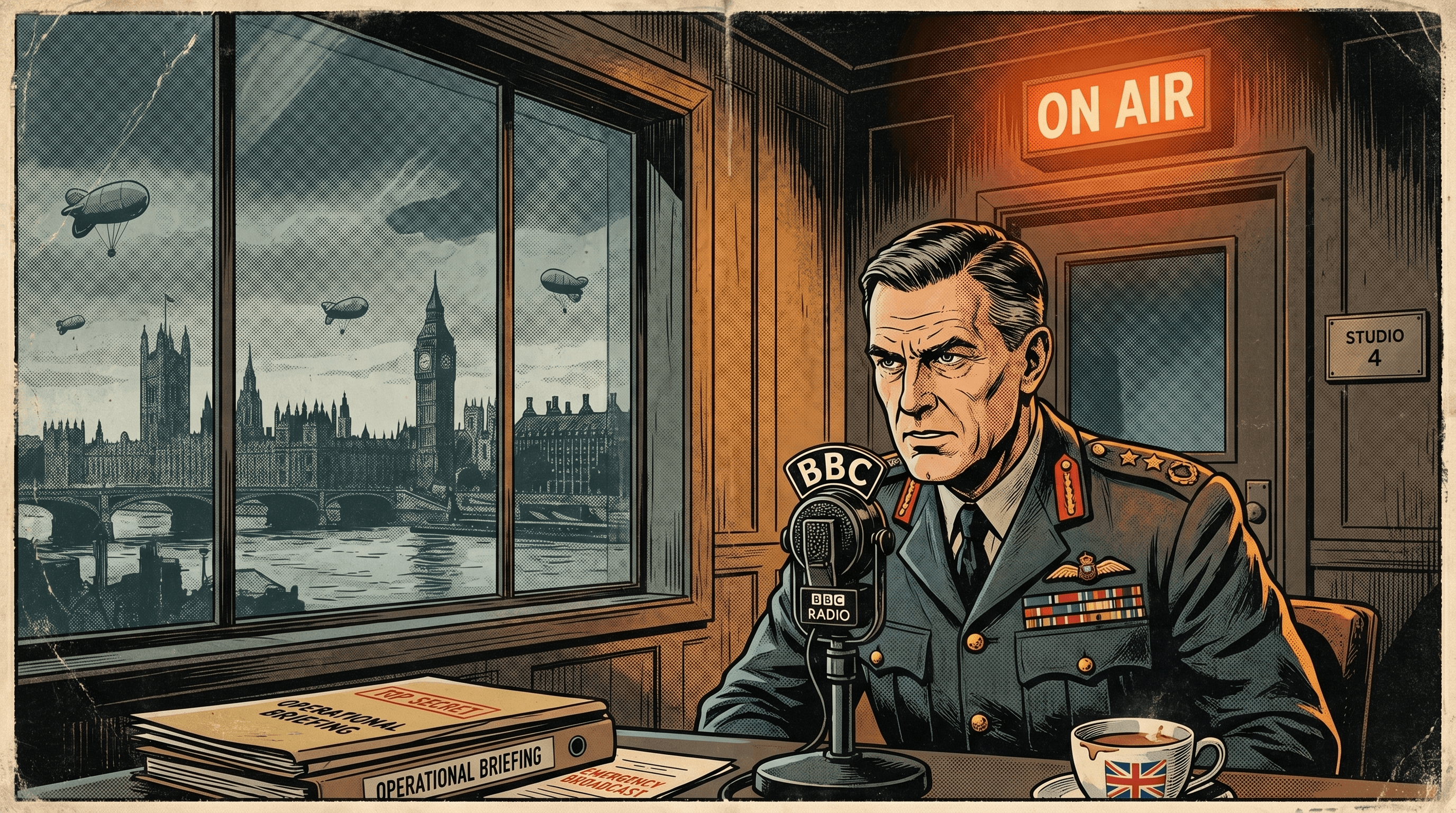
When the Chief of the Defence Staff goes on morning radio to tell the nation it faces its greatest peril since the Cold War, one of two things is true: either the country is genuinely in danger, or the military establishment has discovered that existential dread is an effective lobbying strategy. The uncomfortable answer is that both can be true at the same time.
What the Man Actually Said
Sir Richard Knighton, Britain's most senior military officer, appeared on BBC Radio 4's Today programme and delivered what amounted to a controlled detonation. "This is the most dangerous period that I have known," he said. "The risks and threats to this country are greater than I have known since the Cold War."
That alone would have been enough to ruin a few breakfasts. But Knighton went further. He disclosed that Russian strategic aircraft have made as many incursions into UK airspace in the first five months of 2026 as in the entirety of 2025. Russia, he said, is probing British defences not just with planes but through cyber attacks, sabotage, and assassination attempts. "Russia is definitely raising the stakes and risks crossing a line."
He then turned to what future conflict actually looks like: longer, more attritional wars like Ukraine — not the short, contained operations the British military has spent decades optimising for. Drones and autonomous systems, he added, will be increasingly central to how wars are fought.
None of this was whispered in a classified briefing. It was broadcast to anyone awake before 9am.
The Plan That Keeps Not Arriving
Here is where the story gets revealing.
The Defence Investment Plan, which is supposed to explain how Britain will actually fund its equipment and defence infrastructure over the next decade, was originally due in autumn 2025. It is now June 2026. Defence Secretary John Healey has said the government intends to publish it before the NATO summit on 7 July.
So let's do the maths. The government has had roughly eight months of extra time to produce a document that amounts to a giant spreadsheet with a narrative wrapper. Either the sums are genuinely difficult — possible — or the political decisions those sums require are ones the Starmer government would rather not make in public until the last possible moment. The NATO summit provides a hard deadline and, crucially, an external reason to publish. Nothing focuses a government's mind quite like the prospect of standing next to allies and having nothing to show them.
Knighton, to his credit, was diplomatically blunt about this. "Exactly as the prime minister says, we need to spend more on defence and do it faster," he said. "The challenge for ministers is to make those difficult trade-off decisions." That is the sound of a four-star officer saying you keep agreeing with me in speeches, now write the cheque — wrapped in just enough deference to maintain plausible deniability at the next Whitehall meeting.
The Gap Between Rhetoric and Reality
Think of Britain's defence posture like home insurance. You've been paying a modest premium for years because the neighbourhood seemed safe enough. Then someone starts breaking into houses on your street — first testing locks, then cutting wires, then actually entering homes. You call your insurer and they say, "We'll get back to you in a few weeks with a revised quote."
That's roughly where things stand. Lord Robertson has already warned in terms even less diplomatic than Knighton's that Britain is "under-prepared," "under-insured," and "under attack." He accused political leadership of "corrosive complacency" on defence. His full assessment: "Britain's national security and safety is in peril."
Knighton described the Strategic Defence Review as a "call to arms", and the prescription still hasn't been filled, you don't need a diagnosis to spot the problem.
The core tension is simple. British politicians have become fluent in the language of threat. They can say "most dangerous period since the Cold War" without flinching. What they have not yet demonstrated is the ability to match those words with a procurement budget, a force structure, and a timeline that treats the danger as real rather than rhetorical.
What a Serious Response Would Look Like
Knighton outlined, in broad strokes, what the military actually needs. The UK must prepare for longer, grinding conflicts — not the kind where you deploy a brigade for six months and rotate it home. It needs drones and autonomous systems at scale, the strategic equivalent of insisting cavalry will make a comeback is to pretend otherwise.
But here's the thing about longer, more attritional wars: they cost more. They consume more equipment, more ammunition, more personnel, more political will. The entire British defence model since the end of the Cold War has been built around the assumption that wars will be short, expeditionary, and limited. Knighton is saying, politely but unmistakably, that this assumption is now wrong. The war in Ukraine has been the proof.
Redesigning a military for a different type of conflict is not like updating an app. You can't just push a patch. It requires fundamental choices about what you buy, what you stop buying, where you station forces, and how many people you recruit. All of which costs money and involves trade-offs with hospitals, schools, and the dozen other things competing for Treasury funds.
This is why the Defence Investment Plan matters so much and why its repeated delay is so telling. The plan is the moment when rhetoric meets arithmetic. You can give all the speeches you want about danger and preparedness, but until you publish a ten-year funding commitment, the words are just words.
Four Weeks to Show the Receipts
The NATO summit on 7 July is now the deadline — self-imposed, publicly stated, diplomatically unavoidable. When the Defence Investment Plan finally lands, it will answer the only question that matters: does the Starmer government believe its own rhetoric?
If the plan is ambitious, funded, and specific — matching Knighton's assessment of longer wars, autonomous systems, and a genuine Russian threat — then the delay will be forgotten as the cost of getting it right. If it is vague, back-loaded, or stuffed with accounting tricks that push real spending into the 2030s, then every word about "the most dangerous period since the Cold War" will retroactively become what Lord Robertson already diagnosed: corrosive complacency dressed in khaki.
Sir Richard Knighton has told the country, on national radio, that the threat is real, the tempo is increasing, and the old assumptions are dead. He has done his part. The question is no longer whether Britain's generals understand the danger. It is whether Britain's politicians are prepared to be as honest with the Treasury as the Chief of the Defence Staff just was with the public.
Speeches don't intercept Russian aircraft. Budgets do.


