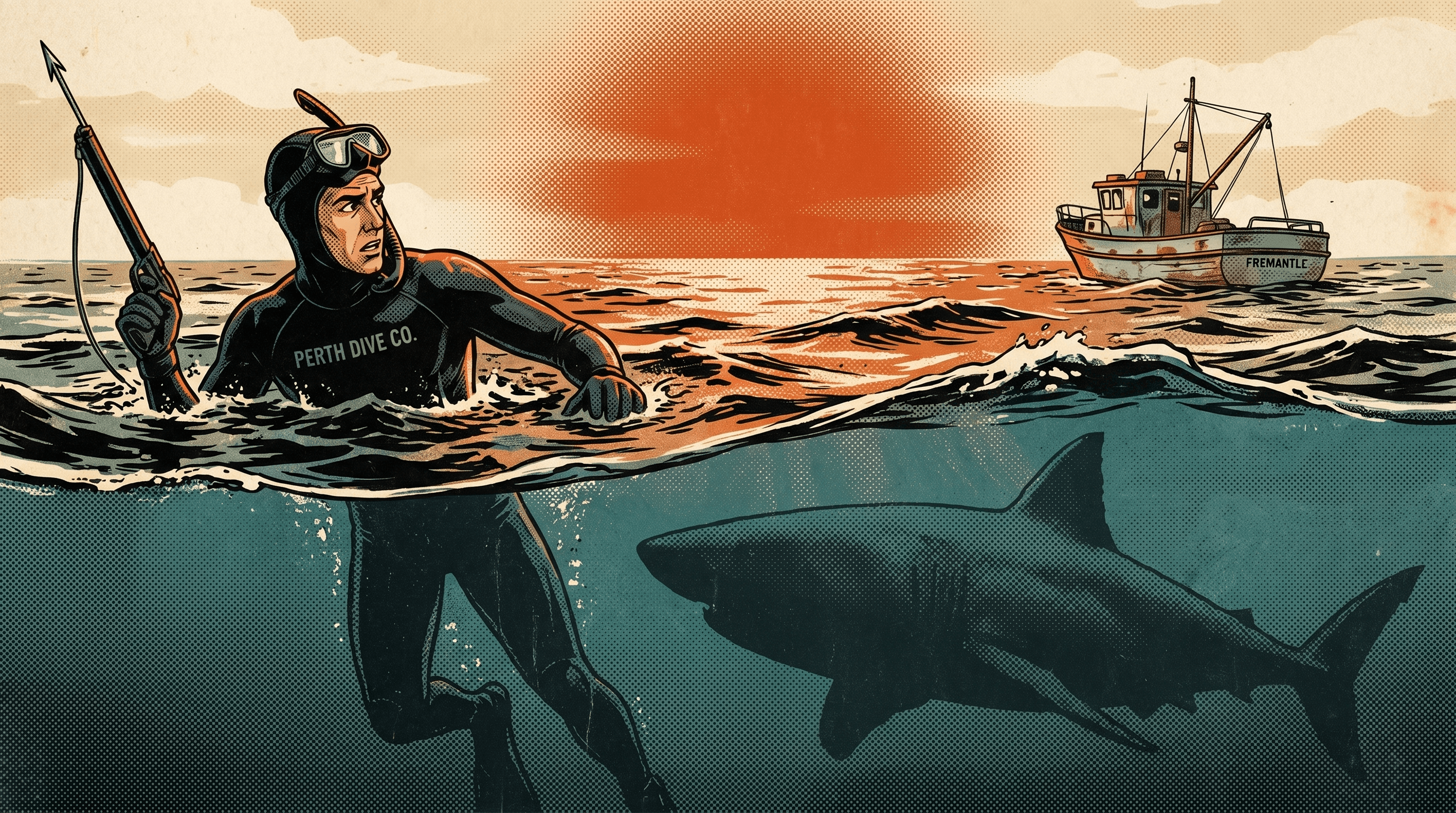
Here's an uncomfortable truth Australia doesn't put on its tourism brochures: the country has spent years building an elaborate apparatus to keep people safe from sharks, and the two people it most recently failed both died doing the one thing the apparatus was never built to protect.
What Happened
On Saturday morning, at 11:25 local time, a 35-year-old man was spearfishing with his family off Michaelmas Island, south-east of Perth in Western Australia. A shark — suspected to be around 4.5 metres, nearly fifteen feet of it — bit him. His family got him into a boat and back to shore, where paramedics were waiting. They could not revive him. He was pronounced dead onshore. He has not been publicly named.
Police are preparing a report for the coroner. The Department of Primary Industries and Regional Development, which goes by the friendlier acronym DPIRD, is helping out and has asked locals to report any shark sightings.
This was not an isolated horror. About three weeks earlier, around 16 May, Steven Mattaboni — 38 years old, a father of two — was killed by a four-metre shark at Horseshoe Reef, north-west of Rottnest Island, also near Perth. Two men. Both in the water off Perth. Both meeting large sharks, four metres and up. Both dead.
The Pattern Nobody Wants to Name
The lazy headline writes itself: sharks are getting bolder, the ocean is turning on us, cue the orchestra from that famous film. It's a satisfying story because it requires nothing of us except fear.
But look at where these two men died, and the real story stops being about the sharks at all.
Australia's shark-safety system — the nets, the drones, the tagging programs — is built around a specific customer. That customer is a beachgoer. Someone who swims between the flags, surfs the popular break, splashes around in waist-deep water on a Sunday. The popular swimming and surfing spots tend to have protective measures in place. That is where the money goes. That is where the technology points.
Now ask yourself where a spearfisher goes. Not to the netted beach. He goes to the reef. He goes to the island. He goes, deliberately and with a snorkel, into the exact patch of ocean where the big fish live — which is also, inconveniently, where the things that eat big fish live. A spearfisher is, by definition, trying to be in the most fish-dense, predator-dense water he can find. He is not avoiding shark habitat. He is commuting to it.
So we have built a guard rail along the edge of the cliff most people stand near, and then we act surprised when the people who climb down into the canyon get hurt. The system isn't failing. It's working exactly as designed — for someone else.
The Vending Machine Problem
Think of Australia's shark protection like a vending machine bolted to the wall of a train station. It is well-stocked, well-lit, and reliably dispenses safety to anyone standing in the station. Nets, drone patrols, tagged sharks pinging their location — all of it clustered around the high-traffic spots where most people are.
This is a completely sensible way to protect the most people for the least money. If you've got a limited budget and a coastline roughly the length of a small country's patience, you put your defences where the crowds are. The maths is unarguable.
But here's the catch with the vending machine: it only helps the people standing in the station. The spearfisher isn't in the station. He has walked twenty miles down the track into the wilderness, precisely because that's where the good stuff is, and there is no vending machine out there. There was never going to be one. You cannot net a reef miles offshore. You cannot drone-patrol every island a diver might choose. The whole logic of the safety system — concentrate protection where the people concentrate — collapses the moment the person spreads themselves across the entire ocean on purpose.
And divers and spearfishers do spread themselves across the entire ocean on purpose. That's the hobby. The risk isn't a bug in their activity; it's practically the address.
So when both recent Western Australia deaths involved large sharks, four metres and over, in the waters near Perth — and both victims were in the water by choice, doing exactly the activity that takes you past the last drone and the final net — that's not a coincidence the headlines should be burying under the word "suspected." That's the actual finding.
When the Reassuring Statistic Reassures the Wrong People
There's a fact that gets trotted out every time this happens, and it's true, so I'll hand it to you straight: shark attacks in Australia, while more common than in many other parts of the world, are often not fatal. Comforting, isn't it? You're more likely to survive an Australian shark than the headlines suggest.
Except that average hides the very people we're talking about. "Often not fatal" is doing a lot of heavy lifting when the not-fatal cases are happening to swimmers near help, near nets, near a beach full of people with phones, and the fatal ones keep happening to a man spearfishing off an island with only his family and a boat between him and a hospital that's nowhere near. A statistic that averages the protected and the unprotected together tells the unprotected absolutely nothing useful. It's like reassuring a skydiver with the safety record of people sitting in chairs.
Two men, three weeks apart, both off Perth, both with large sharks, both dead. You don't get to file that under "but most attacks aren't fatal" without noticing that the survivable ones and the fatal ones are happening to two different kinds of people in two different kinds of water.
A Quick Word on Panic
To be fair, Australia's east coast had its own scare back in January — reports of four attacks in 48 hours, described at the time as a "perfect storm" for sharks. But that phrase tells us almost nothing. But "perfect storm" is exactly the language that turns a question about where we point our resources into a horror-movie pitch about an ocean gone rogue.
The ocean has not gone rogue. The ocean is doing precisely what it has always done, which is contain large animals that occasionally bite people who swim into the parts where large animals live. What's changed isn't the shark. It's our willingness to keep selling a safety system as if it covers everyone, when it covers the beach and waves goodbye to anyone who swims past the buoys.
The Takeaway
Stop asking whether the sharks are getting worse. They aren't — they're four-metre animals doing four-metre-animal things in the water they've always lived in.
Ask the better question instead: who is the safety system actually for? Because right now the honest answer is that nets, drones, and tags protect the people least likely to die and skip the people most likely to. A diver off an island and a spearfisher near a reef are not having an accident at the edges of the system. They are standing in the enormous, unguarded gap at its centre — the gap we've quietly agreed not to mention because admitting it would mean admitting the brochure was never the whole truth.
Two fathers near Perth in three weeks didn't drift outside the safety net. There was never a net where they were. And until Australia says that out loud, every "tragic, isolated" headline is just the system congratulating itself for guarding a door that the dead were never standing at.


