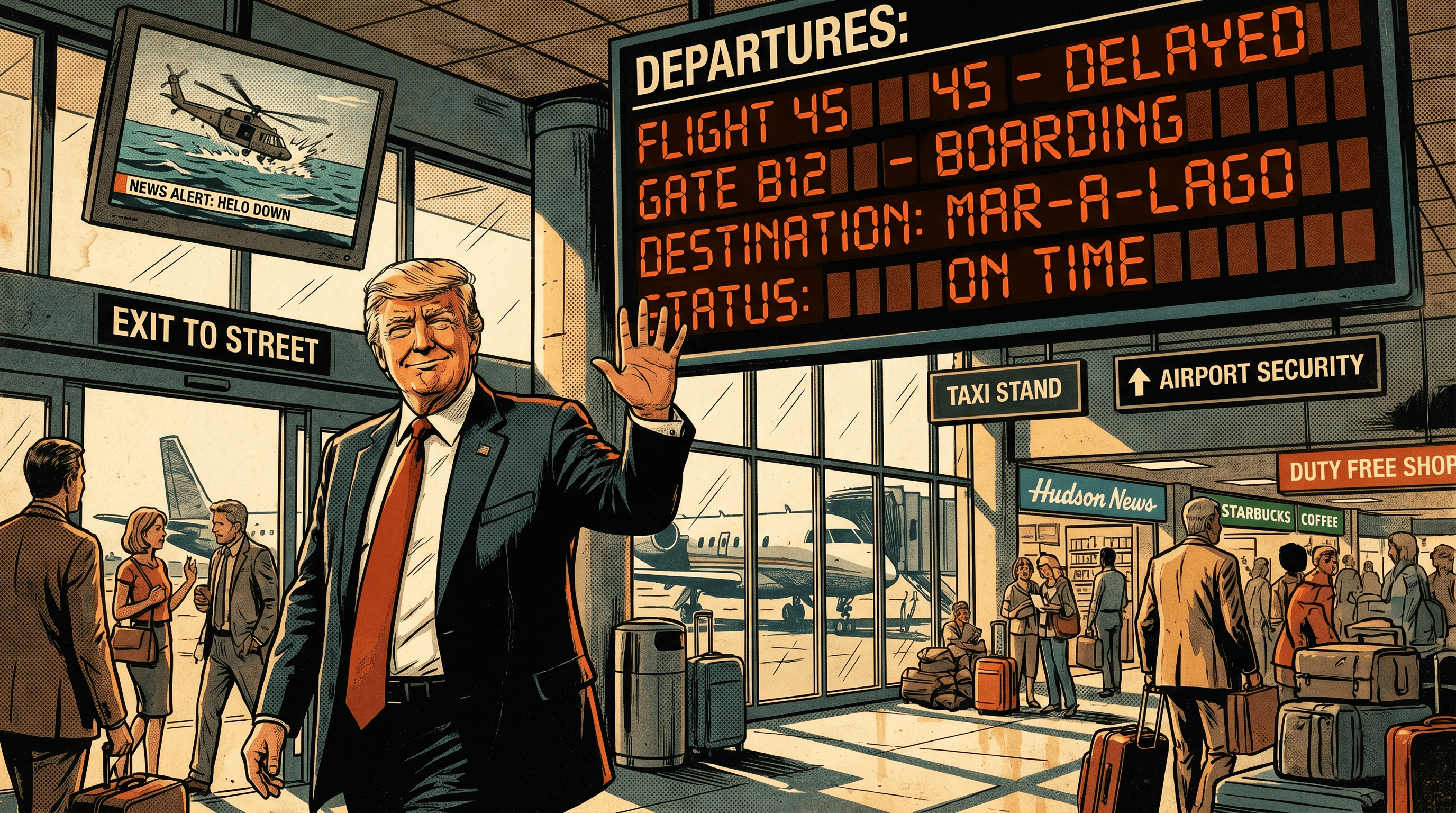
The most powerful military on Earth lost an attack helicopter over the most dangerous stretch of water on the planet, and the official position of the United States government was a shrug at an airport.
A U.S. Army Apache went down near the Strait of Hormuz. Two crew members were on board. Both walked away unharmed, which is the only piece of good news in this entire story and deserves to be said first. But here is how the world learned the rest: President Trump, talking to reporters at JFK in New York, having just watched the NBA Finals, confirmed it on his way out. "The pilots are fine," he said. "Yeah. Nobody injured."
That's it. That was the briefing.
What Actually Happened
Here is the situation in plain terms. The crash was first reported by The New York Times. The president confirmed it. U.S. Central Command, the body that actually runs American forces in the region, did not respond to the Associated Press. The Defense Department did not respond either. As of Tuesday morning local time, the cause was unclear, and Trump's only commitment was that the U.S. would "issue a report tomorrow."
The other source? Iranian state media, which acknowledged the crash but, relying on foreign reporting, had nothing to add. Tehran's information about a downed American helicopter came from reading the American press, because the American government wasn't saying anything.
So the two confirmations of a U.S. combat aircraft going down in a war zone were an off-the-cuff remark from a man fresh from a basketball game and the Iranians citing journalists. The Pentagon, with its budget and its press office and its satellites, contributed silence.
The Vacuum Is the Story
Most coverage will treat this as a crash. It isn't. It's a stress test, and Washington failed it.
When the official channels go quiet, the silence doesn't stay empty. Someone fills it. In this case the someone was a president improvising at an airport and a foreign adversary's media operation. That's not narrative control. That's narrative abandonment, and it tells you more about the state of this war than any helicopter ever could.
Because the silence wasn't only about the crash. It was about the much larger thing the crash sits inside. Trump used the same airport gaggle to announce that a deal with Iran could be signed in "two or three days." He called it "very, very good, strong, powerful." He offered no specifics on why two or three days, as opposed to two or three weeks, or never.
And once you look at what's actually on the table, the "two or three days" starts to sound less like a forecast and more like a man describing a horse he hopes will win.
The Breakdown: Why "Two or Three Days" Is a Fantasy
Picture a negotiation as two people standing on opposite sides of a canyon, each refusing to take a single step toward the bridge. That's where this is.
On one side, the United States has one core demand: Iran must give up its stockpile of highly enriched uranium. That stockpile is believed to still be entombed inside the country after airstrikes during a separate 12-day war in 2025. Iran refuses to surrender it. Full stop.
On the other side, Iran wants sanctions relief and the release of its frozen assets before any final agreement. Trump rejects that. He wants the deal first, the rewards later. Iran wants the rewards first, the deal later. This is the diplomatic equivalent of two people each insisting the other pays before the food arrives, and both of them are very, very hungry.
Now add the referee. The mediation has been going on for weeks with both sides holding hard-line positions. Weeks. Of hard lines. From people who won't take the first step.
So here is the honest scorecard. Both demands are unmoved. Both sides are dug in. The mediator has been at it for weeks with nothing to show. And into this, the president drops "two or three days." When the negotiating positions haven't shifted an inch, a sudden deadline isn't progress. It's a press release wearing a deadline's clothes.
Why the Strait Turns a Helicopter Into a Headline
To understand why one downed Apache matters, you have to understand what the Apaches are doing there.
The Strait of Hormuz is under what's been called a "chokehold" by Iran. The Apaches are a key American asset enforcing a blockade on Iranian crude oil shipments and tankers, and the point of that blockade is to squeeze Tehran into a deal. So this isn't a helicopter on a training run. It's a piece of the pressure machine. When a piece of the pressure machine falls out of the sky, people ask whether the machine is breaking.
These are also, by the way, busy aircraft. The same model of helicopter has been used by the United Arab Emirates to shoot down Iranian drones during the war. So the Apache isn't a bystander in this conflict. It's a workhorse, doing several violent jobs at once.
And the war around it is not improving. An April ceasefire was never converted into a permanent deal. The day before the crash, Iran and Israel exchanged fire in what's been described as the biggest blow yet to the straining ceasefire. A "straining ceasefire" is one of those phrases that means "a ceasefire in the way that a dam with cracks in it is still technically holding back water."
The Bill Everyone Else Is Paying
Here's the part that reaches your kitchen. This war has shaken the global economy, driven up energy prices worldwide, and made basics including food more expensive. The chokehold on the strait isn't an abstraction on a map. It's in your grocery receipt.
Trump understands the leverage perfectly, and said the quiet part out loud. A sustained bombing campaign, he said, would leave Iran with "nothing left" — but "you won't have the strait open for months." He said the U.S. could "easily" reduce Iran to nothing. The catch is that doing so slams the world's most important oil corridor shut for months and sends prices into orbit for everyone who isn't Iran.
So the threat is real but self-punishing. It's like threatening to burn down your neighbor's house when you share a wall. You'll win the argument and lose the roof.
Check the Math
Strip away the airport theatre and here's what you're left with. A combat helicopter went down, and the government that owns it said less than the country it's at war with. A president promised a deal in days over positions that haven't budged in weeks. And the only people on record are a man leaving a basketball game and the Iranian state press quoting Western reporters.
The crash will get its report "tomorrow." The deal will not get signed in two or three days, because nobody at the table has moved and you cannot shake hands across a canyon by announcing how close you are to the edge.
When the official version of events is whatever the president happens to say between the arena and the airport exit, you're not watching a strategy. You're watching a country improvise a war and hope nobody checks the math. Someone should check the math.


